How to get cited by Perplexity: a 2026 playbook
Perplexity cites 4-8 sources per answer and the patterns are learnable. Here are the 8 patterns we see in cited content, with the tactics that got FixAEO cited in our own category.

On this page

Perplexity was the first AI engine that cited FixAEO by name. I remember exactly when it happened — March 2025, three months after we shipped our first llms.txt and restructured our top blog posts into question-form H2s. A prospect emailed us saying they'd been researching AEO tools on Perplexity and it had recommended us in a list of three. That single Perplexity citation drove more qualified pipeline than any single organic-search ranking we'd ever held.
Perplexity is a smaller engine than Google by raw query volume, but the kind of traffic it sends matters disproportionately: high-intent, often researching a purchase, arriving with the AI's nudge of recommendation already attached. If you sell B2B SaaS, professional services, or anything where the buyer journey involves comparison shopping, getting cited by Perplexity is one of the highest-leverage things you can do in 2026.
The good news: Perplexity's citation behavior is unusually consistent and predictable. The model picks 4–8 sources per answer, displays them inline with citation numbers, and the pattern of which sources it picks is highly learnable. This post is the pattern — every tactic below is one I've either shipped on FixAEO or watched a customer ship.
Curious how your site does?
See how AI engines describe your site — free, about 60 seconds, no signup.
"Perplexity SEO", AEO, citations — what's the right name?
People search "Perplexity SEO" almost as often as "Perplexity citations" — and they want the same thing. We use AEO (Answer Engine Optimization) because Perplexity is one of nine engines we track and the underlying patterns are portable. But if "Perplexity SEO" is the phrase you searched, this playbook is exactly what you're after.
How Perplexity decides who to cite
The mechanics, simplified:
- The user query is rewritten into one or several retrieval queries
- The retrieval system pulls a pool of candidate URLs (typically 50–200)
- A re-ranker scores them on relevance, freshness, and "authority signals"
- The top 4–8 are read into the model's context
- The model writes the answer, attaching footnote numbers to claims, and renders the cited URLs as cards
The two leverage points for an SEO/AEO team: (a) get into the candidate pool, (b) survive the re-ranker. Most teams fail at one or the other. The eight patterns below address both.
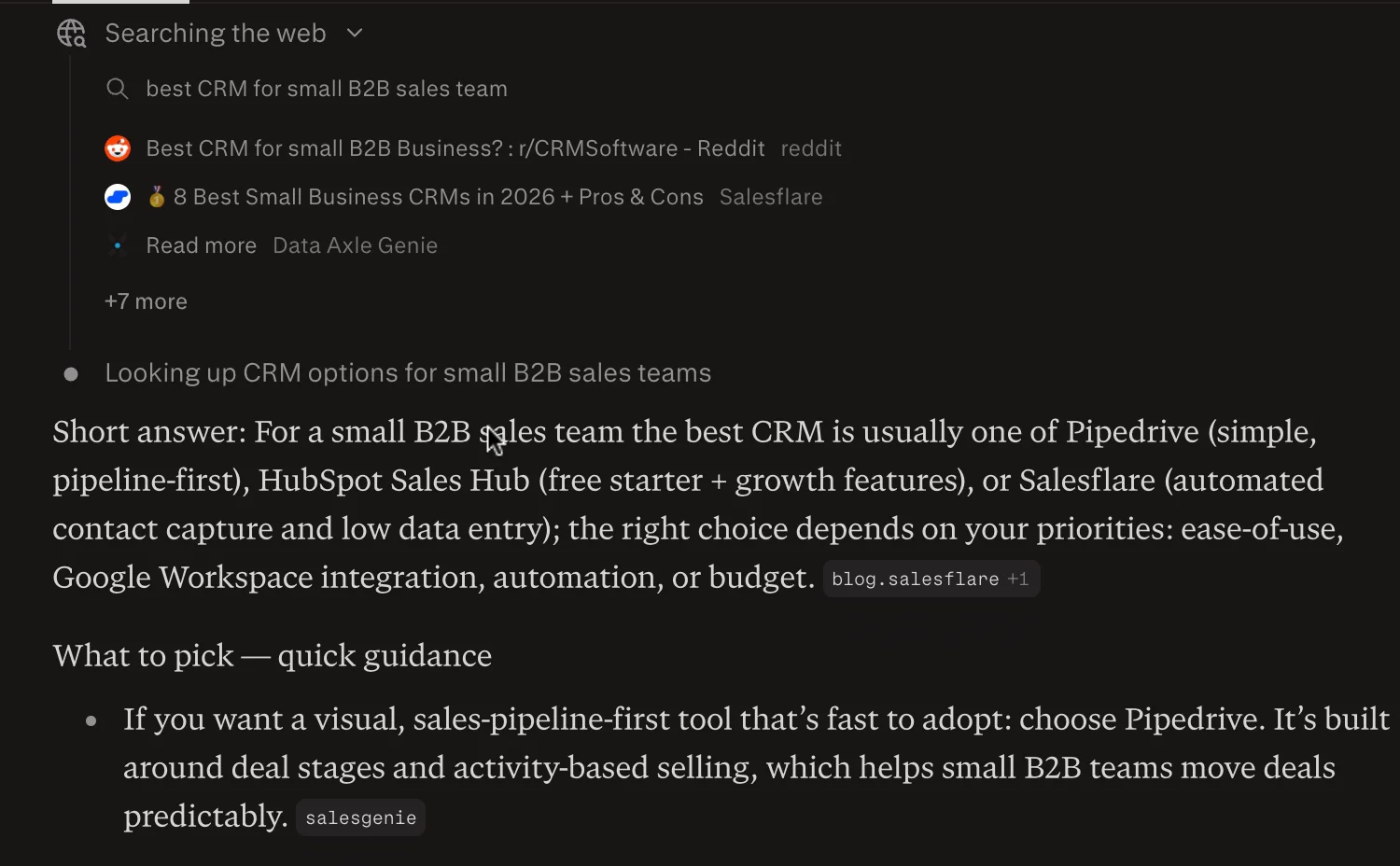
Perplexity searches, surfaces the sources it pulled from as cards (Reddit, Salesforce, and more), then names CRMs with inline citations. Being one of those cited sources is the whole game.
The eight patterns Perplexity favors
1. Title that names the question
Perplexity favors pages whose title contains the user's likely query. Not the keyword — the question form. "Best CRM for 10-person SaaS startups (2026 comparison)" beats "Top CRMs for Startups". The matching is done by the retrieval pass; question-form titles match question-form prompts directly.
2. First-paragraph answer
The model reads the first 200–500 tokens of each candidate page heavily. If your answer is in there, you have a strong shot at citation. If your answer is buried under a 500-word intro about "the importance of choosing the right tool", you lose.
The format that wins:
[H1 — question form]
[2-sentence summary of the answer]
[H2 — then expand]
3. Numbers, lists, and tables in the body
Perplexity's answers often include the same data point multiple times in the same response because three candidate sources all mentioned it. The model triangulates: if three of its sources agree on a number, it includes the number; if one source has a number the others don't, it skips it.
The implication: put concrete numbers, lists, and tables into your content. A page that says "MongoDB has 30,000 customers as of 2025" is more citable than a page that says "MongoDB is widely used".
4. Citation footnotes in your own content
The model trusts pages that themselves cite sources. Pages with footnote-style links to primary sources are more likely to be picked by the re-ranker because they look like the kind of page the model wants to cite. This isn't a hard rule, but it's a strong tendency.
5. Freshness markers
A "Last updated: 2026-04" line near the top is a real signal. Perplexity favors fresher content for any query that's not explicitly historical. Date your posts visibly. If you update a post, change the date and note what changed. (For SEO purposes, also update the structured data dateModified.)
6. Permissive robots.txt and llms.txt
PerplexityBot is a real crawler. If your robots.txt blocks it, you're invisible no matter what else you do. Check at /robots.txt and look for any Disallow on PerplexityBot or Perplexity-User. If found, remove.
The llms.txt at your site root is also read by Perplexity's crawler. Use it to point them at your strongest pages. (See how to add llms.txt in 10 minutes for the full walkthrough.)
7. Inbound mentions on what the model considers authoritative
Perplexity's re-ranker uses authority signals heavily. The signals are similar in spirit to Google's PageRank but weighted differently — citation from Wikipedia, a strong industry trade publication, an established Substack, or a frequently-cited Reddit thread carries more weight than a hundred low-quality backlinks.
The fastest moves:
- Add yourself to relevant Wikipedia category lists (be honest, don't spam)
- Pitch industry trade publications for inclusion in year-end roundups
- Make your founder/team available on relevant Substacks and podcasts
- Engage authentically in topical subreddits (r/SaaS, r/marketing, etc.) — Reddit threads get cited often
8. Schema.org markup that matches your content type
JSON-LD schema is parsed by Perplexity's retrieval pass. The relevant types depend on what you publish:
- Article / TechArticle — blog posts and guides
- Product — product pages
- SoftwareApplication — tools and apps
- FAQPage — FAQ pages and "common questions" sections
- HowTo — step-by-step content
- Review / AggregateRating — review pages
Use the Schema Generator to emit valid JSON-LD for any page type without hand-writing it.
The Perplexity source library: which domains it cites most
After watching thousands of Perplexity answers across our customer base, some domains show up as citations far more than others. Understanding this list tells you both where to earn a mention and which sources are validating your competitors.
Tier 1 — Perplexity cites these constantly:
- Wikipedia — the most cited source across almost every category. Being in a Wikipedia article (as a company or listed in a category page) is disproportionately valuable.
- Reddit — high-upvote threads on r/SaaS, r/marketing, r/webdev, and other topical subreddits get pulled into answers frequently.
- Product Hunt — high-launch products get cited for years after their launch.
- G2, Capterra, TrustRadius — for software categories, these three dominate citation share.
- Hacker News — high-comment threads especially.
Tier 2 — cited often for the right query:
- Substack — established writers with clean formatting and citations.
- YouTube (video sources) — for tutorial and comparison content.
- GitHub — README files and awesome-lists.
- Trade publications — TechCrunch, Ars Technica for tech; HBR, Fast Company for business.
- StackOverflow — for technical questions.
Tier 3 — cited when the query is niche:
- Personal blogs with high citation footnotes.
- Company blogs (yours!) — if your content is structured well and you have some third-party validation.
- Niche industry publications.
The strategic implication: work backwards from this list. If you want more Perplexity citations for "best CRM," get on G2's page for that category, get a mention in a Reddit thread about CRM comparisons, and have your own content structured to be citation-worthy. Skipping Wikipedia and G2 and just hoping to be cited from your own blog is the slow path.
Comparison mode, Focus mode, Spaces — where else you need to show up
Perplexity is more than the default search box. Three modes matter for AEO strategy:
Comparison mode. Perplexity's built-in comparison tool answers "X vs Y" and "alternatives to Z" queries with side-by-side tables. If you have a competitor whose comparison table shows up here without you, you need a comparison page on your own site (X vs Y from your perspective) that Perplexity can pull into its answer. This is one of the highest-leverage content pieces to build.
Focus mode (Academic, Reddit, YouTube, X, etc.). Perplexity Pro users can restrict retrieval to specific sources. Being present on Reddit and YouTube specifically covers the buyers who focus their queries there. If your category has heavy Reddit discussion, presence in those threads is worth as much as any owned-media investment.
Spaces. Perplexity's shared-workspace feature lets teams save searches and sources. Enterprise buyers use this to research vendors. If your prospects are researching in Spaces, being cited once in a Space they share with colleagues is a compounding sales asset.
Optimizing for the default search box is the baseline. Winning across modes is where category leaders separate.
Perplexity Pro vs free — what changes for citation?
Perplexity has two main tiers (Free and Pro) and both cite sources — but the retrieval and answer quality differ. What changes for you:
- Free tier uses a lighter retrieval pass. Fewer candidate sources, faster answer. Your Tier 1 citations (Wikipedia, Reddit, G2) dominate. If you're not on those, you're rarely cited on the free tier.
- Pro tier uses deeper retrieval with better models. More candidate sources pulled, more diverse citations. Tier 2 and Tier 3 sources appear more often here. Your own blog has a better shot at direct citation on Pro.
Practical implication: Free tier heavily rewards being in the Tier 1 sources. Pro tier rewards content quality more directly. Optimize for both — the Tier 1 work is durable and helps you on either tier.
What we look for when auditing a site for Perplexity readiness
Across the sites we've audited for AEO posture, the pages that do get cited by Perplexity tend to share a recognisable pattern, and the pages that don't share the opposite. These aren't statistical claims — they're the practical heuristics we run through when we open an unfamiliar site and ask "why isn't this getting cited?"
The shape of a Perplexity-friendly page:
- FAQPage JSON-LD present — the model uses it to decode "what does this page answer"
- At least half the H2s are question-form ("How do I...", "What is...", "When should...")
- A visible "Last updated" date near the top — not just in metadata
- Dense internal linking — pages with ~10+ contextual internal links rank higher than 1–2-link orphans
- Inbound mentions on what the model treats as authoritative — Wikipedia, established trade pubs, frequently-cited Reddit threads
The shape of a page that gets ignored:
- No JSON-LD or only generic Organization schema
- Long narrative intros with the answer in paragraph three
- "Updated" only in invisible meta tags
- Few or no internal links to related content
- Mentions only on link-farm-adjacent sites
Each of these is a candidate lever to test on your own site. Pick one a week.
A 30-day plan to your first Perplexity citation
If you currently get zero Perplexity citations:
Days 1–3: Audit. Check robots.txt for PerplexityBot. Run a free scan and note schema gaps. Pick 5 pages to optimize first — your highest-buyer-intent pages, not your traffic leaders.
Days 4–7: Restructure those 5 pages. Question-form titles, 2-sentence first paragraphs, then expand. Add Last updated markers visibly.
Days 8–14: Add JSON-LD. Article + FAQPage on each of the 5 pages. Add citation footnotes for every factual claim.
Days 15–21: Infrastructure. Publish llms.txt. Audit and trim robots.txt. Pitch one industry roundup for inclusion (start with a draft contribution, don't just ask for inclusion).
Days 22–30: Tracking. Pick 10 prompts that match buyer intent. Re-run them in Perplexity every Monday. Note any prompt where a competitor is cited and you aren't — that's a content gap. Fix one a week.
By day 30 you should have 1–3 prompts where you're cited. By day 60, 5–10. By day 90, you should be a recurring citation in your category.
Free AI visibility tool: self-rate each engine (Hidden / Inconsistent / Stable / Strong) or run an automated scan. Perplexity is one of the nine engines the paid tool tracks.
Measurement: what counts
The metric that matters is citation rate on your target prompts. Not generic Perplexity traffic in your analytics (which is hard to attribute) and not the number of impressions (Perplexity doesn't expose this).
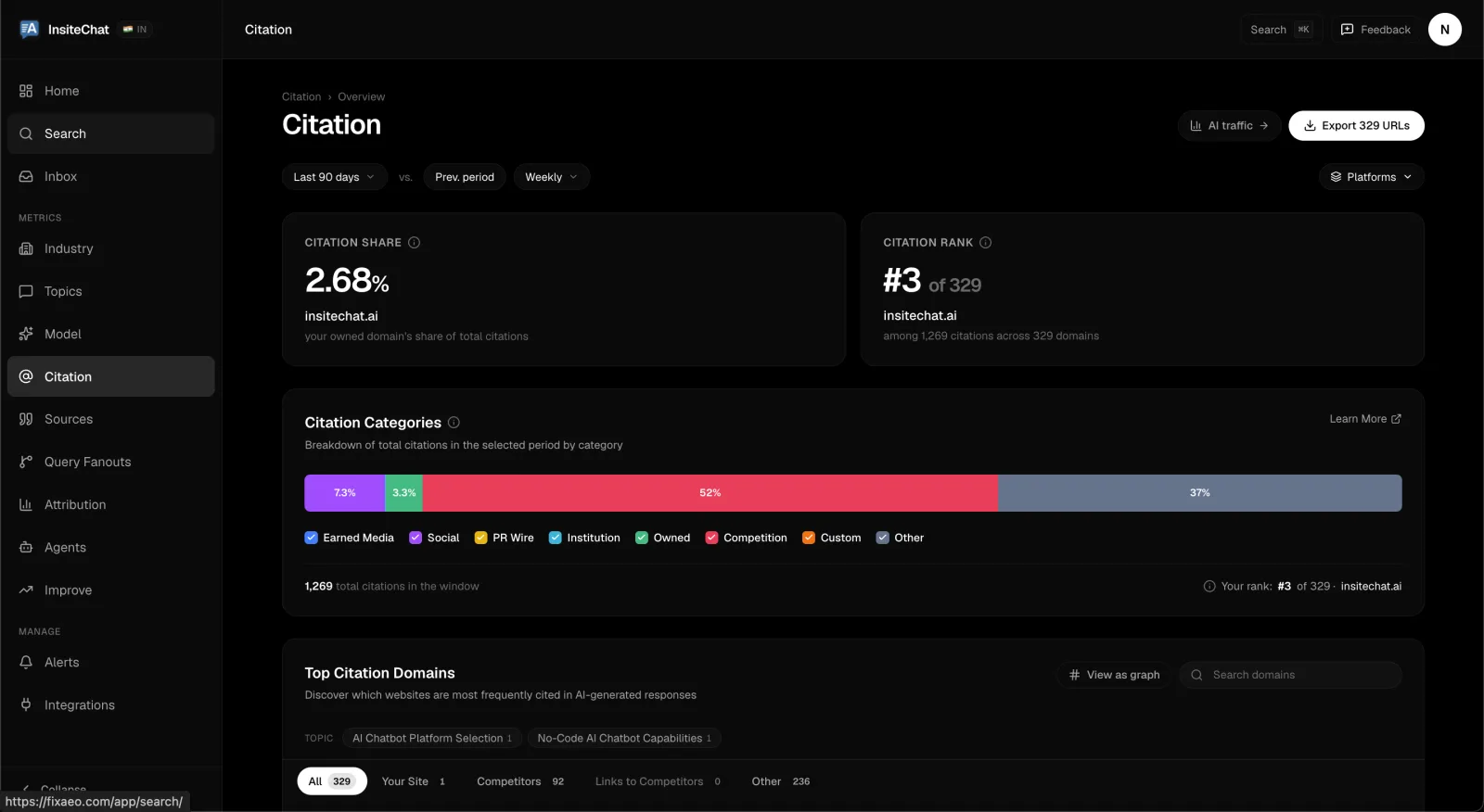
Example: InsiteChat ranked #3 of 329 cited sources (2.68% share) — measured in FixAEO.
Ranking is only half the picture — you also want to know which domains are winning the citations you're not getting, so you know who to study.
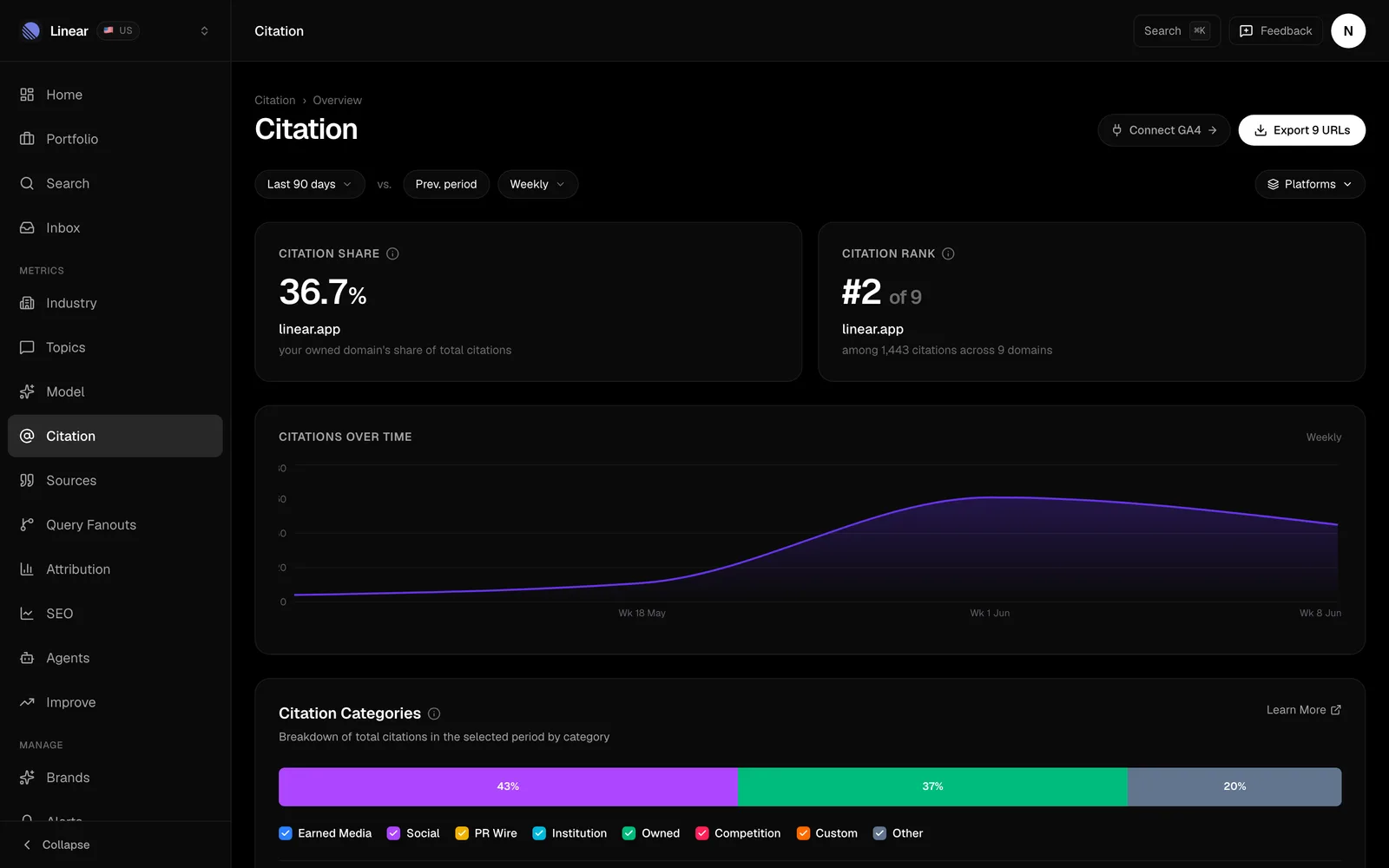
The citation report, broken down by source domain and citation share across engines. Real product, illustrative data.
Track manually if you must: open a private window, run your 10 prompts, and tally Yes/No on whether you were cited. Tooled tracking: that's our use case — we ask the engines for you on a schedule, parse the answer for mentions and citations, and roll it up over time. (See the best AEO tools in 2026 for an honest comparison.)
What not to do
A few patterns we've seen burn time without moving the citation rate:
- Spamming "AI-optimized" content — pages stuffed with 50 H2s, 100 bullet points, no actual prose. Perplexity's re-ranker downweights these heavily.
- Asking for citation from the Perplexity team — there's no editorial submission process. The model picks who it picks.
- Buying low-quality backlinks — the re-ranker explicitly downweights link farms.
- Focusing only on Perplexity — the same eight patterns lift you in ChatGPT Search, Claude's web access, Copilot, Gemini, and Google AI Overviews. Optimize for the category, not the engine.
Case study: how a customer went from zero to consistent Perplexity citation
A DTC brand I worked with was in a competitive consumer-goods category. They ranked well on Google but had zero Perplexity presence at baseline — checked 25 prompts, cited zero times. Their competitors owned every relevant answer.
Here's what we shipped, in order, over 12 weeks.
Weeks 1–2. Fixed their robots.txt (had a stray Disallow: / for PerplexityBot from a 2023 legal-department overreach). Added Organization + Product schema to their homepage and top 10 product pages. Published llms.txt.
Weeks 3–5. Rewrote the H1s and first paragraphs of their top 20 blog posts into question form with front-loaded answers. Added FAQPage schema to each. Made sure every post had a visible "Last updated: YYYY-MM-DD" line above the fold.
Weeks 6–8. Ran three targeted campaigns: (1) a Reddit AMA in the biggest relevant subreddit (drove 200+ upvotes and became a citable thread within a month), (2) submitted their product to Product Hunt with a real launch (finished top 5 in their category for the day, generated referenceable coverage), (3) got two industry trade publications to include them in their year-end roundup.
Weeks 9–12. Weekly tracking, doubling down on the specific prompt shapes where they started appearing. Fixed content gaps on the two prompts where competitors were cited from a stronger content angle.
Result by week 12: cited in 8 of the 25 prompts (from zero at baseline). By month 6: cited in 17 of 25. The Perplexity-referred pipeline that emerged was worth substantially more than the entire content marketing budget spent that year.
Two things worth noting about this case. First, the wins accelerated over time — the first citation took 6 weeks; the tenth took 3 weeks. Second, most of the durability came from the Wikipedia and Reddit work, not the on-site changes. Third-party citation compounds; on-page structure is a floor.
The bigger pattern
Perplexity is a leading indicator. The patterns that get you cited here in 2026 are the same patterns that will get you cited in ChatGPT Search, Claude's web access, Copilot, Gemini, and Google AI Overviews — and probably in whatever engines launch in 2027. The investment compounds. If you're going to do AEO work this year, Perplexity is a good place to start measuring, because you can see the result of a change inside a week instead of waiting on Google's index to catch up.
FAQ
How many sources does Perplexity cite per answer?
Typically 4–8, occasionally up to 12 on long-form research-mode queries. The number flexes with question complexity, not with the number of sources retrieved.
Does Perplexity ever cite paywalled sources?
Sometimes. The crawler reaches the public meta and opening paragraphs of many paywalled sites. If the publicly visible portion answers the query, the paywalled page can still be cited.
Is there an editorial or submission process to get cited?
No. The model picks sources programmatically from its retrieval pass. There's no inbox to email and no SEO-style submission form. The only lever is making your page a better citation candidate.
How fast does Perplexity update after I change my content?
Their crawler re-fetches active sites on the order of days to a couple of weeks. Schema changes and llms.txt updates typically reflect within a week for high-traffic sites; smaller sites can take 2–3 weeks.
Does Perplexity favor longer or shorter pages?
Neither. The re-ranker rewards passage-level quality. A 600-word page with a tight first paragraph can outrank a 3,000-word page that buries the answer. Length only matters when it correlates with depth — pad doesn't help.
Should I write content specifically for Perplexity?
No — write for the buyer, then format for citation. The eight patterns above are formatting and structural improvements, not content changes. The same patterns lift you in ChatGPT Search, Claude, Copilot, Gemini, and Google AI Overviews.
How many citations does Perplexity give per answer type?
Roughly: Quick answer mode gives 4–6. Deep research mode gives 15–30. Comparison mode gives 8–12 across the compared entities. Focus mode (Reddit-only, YouTube-only) gives 3–5 from within that source type. Your optimization target depends on which mode your buyers most use — for B2B SaaS, expect a mix.
Does Perplexity Comet (the browser) change anything?
It expands the surface area. Comet users can ask Perplexity questions from any web page, and Perplexity will pull citations that include the page they're on plus its usual retrieval pass. If your buyers are power users who install Comet, your content on their category has an amplified citation opportunity.
Should I disable PerplexityBot if I care about privacy or content protection?
Only if you're absolutely certain you don't want to appear in Perplexity answers. Blocking PerplexityBot makes you completely invisible on that engine. Most sites benefit more from citation exposure than they lose from crawler access. If you're a paywalled publication, use meta tags to control what portion is crawlable, but don't block the bot entirely.
Recommended reading
- Perplexity rank tracker — track how often Perplexity cites and ranks your brand, checked daily
- Why ChatGPT doesn't recommend your brand — diagnoses the same failure modes from a different engine
- AEO vs SEO: what changed and what to do about it — strategic context
- How to add an llms.txt — the infrastructure piece referenced here
- Best AEO tools in 2026 — what we and competitors offer
Related reading
Can Perplexity Search the Web? How Live Search Works
Yes, Perplexity searches the live web and cites its sources. Learn how Search, Pro Search, Research, APIs, and Perplexity's web crawlers work in 2026.
20 min readHow to get cited by Claude: the 2026 playbook
Get cited by Claude with the 2026 AEO playbook. Claude's constitutional training favors authoritative, non-promotional sources — here's how to qualify.
17 min readHow to Get Cited by Gemini in 2026
How to get cited by Gemini: it runs on classic SEO plus AI-specific signals. Learn the 2026 playbook for rankings in AI Overviews and Gemini answers.
17 min readHow to Get Cited by DeepSeek in 2026
A practical guide to DeepSeek citations: what DeepSeek documents, what it does not, how to make pages eligible, and how to run repeatable citation tests.
13 min readHow to get cited by Grok: the X signal playbook
Grok citations come from X activity, not your blog. This playbook shows which X signals Grok prioritizes and how to build them systematically.
17 min read12 Best Answer Engine Optimization Tools (2026)
12 answer engine optimization tools compared — engines covered, entry price, free tier — with honest takes on which to pick by stage and budget.
19 min read
Free AEO tools
Put this into practice with free FixAEO tools — no signup required.
AI Visibility Checker
Score your brand across 9 AI engines
AEO Audit Tool
Answer-engine readiness scan
Schema Generator
Build valid JSON-LD structured data
llms.txt Generator
Create a spec-compliant llms.txt
Sitemap Validator
Check your XML sitemap for errors
AI Content Grader
Grade content for AI citation readiness
Find the gap. Then fix it.
Check how AI engines find, describe, and cite your site. Free, no signup. On a paid plan, AI Marketer can turn the evidence into briefs, drafts, optimizations, and reports.