How to win back traffic lost to Google AI Overviews
Google AI Overviews run on a third of commercial queries and keep clicks in the SERP. Here are 7 changes that get your brand named in the answer, plus a 30-minute audit and 2-month plan.

On this page

I've watched three companies I advise lose 30%+ of their organic traffic to Google AI Overviews in the last twelve months. Same content, same rankings, same everything — Google just started answering the query on the page itself, and users stopped clicking. The pattern is the same every time: informational queries hit hardest, "what is X" and "how do Y" queries hit first, and the recovery playbook is exactly the same across categories.
If you've watched your organic traffic graph slope downward through 2025 despite stable rankings, you're not alone. AI Overviews — Google's AI-generated answer block that sits above the 10 blue links — now appears on a steadily growing share of commercial searches, and they keep a meaningful share of clicks inside the SERP that used to flow to your site.
This isn't a panic post. AI Overviews aren't going away, but they aren't unwinnable either. The rules just changed. The brands showing up inside the Overview pulled ahead of the ones who hoped Google would put their result back where it used to be. Here's exactly how they did it.
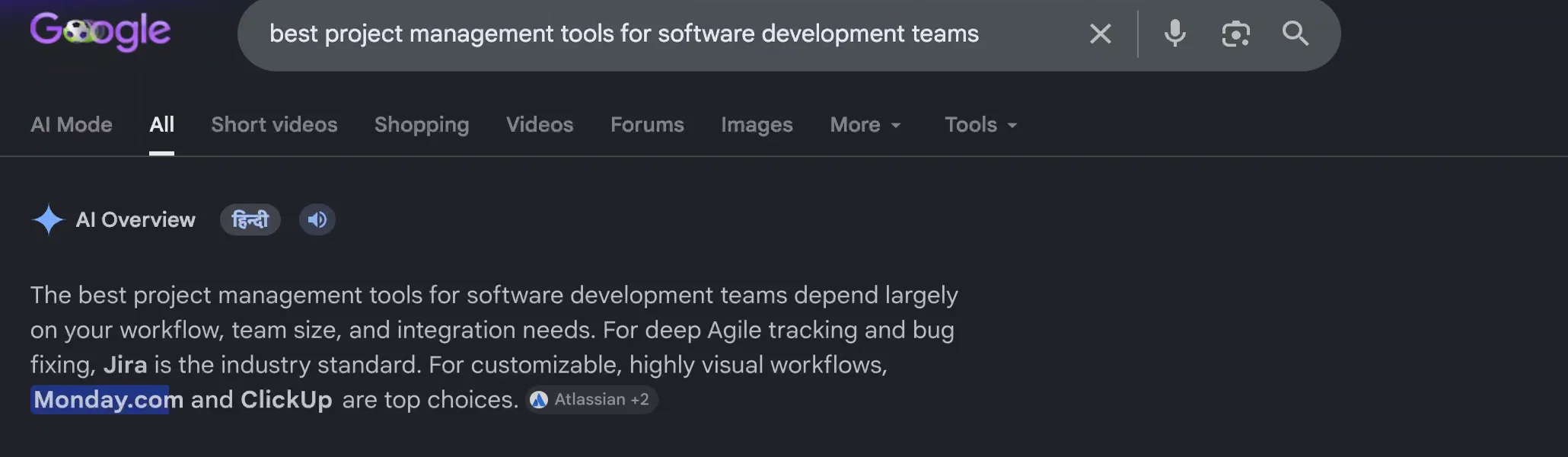
The AI Overview sits above the ten blue links and answers the query in the page itself, naming brands (here Jira, Monday.com, ClickUp) with a source chip. The reader gets the answer without scrolling, which is exactly where the clicks went.
Curious how your site does?
See how AI engines describe your site — free, about 60 seconds, no signup.
What an AI Overview actually is
An AI Overview is a paragraph-shaped synthesis that Google generates from a handful of sources and shows at the very top of the search results page. It usually:
- Spans 2–6 sentences of generated prose
- Cites 3–10 sources via small link cards below the answer
- Includes brand names directly in the answer text
- Sometimes embeds a comparison table or bullet list
- Appears on around a third of commercial-intent queries and rising1
The key shift: the user reads the answer in the SERP itself. If your URL is one of the citation cards, you get a click. If your brand name is named in the answer text, you get attention even without the click. If neither — the search journey can end before your site is considered.
Why traffic dropped — the actual mechanism
It isn't just that the AI Overview occupies vertical space and pushes you down. Two compounding effects:
- Zero-click answers. When the Overview fully answers the user's intent ("what is X", "how does Y work"), the user often doesn't scroll. Informational queries are hit hardest. SERP-watching data sources put the through-rate drop at 20–40% for informational intent.2
- Selection bias toward "authoritative" sources. The model picks from a relatively small set of sources it considers trustworthy. Smaller publishers with weaker brand signals — even if they rank well organically — often don't make the citation list.
The second effect is the unfair one and the one we can do something about. The first is more structural; the response there is to optimize for inclusion in the Overview, not around it.
The three query types AI Overviews swallow (and the one they don't)
Not every query gets an AI Overview, and understanding which ones do explains where your traffic went and how to fight back.
Informational queries get an Overview almost always. "What is [X]", "how does [Y] work", "history of [Z]" — Google's models are confident here because these answers rarely have wrong answers. If your traffic came from informational queries, you took the biggest hit. These are the queries that trained SEO writers churned out "ultimate guide" content for, and they're the queries AI Overviews most reliably kills.
Comparison queries get an Overview about half the time. "Best [X] for [Y]", "alternatives to [Z]", "[A] vs [B]" — Google shows an Overview when it can safely name 3–5 brands. When the category is too niche (only two viable products) or too crowded (30+ options), it often skips the Overview and shows normal results. Your fight here is being one of the brands named, not eliminating the Overview.
Transactional queries mostly don't get an Overview. "Buy [X]", "[X] pricing", "[X] discount" — Google leaves these alone because it doesn't want to insert itself between the user and a purchase. If your traffic is transactional, you're mostly unaffected. Congratulations.
Navigational queries never get an Overview. "[Brand] login", "[Brand] contact", "[Brand] support" — these go straight to the branded site. Untouched.
Look at your Search Console query mix. If 60%+ of your traffic came from informational queries and you've dropped 25%, that's your explanation right there. The recovery playbook below is specifically calibrated for getting back into informational and comparison Overviews.
The seven changes that actually get you in the Overview
The order matters — the early items have the highest leverage.
1. Add Organization + WebSite + FAQPage schema, properly nested
JSON-LD is how Google's models understand "what is this page". A page with no schema is dramatically harder for the synthesis pass to bin correctly. The three to start with:
- Organization — gives the model your entity (brand name, logo, founding date,
sameAslinks to LinkedIn / Wikipedia) - WebSite — declares the canonical search URL and brand
- FAQPage — turns your bulleted "common questions" into a structure the model can lift verbatim
If you're not sure where to start, our Schema Generator emits all three with one input. The validator at search.google.com/test/rich-results will confirm parse success.
2. Front-load the answer in question-style H2s
The model retrieves passages, not pages. A page structured as a series of question H2s, each with the answer in the first 1–2 sentences below, becomes a much richer source for the synthesis pass than a long narrative with the answer buried at the bottom.
A simple test: open one of your top pages. Can a reader who only reads the H2s and the first sentence below each H2 already get most of the value? If yes, the model can too. If no, restructure.
3. Cite your sources, in-text and visibly
Citation begets citation. Pages that themselves cite primary sources (with linked footnotes, not just "as Forbes reported") signal credibility to the synthesis pass. The model is, in a real sense, looking for sources that look like the sources it likes.
The footnote pattern at the bottom of this post is deliberate — every claim has a link to where the number came from. Adopt this on at least your tentpole posts.
4. Build mentions on Wikipedia-tier sites
A single mention in Wikipedia, a Substack writer's roundup, an industry-trade publication, or a high-trust forum thread can outweigh hundreds of generic backlinks for AI Overview inclusion. This is because the synthesis pass uses these higher-trust sources to disambiguate brand entities and decide which sites to cite at all.
Tactics:
- A Wikipedia article about your category (not your company) that links to your product as a representative example
- Inclusion in an annual "best X for Y" roundup from a known industry publication
- Founder-bylined contributions on Substack, Medium, or LinkedIn that link back to your tentpole posts
5. Unblock AI crawlers
Counterintuitive but bites a surprising number of sites: your robots.txt blocks GPTBot, ClaudeBot, Google-Extended, PerplexityBot, or all of the above. Check yours. If any of them are disallowed, you're invisible to the engine they belong to.
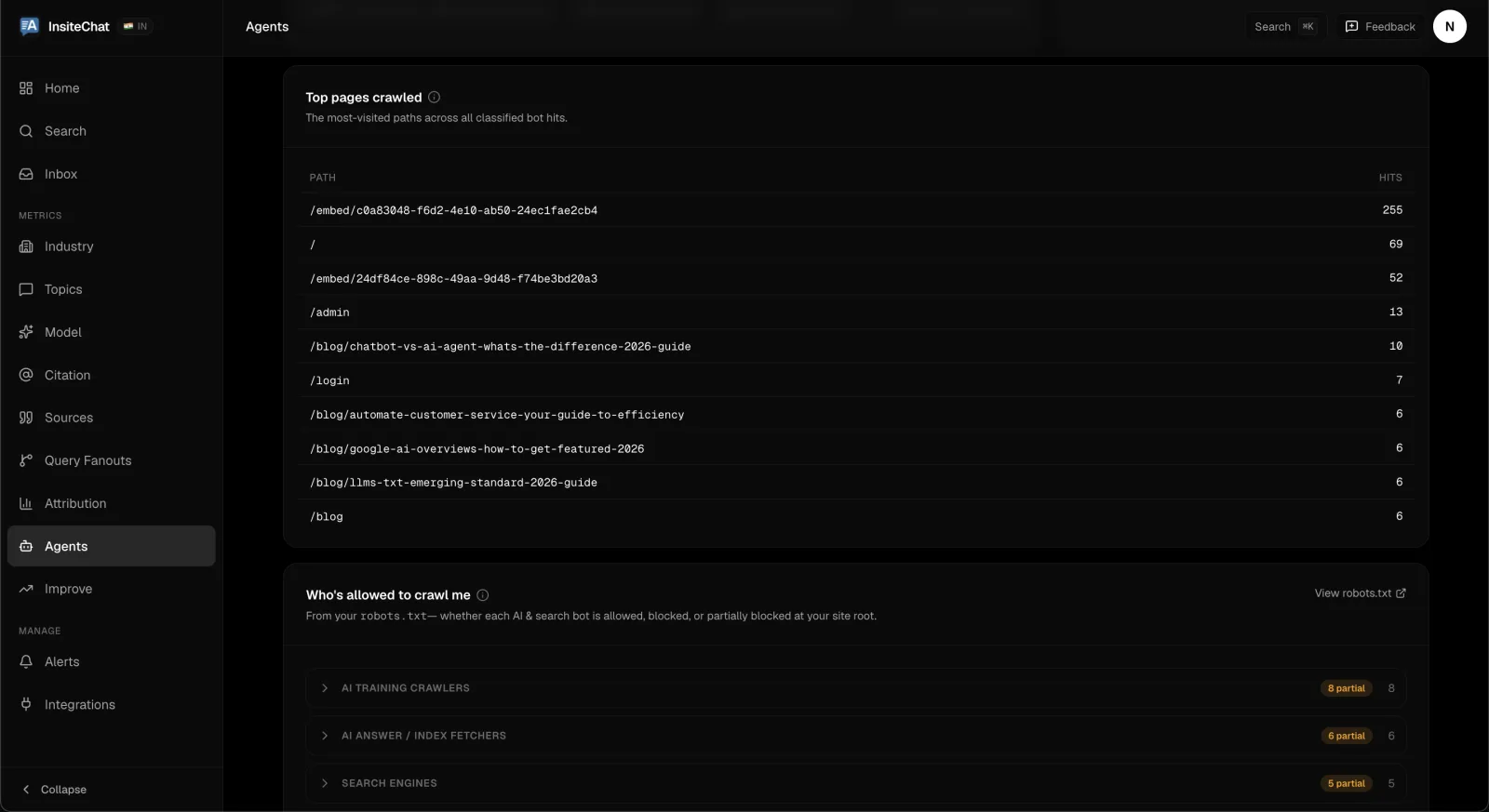
Example: the pages AI crawlers fetch most, plus per-bot access, for InsiteChat — FixAEO.
Our robots.txt Generator emits a permissive but audited rule set, or paste your current rules into the robots.txt Checker to see what's blocking what.
6. Publish an llms.txt
llms.txt is the new convention for telling AI crawlers what's worth indexing — think of it as sitemap.xml for the AI age. It's emerging fast as a standard and is checked by an increasing set of crawlers. Cost to add: ~10 minutes. Upside: you get a curated channel into the model's index.
Our llms.txt Generator produces a spec-compliant file from your site map. If you want the full spec, see our llms.txt tutorial.
7. Track AI Overview inclusion (not just rankings)
You can't optimize what you don't measure. Pick 20–30 prompts that match buyer intent for your category and check, weekly, whether your brand is mentioned in the Overview for each. Track:
- Visibility Score — is your brand in the answer text?
- Citation rate — is your URL in the citation cards?
- Sentiment — positive, neutral, negative
Free version: do it manually in an incognito window. Tooled version: use FixAEO — that's our specific use case.
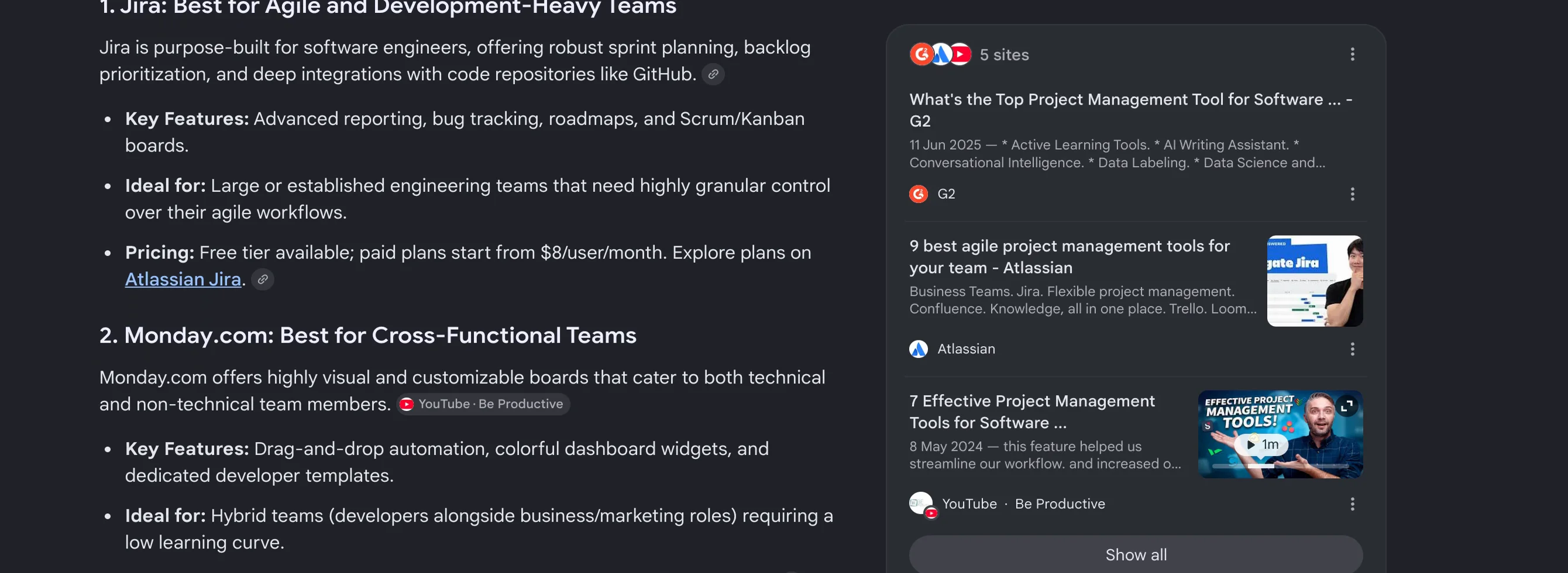
Expand the Overview and a sources panel shows exactly which sites Google pulled from (here G2, Atlassian, a YouTube channel). "Citation rate" is simply whether your URL is one of those cards.
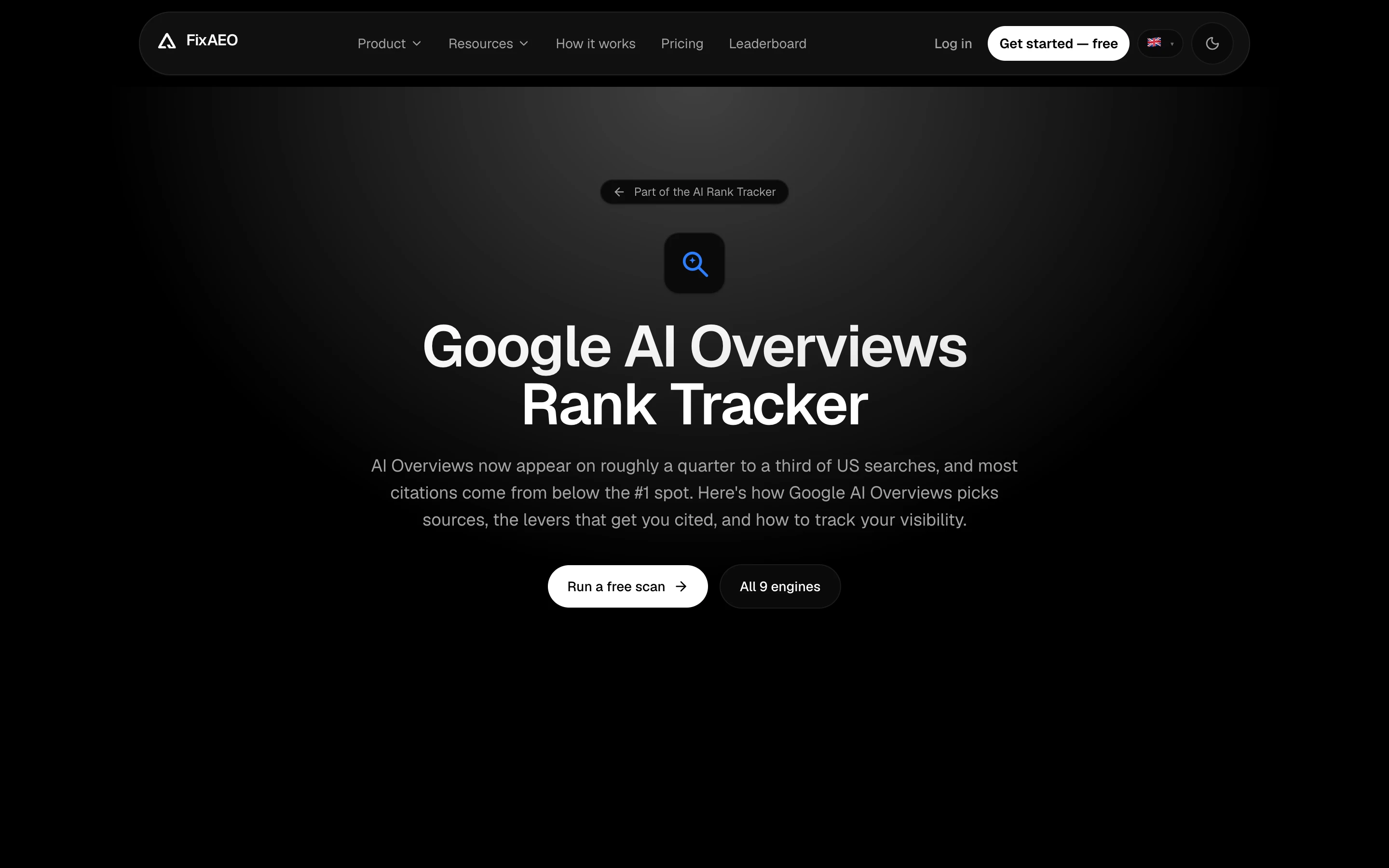
The FixAEO Google AI Overviews Rank Tracker — the specific page I open when a customer wants to see whether they appear in AI Overviews for a real query set.
How I audit a site for AI Overview readiness in 30 minutes
Every audit I run follows the same 30-minute checklist. If you want to DIY, here it is.
Minute 0–5: Baseline queries. Run 10 informational queries relevant to your category in an incognito Chrome window. Screenshot each Overview. Note which brands are named and which of your competitors' URLs are cited.
Minute 5–10: Your citation check. Search for your brand's citations across those 10 queries. If your URL appears zero times, you have a citation problem. If it appears but your brand name isn't in the answer text, you have a naming problem. If both — you're mostly there and just need cadence.
Minute 10–15: Technical audit. curl -s https://yoursite.com/robots.txt — check for AI crawler blocks. View source on your homepage — check for JSON-LD Organization schema. curl -sI https://yoursite.com/llms.txt — check the file exists. This surfaces the fastest wins.
Minute 15–20: Content structure audit. Open your top 3 blog posts. Are the H2s question-shaped? Is the answer front-loaded (first two sentences)? Is there FAQPage schema? If none of these are true, you have three specific rewrites to do.
Minute 20–25: Citation ecosystem audit. Search "site:reddit.com [your brand]", "site:wikipedia.org [your category]", "site:g2.com [your brand]". These are the sites Google trusts most for citations. Zero results anywhere = citation problem.
Minute 25–30: Priority list. Rank the gaps you found. The order is almost always: robots.txt fix first (if blocked), Organization schema second, llms.txt third, page-structure rewrites fourth, citation work fifth. Ship in that order.
That's the audit. Run it monthly on your own site and quarterly on your top competitor to see what they're doing that you're not.
The AI Overview arms race in your category
Here's a pattern I see across every category once AI Overviews land: the first three brands to optimize for inclusion pull ahead, and the rest scramble to catch up. Then a second wave of "we optimized for AI Overviews" content lands, and inclusion consolidates around the brands with the strongest entity signals (Wikipedia, real third-party press).
The implication: getting in early matters more than in traditional SEO. In SEO, the incumbent can lose ground slowly as new competitors publish. In AI Overviews, once an incumbent is named in the answer for six months, unseating them takes a genuine authority shift — new Wikipedia coverage, a major press mention, a category redefinition. That's much harder than beating them on backlinks.
So if you're reading this and Overviews have appeared in your category but you're not in them yet, treat this as urgent. The window to establish inclusion is narrower than it feels. Six months from now, the brands cited today will be much harder to displace.
What about the deeper-intent click?
A separate question worth thinking about: when the AI Overview doesn't fully satisfy the user, where do they go? Increasingly, not to the citation cards but to one of three places:
- A different AI engine (Perplexity, ChatGPT, Claude, Copilot) — they re-ask there for a more detailed answer
- A specific destination they already trust for that category (Reddit, a community forum, a known publisher)
- A "how to" or "comparison" page that the Overview deliberately punted on
The implication: your deeper, more tactical content (the "how to actually do this" or "comparison of options" posts) is now more important than your "what is X" posts. The "what is X" got swallowed by the Overview. The "how to" got more valuable because it's where the unsatisfied user lands next.
A two-month plan
If you do nothing else from this post:
| Week | Action |
|---|---|
| 1 | Audit robots.txt, add Organization + WebSite schema, publish llms.txt |
| 2 | Refactor your top 5 pages to question-style H2 structure |
| 3 | Add FAQPage schema to those 5 pages |
| 4 | Set up weekly AI Overview tracking on 20 buyer prompts |
| 5 | Identify 3 high-trust mention targets, draft contribution pitches |
| 6 | Publish one tentpole tactical post with citation footnotes |
| 7 | Re-audit the 5 refactored pages against your tracking dashboard |
| 8 | Double down on whichever change moved the metric most |
Two months in, you should be seeing measurable Visibility Score gains on at least a quarter of the prompts you track. That's the leading indicator. Click-recovery follows Visibility Score by a quarter or so, in our experience.
The customer story: what a real recovery looks like
Here's the specific case I keep in my head when I explain this to founders.
A B2B SaaS company I advised — content-marketing focused, ~100 blog posts published over three years, decent domain authority. Their organic traffic peaked in Q3 2024. By Q1 2026 it was down 42%. Rankings hadn't moved much. Google AI Overviews had gutted their informational-query traffic — the "what is [category]" and "how to [category task]" posts that had been their engine for years.
Their audit found four issues: no Organization schema, no FAQPage schema on any of their top posts, an outdated robots.txt from 2023 that blocked GPTBot, and blog posts written in narrative style (long intros, buried answers). Zero third-party citation issues, though — they'd built solid press coverage over the years.
Fix ship order and timeline: Week 1 they added Organization schema and updated robots.txt. Week 2 they added FAQPage schema to their top 20 posts. Weeks 3–6 they rewrote the H2s and first paragraphs of their top 10 posts into question/answer shape. Week 7 they published an llms.txt.
Result by Week 12: they were showing up in AI Overviews for 8 of the 20 queries they were tracking (from zero at baseline). By Week 20, that was 14 of 20. By Week 30, GA4 showed organic traffic recovered to 78% of the Q3 2024 peak, and the queries hardest hit (informational) were within 10% of their old volume.
Notable: they never recovered 100%. Users who got their answer from the Overview and didn't need to click aren't clicking. But the click-through from citation cards, plus the deeper-intent traffic from users whose Overview didn't fully satisfy them, added up to a real recovery. That's what "recovery" looks like when it works — not full restoration, but a healthy portion of the traffic back, plus better protection against future Overview expansion.
The honest take
AI Overviews are a permanent fixture. Wishing them away doesn't help; the channel structurally rewards different signals than it used to, and the brands optimizing for those signals are pulling further ahead every month. The seven changes above are the cost of staying competitive. The good news is they're all under your control, none of them require permission from Google, and the ones with schema and llms.txt and robots.txt are durable infrastructure — you do them once and they pay back for years.
If you want to short-circuit the audit step, run a scan on your own site — we'll surface every one of these seven items, ranked by severity, in 3 minutes. And keep a Google AI Overview tracker running so you can see the recovery happen instead of guessing.
FAQ
What share of Google searches now show an AI Overview?
Roughly a third of commercial queries as of early 2026, with the share rising month over month. Informational queries trigger Overviews more often than transactional ones; navigational queries rarely.
Do AI Overviews count as zero-click results?
Often, yes. When the Overview fully answers the user's intent, the user typically doesn't scroll to the citation cards. That said, the citation cards do still receive meaningful click-through for users who want a deeper answer — so being cited inside the Overview is still worth optimizing for.
Can I opt my site out of AI Overviews?
Sort of. Adding Google-Extended: Disallow in robots.txt tells Google not to use your content for Bard and AI Overview generation, but it does not affect normal Google Search indexing. Most sites should leave it allowed — opting out means you can't be cited, which is worse than the alternative for almost everyone.
How long does it take to start appearing in Overviews after a change?
Schema and llms.txt changes are typically reflected within days. Citation-authority signals (Wikipedia, industry pubs) take weeks to months. Content restructuring effects show up at the speed of Google's next crawl + index pass — usually 1–2 weeks for active sites.
Does the AI Overview ever show only my brand?
It can on branded queries (someone searches your exact brand name). On generic queries it always names 2–5 brands. Single-brand inclusion is rare and usually means you dominate the topic; aim for being one of 2–3 named, not the only one.
What's the single highest-leverage change?
Adding FAQPage and Organization schema. Both take under an hour, both feed the model the structured information it needs to decide whether to include you, and both are usually missing.
Does Bing Copilot count the same as Google AI Overviews for this playbook?
Similar but not identical. Bing Copilot uses many of the same signals (schema, entity clarity, third-party citations) but with Bing's own index behind it, which weighs different sources than Google's. The AEO work you do for AI Overviews benefits Bing Copilot too, but if Bing Copilot is a significant traffic source, treat it as a separate diagnostic.
Should I optimize for AI Overviews or for ChatGPT?
Both, with the same content. The playbook overlaps ~80%. AI Overviews cares slightly more about backlinks and traditional authority signals (because it inherits Google's ranking system). ChatGPT cares slightly more about how quotable your specific sentences are. Ship the same fixes and both will move.
How do I know if my recovery is working?
Two signals. First, weekly visibility tracking (via a tool like FixAEO or manually) — you should see your name appearing in Overviews for prompts where it wasn't before. Second, GA4 attribution — you should see AI-referred sessions climbing month over month. If neither moves after 60 days of shipping fixes, something's wrong.
Can I recover lost traffic completely, or is some of it just gone?
Some of it is structurally gone. Users who got their answer from an Overview and didn't need to click are not coming back for that specific query. What you can recover is (a) the click-through from being in the citation cards, (b) the branded-search increase from being named in the Overview, and (c) the deeper-intent traffic from users whose Overview answer wasn't enough. That's usually 40–70% of the lost volume — real recovery, but not 100%.
Footnotes
-
Coverage statistics here aggregate from multiple SERP-monitoring sources; ranges given are conservative midpoints from the public reporting in early 2026. Exact percentages drift week-to-week as Google adjusts the Overview triggering threshold. ↩
-
Click-through-rate impact varies wildly by query type. Informational queries see the largest drops; transactional and navigational queries are much less affected (the user still has to click to complete the action). ↩
Related reading
How to Get Cited by Gemini in 2026
How to get cited by Gemini: it runs on classic SEO plus AI-specific signals. Learn the 2026 playbook for rankings in AI Overviews and Gemini answers.
17 min readHow to get cited by Perplexity: a 2026 playbook
Perplexity cites 4-8 sources per answer and the patterns are learnable. Here are the 8 patterns we see in cited content, with the tactics that got FixAEO cited in our own category.
16 min readWhy ChatGPT doesn't recommend your brand
ChatGPT SEO fix: six reasons ChatGPT names competitors instead of you, ranked by frequency across 1,000+ FixAEO scans — with a fix for each and a 30/60/90 day plan.
17 min readHow to add llms.txt to your website in 10 minutes
llms.txt tells AI assistants what your site is about. Get the exact format, a copy-paste template, deployment steps for every major host, and how to prove it's working.
17 min readGEO vs AEO vs SEO: a 2026 terminology breakdown
GEO, AEO, SEO — and now LLMO. A clean breakdown of what each acronym actually means, how they nest, and which one applies to your work in 2026.
17 min readAEO vs SEO: what changed and what to do about it
AEO vs SEO in 2026: AI answers and search engines reward different signals. The data, a plain comparison, and a 30-day migration plan your SEO team can run.
17 min read
Free AEO tools
Put this into practice with free FixAEO tools — no signup required.
AI Visibility Checker
Score your brand across 9 AI engines
AEO Audit Tool
Answer-engine readiness scan
Schema Generator
Build valid JSON-LD structured data
llms.txt Generator
Create a spec-compliant llms.txt
Sitemap Validator
Check your XML sitemap for errors
AI Content Grader
Grade content for AI citation readiness
Find the gap. Then fix it.
Check how AI engines find, describe, and cite your site. Free, no signup. On a paid plan, AI Marketer can turn the evidence into briefs, drafts, optimizations, and reports.