Answer Engine Optimization Services: A Buyer's Guide
What answer engine optimization services actually do, what the work involves, and how to choose between DIY, an agency, or a self-serve tool without overpaying.

On this page

"Answer engine optimization services" is a phrase that means five different things depending on who's selling it. Some providers run a real program across the AI engines. Some are SEO shops that swapped one acronym for another and changed nothing. I've built the tooling that tracks brand mentions across 9 AI engines, and I talk to founders and marketing leads shopping for AEO services every week. This is the honest version of what the work is, how to tell good from bad, and how to decide whether to pay for a service at all.
I'll be upfront: I build FixAEO, which competes with the "services" model. That doesn't mean services are bad. It means I've watched enough of them succeed and fail to have a strong view on when they're worth the money and when they're not.
Curious how your site does?
See how AI engines describe your site — free, about 60 seconds, no signup.
What AEO services actually cover
Answer engine optimization is the work of getting your brand mentioned and cited when people ask AI assistants questions. Not ranked on a results page. Named inside the answer. If someone asks ChatGPT "what's the best project management tool for small teams" and your product never comes up, that's the gap an AEO service is hired to close. If the term itself is new to you, I wrote a plain explainer of what AEO is that covers the basics.
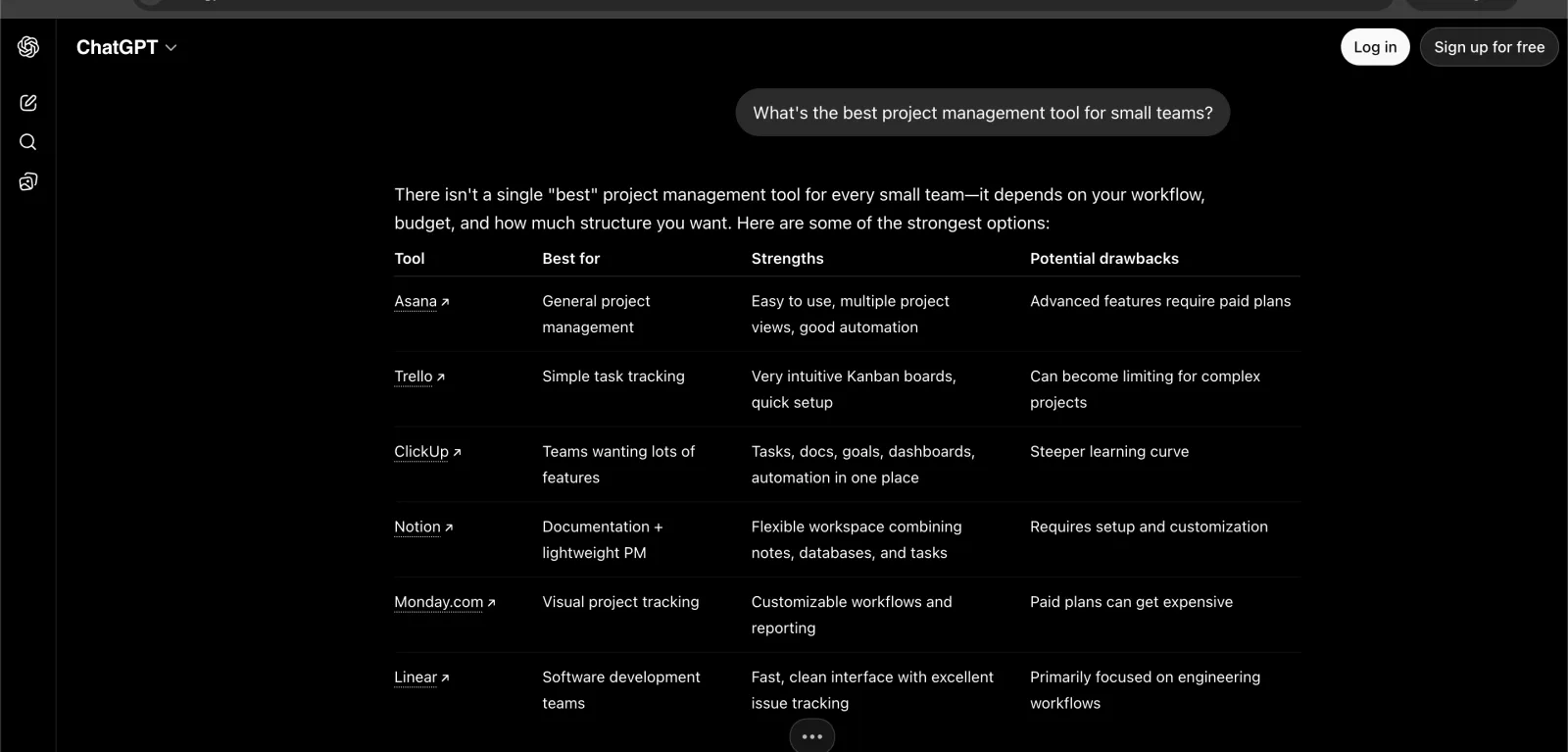
ChatGPT (logged out) answering a real buyer query — these six tools are the answer. AEO work is about getting a brand into lists like this.
A real service touches five areas. None of them are magic.
Entity and brand presence. AI models reason about your brand as an entity, not a string of keywords. They pull from Wikipedia, Crunchbase, G2, Reddit, review sites, and the broader web. Part of the work is making sure your brand exists clearly and consistently in those sources, so the model has something to cite in the first place. A brand with a thin web footprint is invisible no matter how good its own site is. This work is slow — Wikipedia edits get reverted, Crunchbase profiles need maintaining — but it's the highest-leverage part of the stack because it changes what AI engines know about you, not just what they see.
Content structured for citation. AI engines lift specific sentences and facts out of pages. Content built to get cited answers a question directly, states facts cleanly, and doesn't bury the point under 600 words of windup. This is different from old SEO content padded for word count. Shorter, denser, more quotable. If your existing blog posts start with three paragraphs of context before the actual answer, the AI won't scroll — it'll pick a competitor who put the answer in the first sentence.
Technical signals. This is llms.txt, schema markup, clean HTML that machines can parse, and a robots/crawl setup that actually lets the AI crawlers in. These are the cheap, fast wins. A surprising number of sites block GPTBot or PerplexityBot by accident and wonder why they're never cited — I've audited multiple $10M/year businesses that had a Disallow: * from a decade-old paranoid robots.txt. Fixing that alone can move visibility 15+ points overnight.
Cross-engine monitoring. You can't improve what you can't see. The core of any real service is tracking where your brand shows up across engines over time. ChatGPT, Claude, Gemini, Perplexity, Grok, DeepSeek, Copilot, Google AI Overviews, and Google AI Mode all behave differently and cite different sources. A monthly screenshot is not monitoring. Real monitoring is at least weekly, across engines, with alerts when something changes materially.
Reporting tied to outcomes. Mentions are nice. The question that matters is whether AI traffic turns into signups or sales. Good reporting connects visibility to referral traffic and conversions, which usually means a GA4 setup that can see AI traffic plus a defensible attribution model. If your provider can't show you the line from "we improved your Perplexity mentions" to "here's the referral traffic that came from it," they don't actually know if their work is landing.
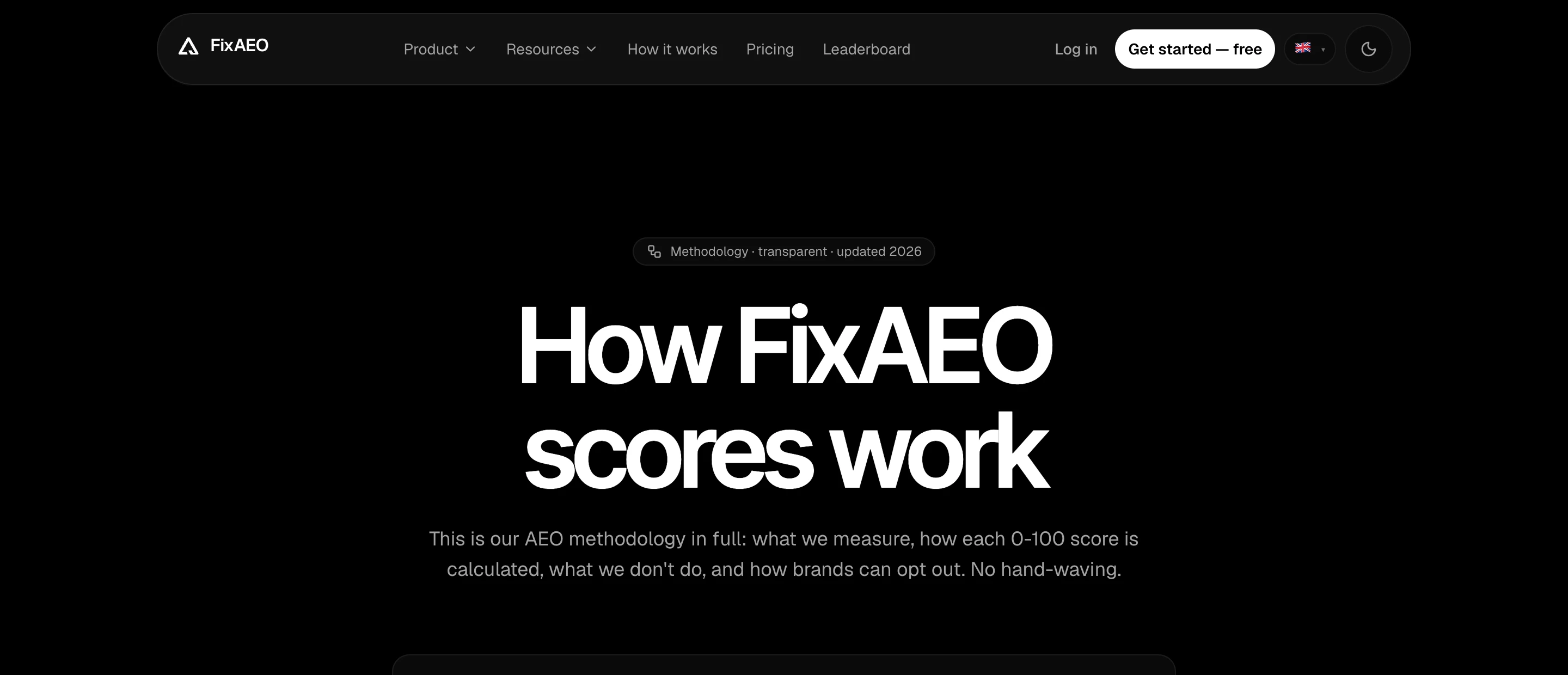
A good AEO service partner shows you their methodology, not a black box. FixAEO's methodology page walks through exactly how the scan and scoring work — the same transparency any agency should offer.
AEO service pricing tiers explained
Pricing in this space is all over the map, but there are three clusters worth knowing.
Tier 1: Under $2,000/mo. Usually a boutique or one-person shop. Good ones exist — they're often ex-in-house marketing leads who now consult. Watch for scope creep and single-point-of-failure risk. Best for early-stage startups who need a hands-on partner and can't afford agency rates.
Tier 2: $2,000–$8,000/mo. The mid-market. This is where most established AEO agencies live. You should get a strategist plus one or two executors, weekly deliverables, a proper monitoring stack, and monthly reporting tied to KPIs. This is the sweet spot for series A/B SaaS companies who have a real budget but aren't Fortune 500. Ask specifically who does the work (senior or offshore junior?) and what tools they use — many agencies at this tier resell a tool like FixAEO underneath, which is fine as long as they're transparent about it.
Tier 3: $8,000+/mo. Full-service agencies or specialist firms with strategist teams and multi-brand coordination. Worth it if you have multiple products, multiple markets, or a genuinely complex enterprise setup with procurement requirements. Below that scale, you're paying for capacity you won't use.
Anything advertising a $500/mo AEO retainer is almost certainly a repackaged SEO service — the actual AEO work at that price point can't cover monitoring, content, and reporting all together. Buyer beware.
DIY, agency, or self-serve tool
There's no single right answer here. It depends on your time, your budget, and whether you have someone in-house who can do the work.
Do it yourself if you have technical skills and time. The technical layer (schema, llms.txt, crawl access) is genuinely doable in a weekend. The content layer takes ongoing effort but it's the same muscle as writing good content. The thing you can't easily fake on your own is the monitoring, and that's where a free tool fills the gap. Start with my AEO audit checklist and work down it.
Hire an agency if AEO is a real revenue lever and you don't have the bandwidth in-house. A good agency brings a process, does the grunt work, and saves you the learning curve. Expect to pay anywhere from $2,000 to $15,000 a month depending on scope. The risk is paying agency rates for SEO basics relabeled as AEO. More on spotting that below.
Use a self-serve tool if you want the monitoring and the data without the retainer. Tools handle the part that's genuinely hard to do alone, which is tracking visibility across every engine on a schedule. You still do the content and technical fixes, but you do them knowing what's actually moving the needle. For most small teams and solo founders, this is the right starting point, and you can always layer an agency on later. I compared the options in best AEO tools 2026.
A lot of teams end up doing a mix. Tool for the data, in-house for the content, agency for a specific push like a launch.
Agency vs FixAEO self-serve: which fits
Here's the honest comparison. This is the exact conversation I have with prospects who are weighing both.
| Agency | FixAEO self-serve | |
|---|---|---|
| What you get | Strategy + execution + reporting | Data + prioritized fix list + tracking |
| What you do | Sign off, review reports | The actual content and technical work |
| Monthly cost | $2K–$15K/mo | $29–$79/mo (up to Enterprise custom) |
| Best when | Content bandwidth is the bottleneck | Data and clarity are the bottleneck |
| Multi-brand | Yes, at cost | Yes, from Growth ($79/mo) |
| How fast to start | 2–4 week onboarding | Same-day scan |
| Time-to-first-fix | Week 2–3 | Day 1 |
The pattern I see most often: teams start with FixAEO to get the data and confirm AEO is a real revenue lever for them. Once the numbers justify it, they add an agency for content bandwidth — and the agency uses FixAEO as its measurement layer. That's a healthier arrangement than either alone.
If your marketing team already writes good content and you just need to know what to point them at, skip the agency. If you have budget but no marketing team, hire the agency. If you have both, layer them.
What good AEO work looks like month to month
If you hire someone, here's roughly what a competent engagement produces. Use it as a yardstick.
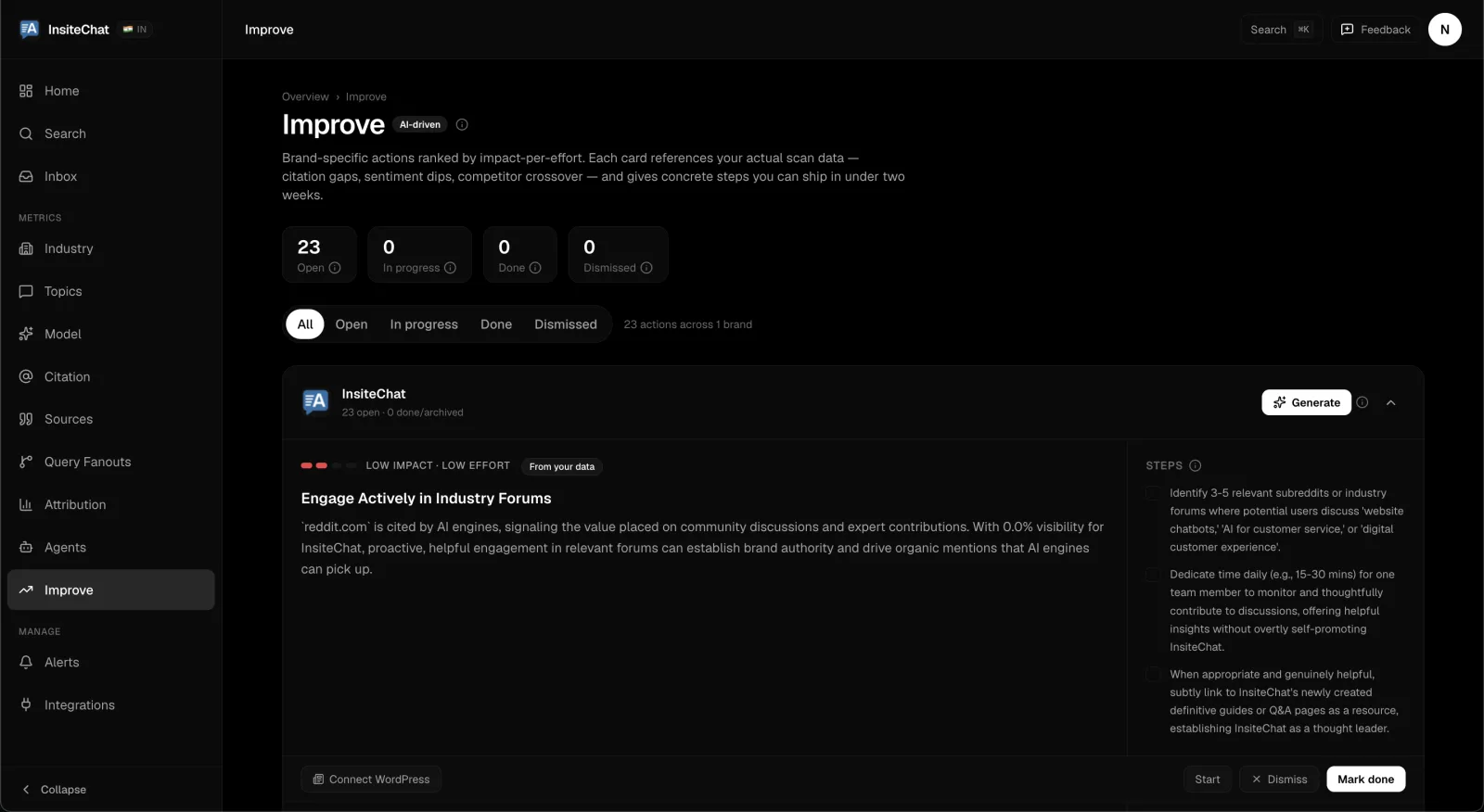
Prioritized AEO actions ranked by impact — FixAEO's recommendations for InsiteChat. The same view an agency should be delivering.
Month one is an audit and the technical fixes. Crawl access checked and fixed, schema added, llms.txt published, a baseline reading of where you show up today across engines. Most of the fast wins land here. Expect a visibility score movement of 5–15 points from the technical fixes alone. If nothing moves in month one, your provider is going too slow.
Months two and three are content. New pages built to answer the questions your buyers actually ask the AI, plus rewrites of existing pages so they're quotable. Work on entity presence starts here too, which is slower because it depends on third-party sources you can't fully control. Expect two to five new pages a month and one or two Wikipedia/directory improvements.
Months four to six are the grind. Monitor, see what's moving, double down on the topics where you're gaining, fix the ones where a competitor is eating your share. AEO is not a one-time project. The models retrain, your competitors publish, and your position drifts if nobody's watching. This is when you should see AI referral traffic start showing up in GA4 in a meaningful way.
Beyond month six is where you separate the good providers from the ones renting your budget. Good providers get better results at month twelve than month six — they've learned your buyer's language, they've built entity assets that compound, and they know which prompts are contested vs stable. Bad providers show a growth curve that flattens after month four because they've run out of easy wins.
If a provider promises you'll "dominate ChatGPT in 30 days," walk away. Nobody controls what the models say, and anyone claiming they do is selling certainty they don't have.
Red flags in an AEO agency pitch
I've read enough of these decks to spot the patterns. Here are the six I run away from.
- They talk about "AI-powered content" as if that's the AEO strategy. Using AI to write your content doesn't get you cited by AI. Different problem.
- The report they show you is an SEO report with the word "AI" swapped in. If you see "keyword rankings" as the primary metric, they haven't updated their methodology.
- They can't name the AI engines they track. "AI search" is not a list. Ask for the specific engines.
- They guarantee ranking or visibility outcomes. No serious provider does this because nobody controls what LLMs say. Guarantees mean either (a) they're lying, or (b) they've picked a metric so soft that any effort will hit it.
- The pricing is per-keyword or per-page. AEO doesn't work like that. The unit isn't a keyword; it's an entity showing up in a class of answers.
- They resell a monitoring tool without disclosing it. It's fine if they use FixAEO or Peec under the hood — most do — but they should say so and show you the raw data, not hide it behind their own PDF.
If a pitch trips two or more of these, walk. There are too many decent providers out there to gamble on a bad one.
How to structure the retainer if you hire an agency
If you decide to hire, here's what a good contract looks like. Copy this into your evaluation checklist.
Scope in writing. Which engines they track, which pages they'll rewrite, how many net new pages a month, what entity work they'll do. Vague scopes turn into billed hours later.
Weekly monitoring, monthly reporting. Not the other way around. Monthly monitoring misses fast competitor moves; weekly reporting is too much overhead for most teams to consume.
A three-month kill switch. You should be able to cancel with 30 days' notice after the first three months. Providers who insist on 12-month contracts up front don't want customer feedback shaping their work.
Access to the raw tool. If they use FixAEO or Peec, you get a login. This matters — the raw data belongs to you, not their agency PDF.
Clear success metrics. Visibility score movement, cited-prompt count, AI referral traffic in GA4, and revenue attributed to AEO. If they can't commit to any of these, they don't know what "working" looks like.
A named senior on the account. Not a rotating cast of juniors. If they can't promise you a specific person, you'll get whoever's free that week.
Who these services fit best (by company type)
Series A/B SaaS with product-market fit
You have revenue, you have content bandwidth, and AI is starting to send meaningful referral traffic. A tier-2 agency ($2K–$8K/mo) makes sense here if content production is your bottleneck — you know what to do, you just need more hands. Or start with FixAEO Growth and hire a fractional content contractor. Either path lands roughly the same result at different price points.
Bootstrapped startup or solo founder
Skip the agency entirely. Start with the FixAEO free tier, upgrade to Lite ($29/mo) when you need daily tracking, and do the content work yourself. The learning curve is real but the compounding value of understanding your own AI visibility is worth the six months of self-education. Come back to agencies once you're at $2M+ ARR and can justify the retainer.
Multi-brand SaaS or agency reselling
You need portfolio-view monitoring across every brand. FixAEO Growth or Enterprise for the data layer. Layer an in-house or contract content team on top. Agencies serving multi-brand companies at this scale usually add process overhead without proportional value — you're better with a strong internal marketing lead running the same tool the agency would.
Enterprise or Fortune 1000
Sales-led AEO agencies exist for this segment and they're often worth it — they know procurement, they understand your risk tolerance, and they have the reporting maturity for a CMO. FixAEO Enterprise as the measurement layer, agency for the strategy and execution. Budget accordingly ($10K–$50K/mo depending on scope).
The cheapest first move
Before you spend a dollar, get your own baseline. Run your brand through a few questions across the major engines and see what comes back. You'll learn three things fast: whether you show up at all, which engines like you, and which competitors keep getting named instead of you. That data changes how you negotiate with any provider, and half the time it tells you the fixes are small enough to do yourself.
The free AI visibility checker does exactly this. It's the same baseline a paid service would charge you to produce. Run it before you take any sales call.
How to evaluate an AEO provider
I'd ask every one of these before signing anything.
Which engines do you actually track? The answer should be a specific list, not "AI search." If they only watch ChatGPT, that's a third of the picture. There are at least 8 engines that matter, and Perplexity and Google AI Overviews drive real traffic that ChatGPT doesn't.
Show me a sample report. A real one, redacted is fine. You're looking for cross-engine visibility tracked over time and a link to business outcomes. If the report is a list of keywords and rankings, it's an SEO report wearing an AEO costume.
What's your method for getting cited? A good answer talks about entity presence, content structure, and third-party sources. A weak answer is vague, or it's all about backlinks and meta tags. Backlinks help, but they're not the whole game in AI search.
How do you measure success? Mentions and share of voice are leading indicators. The real measure is AI referral traffic and what it converts to. If they can't connect their work to revenue, you'll have a hard time justifying the spend. I broke down how to do this in measuring AEO ROI.
Can I see my baseline before I commit? Any provider worth hiring can pull your current AI visibility in an afternoon. If they can't show you where you stand today, they can't show you progress later. You can also just check this yourself for free, which I'd do before any sales call so you're not negotiating blind.
Who on your team will actually do the work? Titles matter less than tenure. Ask for the LinkedIn of the specific person who'll be executing. If they can't tell you or the person has three months of experience, that's your answer.
FAQ
How much do answer engine optimization services cost?
It ranges widely. Self-serve monitoring tools run from free to a few hundred dollars a month. Agency retainers typically sit between $2,000 and $15,000 a month depending on whether they're doing content production or just strategy and monitoring. The technical setup, if you do it yourself, costs nothing but time. See the pricing-tiers section above for the full breakdown.
Is AEO different from SEO, or just a rebrand?
They overlap but they're not the same. SEO optimizes for ranking on a results page. AEO optimizes for being named and cited inside an AI-generated answer, which depends more on entity presence and how quotable your content is. Plenty of "AEO services" are repackaged SEO, so check whether the work and the reporting are actually built for AI engines.
Can I do AEO myself without hiring anyone?
Yes, for most of it. The technical fixes (schema, llms.txt, crawl access) and the content work are all doable in-house if you have the time. The one piece that's genuinely hard to do alone is tracking visibility across every engine on a schedule, and a free or cheap tool covers that. Many teams never need an agency.
How long until AEO services show results?
The technical fixes can show up in weeks. Content and entity work take longer, usually a few months, because the models pull from third-party sources that don't update overnight. Be skeptical of anyone promising fast, guaranteed wins, since nobody controls what the AI says.
Should my SEO agency also do AEO?
Sometimes, if they've genuinely invested in the discipline. Most haven't. The muscle for AEO is different — entity graphs, content that's structured for LLM extraction, monitoring across generative engines — and asking a keyword-focused SEO shop to "add AEO" usually gets you their existing work with a new label. Ask for their AEO-specific track record.
What's the ROI on AEO services?
For most B2B SaaS companies, the ROI hinges on how much of your buying process starts in an AI answer. If your buyers ask AI first, being cited is a direct pipeline driver. If your buyers still Google, AEO is a hedge. Measure it in your GA4 or your CRM — how to measure AEO ROI walks through the setup.
Can I fire my agency and go DIY later?
Yes, and many teams do. The healthy path: hire an agency to get you from 30 to 70 on visibility, then downgrade to a monitoring tool and in-house maintenance once you're there. The unhealthy path: sign a 12-month contract for capacity you don't need.
What if my agency uses FixAEO under the hood?
Fair — most decent AEO agencies do. What matters is transparency (they should tell you), access (you should have a login too), and the value they add on top (strategy, content production, entity work). If the agency's entire deliverable is a re-branded FixAEO report, you're paying agency rates for something you could buy for $29/mo.
If you're shopping for a provider or deciding whether to start in-house, get your own numbers first. The free AEO audit tool gives you a baseline and a fix list in a few minutes, so you walk into any decision knowing what's actually broken.
Related reading
What is AEO? Answer Engine Optimization explained
Answer Engine Optimization (AEO) means getting AI assistants to recommend your brand. Learn what AEO is, why it matters more than SEO, and how to start.
18 min readThe 30-point AEO audit checklist (2026)
AEO audit checklist: 30 signals across 7 categories — from crawler access to per-engine verification. Copy it into Notion and run your audit today.
16 min read12 Best Answer Engine Optimization Tools (2026)
12 answer engine optimization tools compared — engines covered, entry price, free tier — with honest takes on which to pick by stage and budget.
19 min readHow to measure AEO ROI: a copy-paste spreadsheet
Measure AEO ROI with attributable visits, conversion rate, gross profit, and cost. Includes a transparent worked example, spreadsheet layout, and limitations.
13 min read
Free AEO tools
Put this into practice with free FixAEO tools — no signup required.
AI Visibility Checker
Score your brand across 9 AI engines
AEO Audit Tool
Answer-engine readiness scan
Schema Generator
Build valid JSON-LD structured data
llms.txt Generator
Create a spec-compliant llms.txt
Sitemap Validator
Check your XML sitemap for errors
AI Content Grader
Grade content for AI citation readiness
Find the gap. Then fix it.
Check how AI engines find, describe, and cite your site. Free, no signup. On a paid plan, AI Marketer can turn the evidence into briefs, drafts, optimizations, and reports.