What is AEO? Answer Engine Optimization explained
Answer Engine Optimization (AEO) means getting AI assistants to recommend your brand. Learn what AEO is, why it matters more than SEO, and how to start.

On this page

If you have ever asked ChatGPT for a recommendation — "best CRM for a small SaaS", "who makes the most durable luggage", "which fintech has the best API for payouts" — you have used a conversational search engine, also called an answer engine.
Answer engines don't return ten blue links. They return one (or three) recommended brands, with a short pitch and the reasoning behind the pick.1 The brands that show up in those answers are increasingly winning the consideration phase before the user reaches Google.
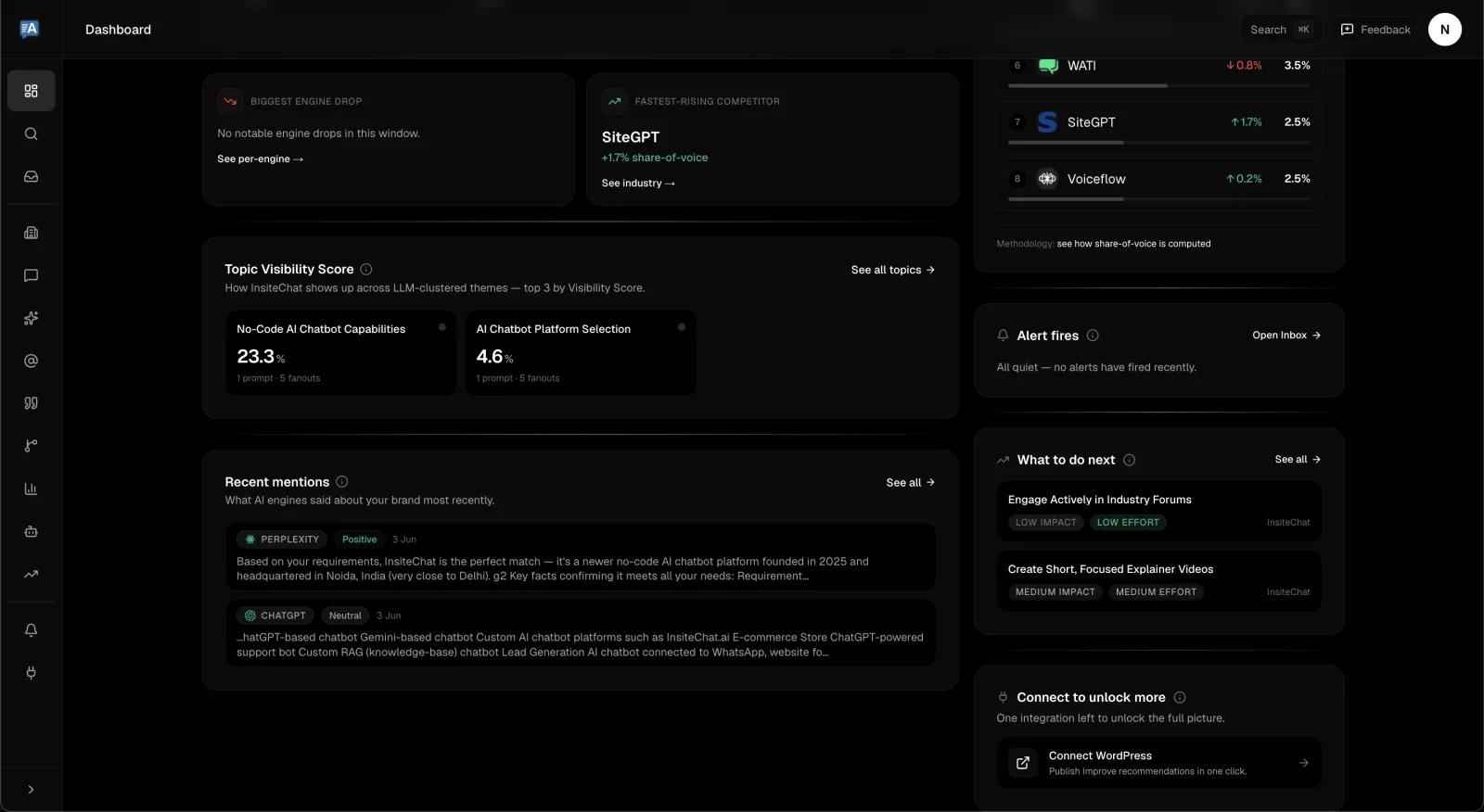
Example: Perplexity naming InsiteChat in a real answer — the kind of mention AEO is about. Tracked in FixAEO.
Answer Engine Optimization (AEO) is the practice of making sure your site is the brand they recommend. This post explains what AEO is, how it differs from SEO, and the concrete steps you can take this week. For the full walkthrough with every tactic in one place, see the complete AI search optimization playbook.
Why AEO matters now
Three trends, compounding:
-
AI assistants are eating search. ChatGPT crossed 700 million weekly users in 2025.2 Google's own AI Overviews now appear on the majority of commercial queries, often with a recommended brand inside the synthesis.3 Perplexity, Claude, Copilot, Grok, and Gemini all shipped first-party search-and-recommend experiences in the last 18 months — see the AI search statistics for 2026 for the full breakdown of how fast this shift is moving.
-
The "consideration funnel" is collapsing. Where users used to compare 4–6 vendors via blog reviews and YouTube videos, they now ask one AI assistant a single sentence and trust the synthesis. If your brand is not in that synthesis, you lose the deal silently — there is no bounce metric for "the AI didn't mention you."
-
Traditional SEO doesn't translate directly. Ranking #1 on Google for
"best CRM"does not guarantee ChatGPT recommends you — different signals, different training data, different real-time retrieval sources. You can be the SEO winner and the AEO loser simultaneously.
AEO vs SEO — the practical differences
| SEO | AEO | |
|---|---|---|
| Goal | Rank in search results | Be cited / recommended in AI answers |
| Primary signal | Backlinks, keywords, RankBrain | Structured data, citation freshness, retrieval-friendly content |
| Distribution | Google, Bing | ChatGPT, Claude, Copilot, Gemini, Perplexity, Grok, DeepSeek |
| Click model | User clicks your link | User reads AI's synthesis (no click) |
| Measurement | Rank tracker, GSC impressions | Visibility Score, sentiment, citation count |
AEO is additive to SEO, not a replacement. Most of the SEO basics still matter — but for different reasons, and the best AI SEO tools in 2026 can help you do that classic SEO work faster while you layer AEO on top. A schema.org/Organization markup that boosts your Google snippet also makes you machine-readable to a model that has never seen your site before.
What AI assistants actually use to pick a brand
Three big inputs, in roughly this order of importance:
1. Training data (slow, expensive to influence)
The base model already has opinions baked in from its pre-training cutoff. If your brand was barely mentioned in the open web 12 months ago, the model has no baseline familiarity. You can't change this directly — but you can change it gradually by building authoritative citations now that will land in the next training cycle.4
2. Retrieval-augmented generation (fast, the biggest lever today)
When an AI assistant gets a real-time query like "best CRM in 2026", it almost always reaches out to a search index — Bing, Google's API, or a partner like Perplexity's own crawler. The pages it retrieves are the ones it summarises.5 This is the foundational pattern behind every modern AI search product.
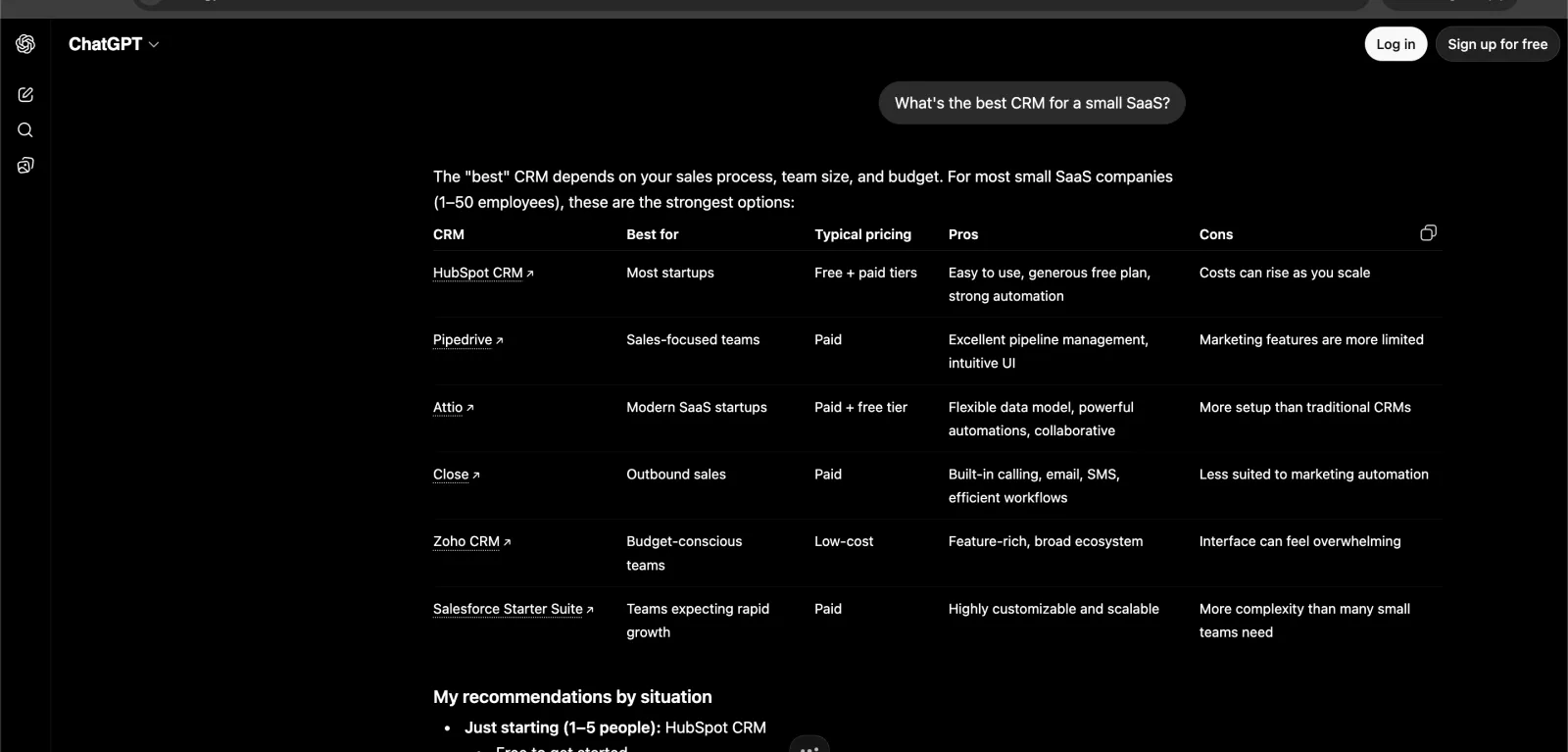
Example: ChatGPT (logged out) answering "best CRM for a small SaaS" — HubSpot, Pipedrive, Attio, Close, Zoho, Salesforce. This is retrieve-and-summarise in action; the named brands are the ones that won the answer.
This is where you have the most leverage right now:
- Be on the first SERP for your category's question-form keywords ("how to", "what is", "best of")
- Publish answer-shaped content with explicit Q&A headings, FAQ schema, and a clear "this is what we do" within the first 200 words
- Earn citations from authoritative sources — Wikipedia, industry publications, Reddit threads with high upvotes — because AI models cross-reference
3. Structured signals (fast, often missing)
Models read JSON-LD, OpenGraph tags, and the new llms.txt standard the same way browsers read your HTML.6 If your home page does not have an Organization schema with name, description, sameAs, and logo, the model has to guess. Guessing leads to confusion which leads to your competitor being recommended.
Add structured data for:
Organizationon the home pageProductorSoftwareApplicationon product pagesFAQPageon FAQ sectionsArticleon every blog postBreadcrumbListon inner pages
How the 8 AI engines actually pick answers
"AEO" is one practice, but it points at eight different engines, and they don't agree with each other. Optimizing for one doesn't automatically win you the others. Here is the short version of what each one weights — with a link to the full playbook for each. (FixAEO tracks these eight — six conversational engines plus Microsoft Copilot and Google AI Overviews — and a ninth, Google AI Mode.)
ChatGPT
ChatGPT reaches for a search index on live queries, reads the pages it pulls, and names brands with a Sources row underneath. The most common reasons it names a competitor instead of you are boring and fixable — a robots.txt that blocks GPTBot, no Organization schema, no llms.txt, marketing-pages-not-answer-pages, and no third-party citations. We ranked all six across 1,000+ scans in why ChatGPT doesn't recommend your brand, and you can watch your own ChatGPT visibility on the ChatGPT rank tracker.
Claude
Claude picks sources it can defend, not sources it can rank. Its constitutional training over-weights established, authoritative sources (Wikipedia, government domains, academic publishers, mid-tier trade press), under-weights promotional language ("#1 best", "revolutionary"), and rewards a precise, well-sourced answer over a list of 47 generic best practices. Claude Search now answers inside Claude.ai with inline citations, so if your buyer is a builder or knowledge worker, Claude touches their workflow more than search-volume numbers suggest. Full detail in the Claude citations playbook.
Gemini
Gemini is still half a search engine. It grounds live queries in a real Google search before answering, which means your Google ranking is your Gemini citation ceiling — rank #11 and you're invisible for that query. Google's Knowledge Graph and entity matching dominate at retrieval time. Classic SEO still works here, AEO signals add a multiplier, and Knowledge Graph presence is the unfair advantage. See the Gemini citations playbook and track it on the Gemini rank tracker.
Perplexity
Perplexity is the most predictable engine. It rewrites your query, pulls a candidate pool of 50–200 URLs, re-ranks them on relevance, freshness, and authority, then reads the top 4–8 into context and shows them inline as numbered cards. Two leverage points: get into the candidate pool, then survive the re-ranker. The patterns are unusually learnable — I broke them down in the Perplexity citations playbook, and you can monitor your slots on the Perplexity rank tracker.
Grok
Grok is a social search engine pretending to be a chat assistant. It grounds answers in X's real-time index — often before the open web — so a post from 30 minutes ago can outrank a blog post from 30 days ago. Recency dominates, and the re-ranker reads engagement quality (thoughtful replies from real accounts beat raw likes from bots). For Grok, roughly 70% of the playbook lives on X, not your domain. The on-site basics are the floor, not the lever. See how to get cited by Grok.
DeepSeek
DeepSeek's consumer product can search the web and attach numbered sources, while its API can be connected to developer-provided retrieval tools. DeepSeek does not publish citation weights or a dedicated consumer-search crawler identity. If your buyers use it, test a fixed prompt set, keep important pages accessible, and publish evidence that can be checked. The DeepSeek citation guide separates documented behavior from hypotheses.
Copilot
Microsoft Copilot rides on Bing's index and surfaces cited sources inside Windows, Edge, and Microsoft 365. The practical takeaway: your Bing footing matters here in a way it doesn't for the other engines, so don't let Bing indexing rot while you chase Google. FixAEO scans Copilot as one of its nine tracked engines.
Google AI Overviews
AI Overviews is the AI answer block that sits above the ten blue links, and it's essentially Gemini on the SERP — same model, same picker logic. It spans a few sentences, cites 3–10 sources as link cards, names brands directly in the answer text, and appears on around a third of commercial-intent queries and rising. It keeps clicks inside the SERP, so being named in the answer matters even when nobody clicks. If your traffic slid while your rankings held, this is usually why — the fix is in how to win back traffic lost to Google AI Overviews, and you can watch it on the AI Overviews rank tracker.
The through-line: retrieval is a major lever on every engine, but the providers and implementation details differ—and are not always public. Optimize the accessible, evidence-backed fundamentals once, then test the actual product surfaces your buyers use.
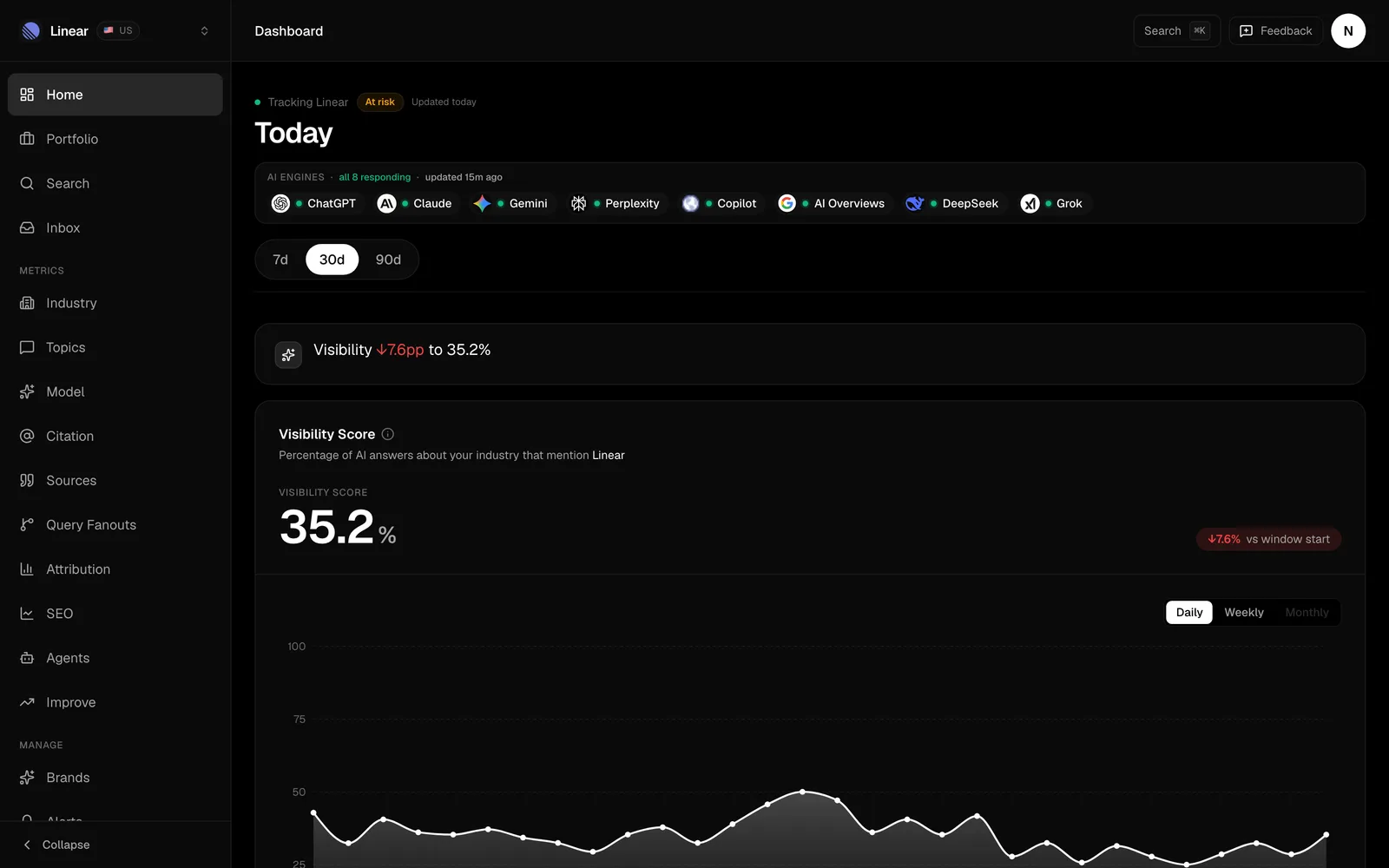
The FixAEO dashboard: one visibility score per engine, across all 9, with a 30-day trend. Real product, illustrative data.
What you can do this week
In order of effort-to-impact ratio:
-
Add
/llms.txtto your site. It is a plain-text manifest describing your business, your products, and your key pages, written for AI consumption. Five minutes, zero downside.6 -
Audit your
robots.txt. Many sites accidentally blockGPTBot,ClaudeBot,Google-Extended, andPerplexityBot. Paste the file into the free robots.txt checker for an immediate crawler-access summary, then use the full AEO audit checklist. If you want to be in AI answers, you have to let the crawlers in.7 Our AI crawler access guide shows how to test the live HTTP response, WAF decisions, returned HTML, and verified logs after the policy check. Letting them in is step one; confirming they actually arrive is step two — Agent Analytics shows which AI crawlers are really reading your pages. -
Add JSON-LD
Organizationschema to your home page. Includename,description,logo,sameAs(LinkedIn, X, Crunchbase, GitHub), andemail. -
Publish one comparison post for your most competitive query — "X vs Y vs Z" — with a fair, citation-heavy treatment. AI assistants love comparison posts because they aggregate the answer for them. You don't have to win in the post; you have to be in the post.
-
Run a free AEO audit to see where you stand. FixAEO will check the above plus the rest of its heuristic suite and tell you which engines currently recognise your brand. If you'd rather do the audit yourself first, 20 free Claude prompts for AI search visibility walk you through the same checks manually.
AEO metrics: what to actually measure
You cannot improve what you cannot measure. AEO has its own scoreboard, and it's not the SEO one. Four things are worth tracking:
- Visibility Score — across the engines you care about, what percentage of your target prompts name you? This is the headline number. A 0–100 score that moves as you fix things.
- Share of voice — of the brands named for a given prompt, what fraction are you versus your competitors? Visibility says whether you show up at all; share of voice says how much of the answer you own relative to the field. You can be visible and still be the fifth brand in a six-brand list.
- Sentiment — when you are named, what's the tone? Recommended pick, neutral also-ran, or an outright warning? A mention with bad sentiment can hurt more than no mention.
- Citation vs mention — this distinction trips people up, so be precise about it. A mention is the engine naming your brand in the prose ("HubSpot is a solid pick"). A citation is the engine linking your actual page as a source. They are not the same thing, and they don't always co-occur — an engine can name you without linking you, or link a competitor's page while naming you in the text. Both matter, and you want to track them separately.
How each engine computes and displays these differs, which is why we spell out exactly how FixAEO scores a brand in the methodology — same prompt set, same engines, same math each run, so week-over-week movement is real and not noise.
Track these weekly across the prompts your buyers are actually asking. The list of prompts is the hardest part — start with your top 10 SEO keywords reformulated as questions ("best CRM for indie SaaS" → "What is the best CRM for an indie SaaS founder?").
Your first 30 days of AEO
You don't need a tool to start, and you don't need to do everything at once. Here's a week-by-week plan that goes from "no idea where I stand" to "measurable, repeatable AEO." The first three weeks are tool-agnostic — you can do them by hand. Week 1 is the only step where a scan saves you real time.
Week 1 — Baseline and unblock. Find out where you actually stand and clear the obvious blockers. Pull your robots.txt and confirm you're not blocking GPTBot, ClaudeBot, Google-Extended, or PerplexityBot — this is the single most common reason a site is invisible to AI. Then get a baseline: run a free AEO scan on FixAEO to see which engines currently recognise your brand and get a 0–100 starting score, or do it manually by asking three or four engines your category's buying question logged out. Write the number down. Everything after this is measured against it.
Week 2 — Fix the structured signals. Add Organization JSON-LD to your home page with name, description, logo, sameAs (LinkedIn, X, Crunchbase, GitHub), and email. Add /llms.txt — a five-minute plain-text manifest describing your business and key pages. Add Product or SoftwareApplication schema on product pages and FAQPage schema where you have FAQs. This is the week you go from "the model has to guess who you are" to "the model can read you cleanly."
Week 3 — Publish answer-shaped content. Pick your single most competitive buying query and write one thing for it: either an answer-shaped page (explicit Q&A headings, a plain "this is what we do" in the first 200 words) or a fair, citation-heavy comparison post. You don't have to win the comparison — you have to be in it, because AI assistants love comparison posts and pull brands straight out of them. Publish under a real author, not a faceless "team," since several engines weight author authority.
Week 4 — Re-measure and pick your engine. Re-run the same scan or the same manual prompts. Compare against your Week 1 number. Then decide where to double down: your buyers live on a specific engine, and the per-engine playbooks above tell you what that engine actually rewards. Builders and enterprise → Claude. Google-heavy category → Gemini and AI Overviews. Research-and-buy motion → Perplexity. Developer or crypto audience → Grok. After 30 days you have a baseline, a clean foundation, one strong page, and a direction — which is more AEO than most of your competitors have done at all.
The next 12 months
AI assistants are still figuring out their citation models. Perplexity displays sources prominently; Gemini sometimes does; ChatGPT does only for some queries. As this normalises, the citation reward (free traffic from being in an AI answer) will grow.
The companies that show up in those answers in 2027 are the ones investing in AEO in 2026. Be in that group.
Run your free AEO scan at fixaeo.com — get a 0–100 score and concrete fixes in under 30 seconds, no signup required.
FAQ
What is Answer Engine Optimization (AEO)?
Answer Engine Optimization (AEO) is the practice of making sure your site is the brand AI assistants recommend when users ask for a recommendation. Answer engines return one or three recommended brands with a short pitch and reasoning, instead of ten blue links.
How is AEO different from SEO?
SEO aims to rank in search results using signals like backlinks and keywords; AEO aims to be cited or recommended in AI answers using structured data, citation freshness, and retrieval-friendly content. You can be the SEO winner and the AEO loser at the same time, because ranking #1 on Google does not guarantee ChatGPT recommends you.
Why does AEO matter now?
Three trends are compounding: AI assistants are eating search (ChatGPT crossed 700 million weekly users in 2025), the consideration funnel is collapsing as users trust a single AI synthesis, and traditional SEO does not translate directly to AI recommendations. If your brand is not in that synthesis, you lose the deal silently.
What do AI assistants use to pick a brand?
Three big inputs, in rough order of importance: training data baked in from pre-training, retrieval-augmented generation that pulls real-time pages from a search index, and structured signals like JSON-LD, OpenGraph tags, and the llms.txt standard. Retrieval is the biggest lever you have today.
How do you measure AEO?
The metrics that matter are Visibility Score (across AI engines, what percentage of your target prompts name you), share of voice (of the brands named, how many are you versus competitors), sentiment (when named, is the tone a recommended pick, an also-ran, or a warning), and the citation-vs-mention split (whether the engine names you in the prose versus links your page as a source). Track these weekly across the prompts your buyers are actually asking. FixAEO's methodology explains exactly how each is scored.
Is AEO different from GEO and LLMO?
Mostly no — they're three names for the same practice: getting your brand into AI-generated answers. AEO (Answer Engine Optimization) is the term we use. GEO (Generative Engine Optimization) and LLMO (Large Language Model Optimization) are alternate labels for the same work, and you'll also see "ChatGPT SEO," "Perplexity SEO," and "AI search optimization" pointing at it too. The terminology hasn't settled. If you want the nuances, we compare them in GEO vs AEO vs SEO.
How long does AEO take to work?
Faster than SEO, because the biggest lever is retrieval, not training data. Fixing a robots.txt block or adding Organization schema can change what an engine says about you within days to a couple of weeks, once it re-crawls. Building the citations and authority that shift the model's baseline familiarity is slower — think months, and some of it only lands in the next training cycle. The 30-day plan above is enough to move your visibility score; compounding gains come after.
Do I have to optimize for all 9 engines separately?
No. Optimize the fundamentals once — crawler access, structured data, llms.txt, answer-shaped content, third-party citations — and they help you across every engine. After that, tune for the one or two engines your buyers actually use. Retrieval is the shared lever; the difference is where each engine retrieves from (Google for Gemini, X for Grok, Bing for Copilot, a broad web index for ChatGPT and Perplexity). Start with the foundation, then pick your engine.
Does AEO replace SEO?
No — AEO is additive to SEO, not a replacement. Most SEO basics still matter, often for AI reasons: the Organization schema that improves your Google snippet also makes you machine-readable to a model that has never seen your site. For Gemini and AI Overviews, your Google ranking is literally your citation ceiling. The deeper comparison lives in AEO vs SEO.
Footnotes
-
OpenAI: Introducing ChatGPT search. Read the announcement. ↩
-
OpenAI: ChatGPT — A year in chat. ↩
-
Google Search Central: AI features and your website. Read the AI features guidance. ↩
-
Lewis et al.: Retrieval-Augmented Generation for Knowledge-Intensive NLP Tasks. Read the original RAG paper. ↩
-
OpenAI Help Center: How ChatGPT search works. Read the help article. ↩
-
llmstxt.org: The /llms.txt file. Read the proposal. ↩ ↩2
-
Google Search Central: Introduction to robots.txt. Read the robots.txt guide. ↩
Related reading
What Is AI Visibility (and Why It Matters in 2026)
AI visibility measures whether ChatGPT, Gemini, and other AI engines mention, recommend, or cite your brand — and why tracking it matters in 2026.
14 min readAEO vs SEO: what changed and what to do about it
AEO vs SEO in 2026: AI answers and search engines reward different signals. The data, a plain comparison, and a 30-day migration plan your SEO team can run.
17 min readThe 30-point AEO audit checklist (2026)
AEO audit checklist: 30 signals across 7 categories — from crawler access to per-engine verification. Copy it into Notion and run your audit today.
16 min readHow to measure AEO ROI: a copy-paste spreadsheet
Measure AEO ROI with attributable visits, conversion rate, gross profit, and cost. Includes a transparent worked example, spreadsheet layout, and limitations.
13 min readHow to win back traffic lost to Google AI Overviews
Google AI Overviews run on a third of commercial queries and keep clicks in the SERP. Here are 7 changes that get your brand named in the answer, plus a 30-minute audit and 2-month plan.
17 min readAgent Analytics: See Which AI Crawlers Are Actually Reading Your Site
Before ChatGPT or Perplexity can recommend you, an AI crawler has to read your pages. Agent Analytics shows which bots visit, what they read, and whether the visit worked — the top of the AEO funnel.
8 min read
Free AEO tools
Put this into practice with free FixAEO tools — no signup required.
AI Visibility Checker
Score your brand across 9 AI engines
AEO Audit Tool
Answer-engine readiness scan
Schema Generator
Build valid JSON-LD structured data
llms.txt Generator
Create a spec-compliant llms.txt
Sitemap Validator
Check your XML sitemap for errors
AI Content Grader
Grade content for AI citation readiness
Find the gap. Then fix it.
Check how AI engines find, describe, and cite your site. Free, no signup. On a paid plan, AI Marketer can turn the evidence into briefs, drafts, optimizations, and reports.