Scrunch AI Review (2026): Features, Pricing, Pros & Cons
An honest Scrunch AI review — what it does, the Agent Experience Platform, real 2026 pricing, engine coverage, pros, cons, and who should skip it. Verified July 2026.

On this page
Scrunch AI is one of the better-funded names in AI-search visibility — $19M raised, enterprise logos, and a genuinely novel bet on serving your site to AI agents. It's also $250/mo minimum, and half its engine coverage is locked behind a sales call. This review is the honest version: what Scrunch actually does, what it costs, where it's strong, where it isn't, and who should look elsewhere.
Disclosure: I build FixAEO, a free, self-serve AEO tool that competes with Scrunch. So read this knowing that. I've kept it fair — I'll point out where Scrunch genuinely beats us — and every price and fact below was checked against Scrunch's own pages, funding announcements, and G2 on 2026-07-10, not lifted from an older review. Where a number moves often, I've said so.
Curious how your site does?
See how AI engines describe your site — free, about 60 seconds, no signup.
What is Scrunch AI?
Scrunch AI (scrunch.com) is an AI search visibility and optimization platform — the category people call AEO (Answer Engine Optimization) or GEO (Generative Engine Optimization). In plain terms: it helps a brand show up, get cited, and get recommended when tools like ChatGPT, Gemini, and Perplexity answer questions about its industry or products. It also flags when AI misrepresents your brand.
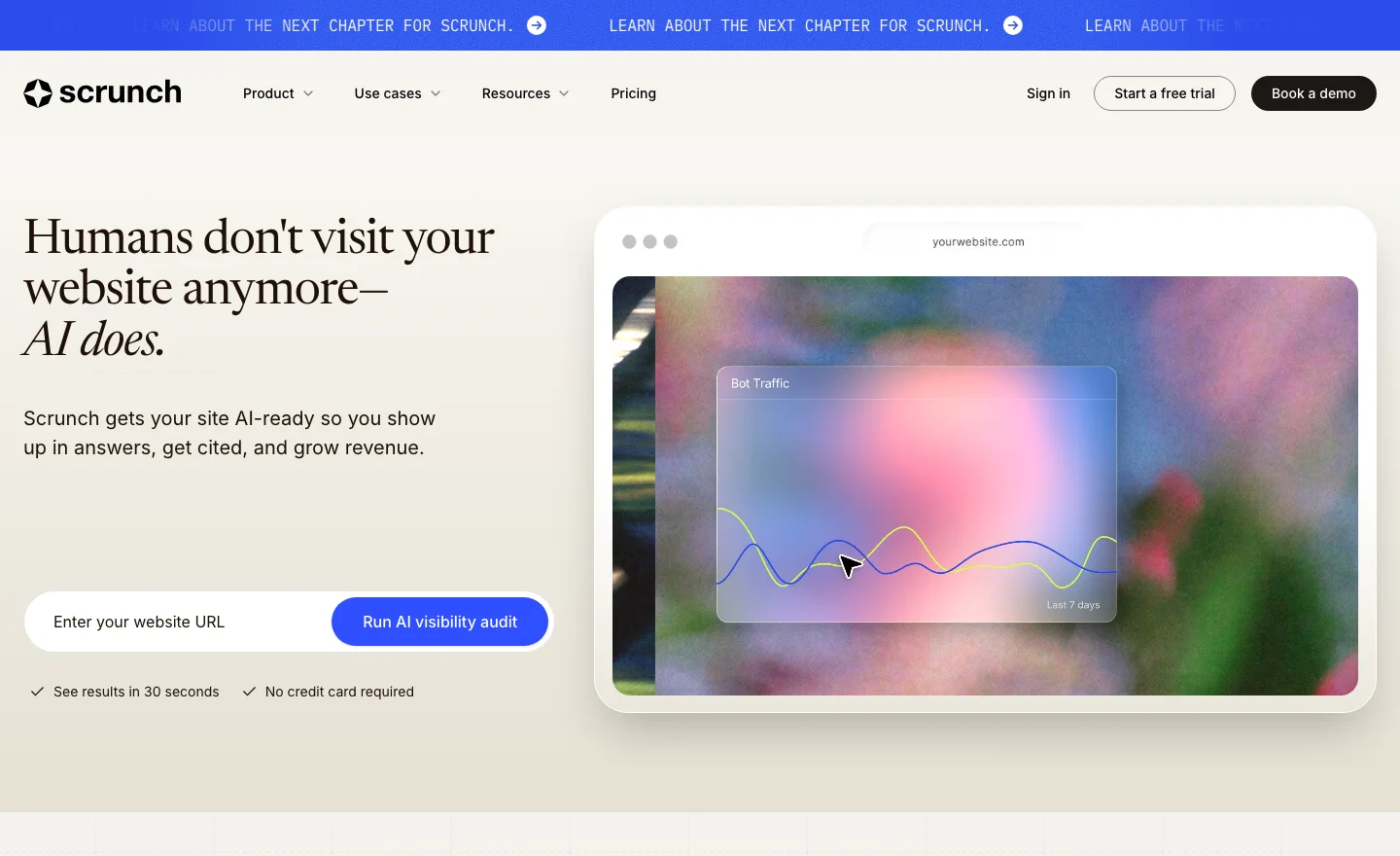
Scrunch's homepage, July 2026 — the pitch is getting your site "AI-ready."
The company positions itself as "The AI Customer Experience Platform," which is broader than pure tracking — and that's deliberate, because its flagship feature isn't a dashboard, it's infrastructure (more on the Agent Experience Platform below).
The facts that most reviews leave out:
- Founded: 2023 in Salt Lake City, Utah. The enterprise platform launched publicly in November 2024.
- Founders: Chris Andrew (CEO) and Robert MacCloy (CTO), both from the early team at Hearsay Systems.
- Funding: ~$19M total — a ~$4M seed (Mayfield, March 2025) and a $15M Series A led by Decibel (closed July 2025), with Mayfield, Homebrew, and angels including TJ Parker (PillPack), Bryant Chou (Webflow), and Clara Shih (ex-Salesforce/Meta AI).
- Traction: 500+ companies and agencies, with named customers including Lenovo, Skims, Crunchbase, and Penn State.
That funding and logo list matter for one reason: Scrunch is a real, durable company, not a weekend wrapper. If you're an enterprise worried about betting on a vendor that vanishes in a year, that's a point in its favor.
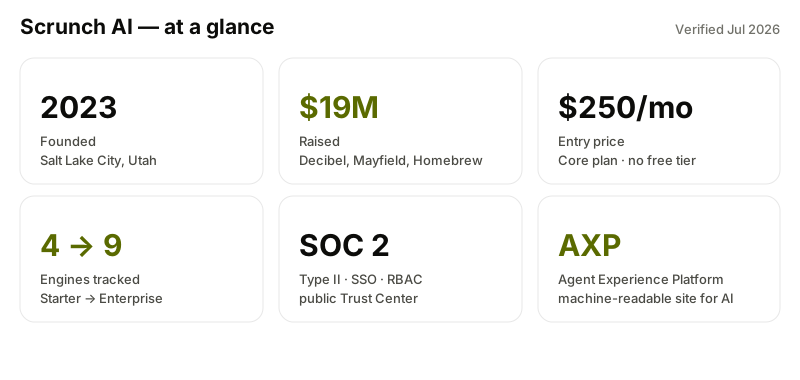
Scrunch AI at a glance
| Scrunch AI | |
|---|---|
| What it is | Enterprise AI-search visibility + optimization platform |
| Best for | Mid-market and enterprise brands + agencies |
| AI engines | 4 on the entry tier; up to ~9 on Enterprise |
| Entry price | $250/mo (Core plan) |
| Free tier | No — 7-day trial only (no card) |
| Standout | The Agent Experience Platform (serves a machine-readable site to AI crawlers) |
| Watch out | $250 floor, key engines gated to Enterprise, prompt credits burn per-engine |
| Security | SOC 2 Type II, SSO (SAML/OAuth), RBAC, Trust Center |
What Scrunch AI does — the full feature set
Most reviews stop at "it tracks your AI visibility." Scrunch is deeper than that. It's organized around a Monitoring layer, an Insights & Optimization layer, two named modules (Knowledge Hub and Journey Mapping), and the Agent Experience Platform underneath. Here's what each actually does, verified against scrunch.com.
Monitoring — the metrics it tracks
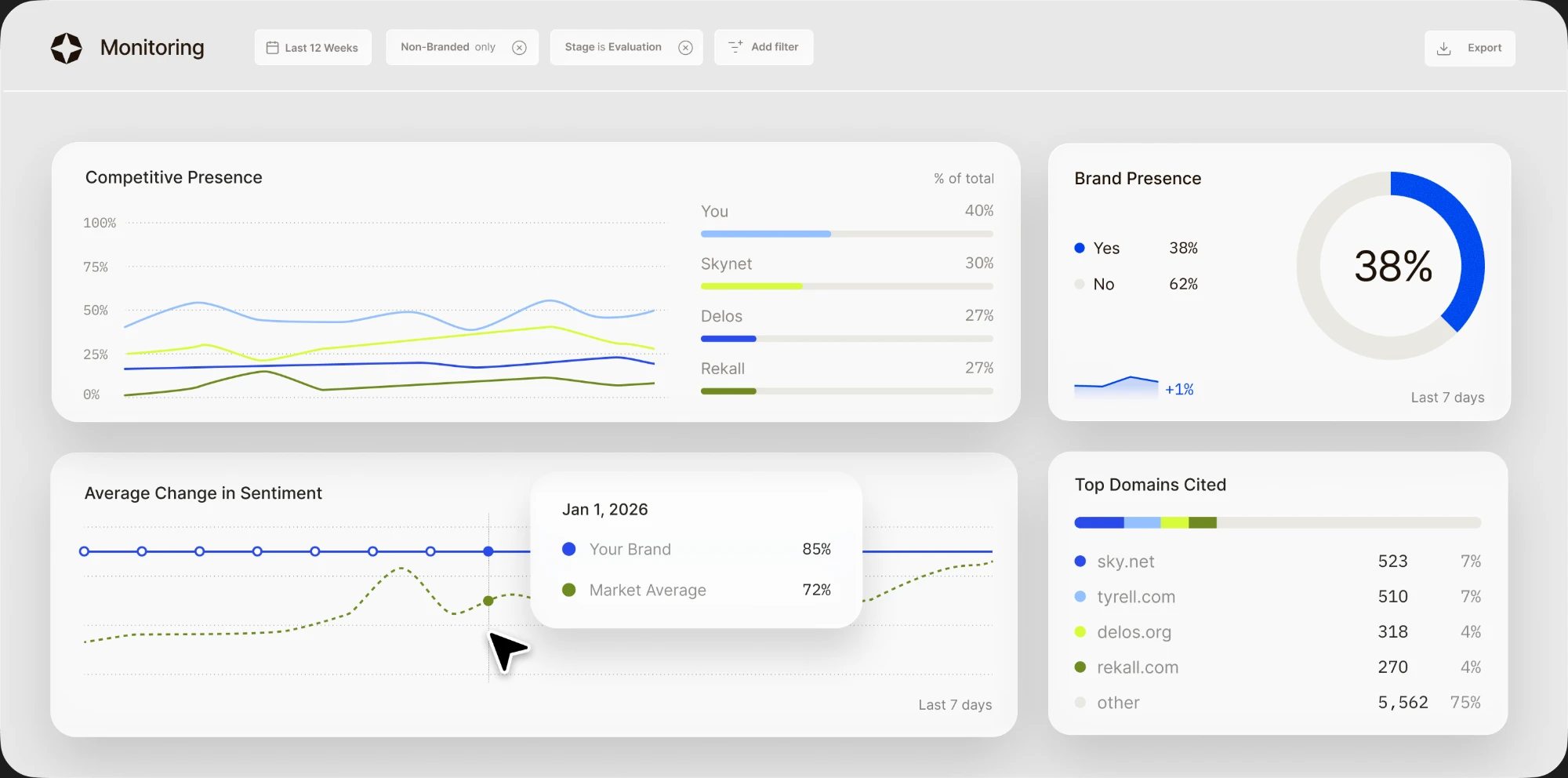
Scrunch's Monitoring view (image via Scrunch). The brands shown — Skynet, Delos, Rekall, Tyrell — are Scrunch's placeholder demo data, not a live account.
The tracking layer is genuinely rich. Scrunch reports:
- Brand presence — how often you're mentioned across tracked prompts and platforms, including where in the answer you land (top, middle, or bottom).
- Position and competitive Share of Voice — the percentage of AI responses that explicitly name you versus competitors, across your tracked prompts.
- Sentiment — whether AI describes your brand positively, neutrally, or negatively.
- Citation sources — your citation share and the top cited domains feeding each answer, so you can see which sources you'd need to earn influence on.
- Prompt analytics — trends, citations, competitors, and rankings per prompt, including "presence by variant" across different phrasings of the same question, and which sources drive your inclusion.
- Competitive benchmarking — by competitor, persona, topic, geography, platform, and time.
Everything is filterable by topic, persona, platform, funnel stage, and country. That's a deeper monitoring layer than most trackers in the category — and the part G2 reviewers most consistently praise for being clean and readable.
Two traffic metrics thinner tools skip
Beyond answer-level metrics, Scrunch splits AI traffic into two distinct things — a distinction lighter tools tend to blur:
- AI referral traffic — real sessions and conversions arriving from ChatGPT, Perplexity, Copilot and the like, pulled in through a Google Analytics connection.
- AI agent (bot) traffic — how often crawlers like GPTBot, ClaudeBot, and PerplexityBot actually hit your site, with a real-time bot feed and trend lines.
One tells you humans are arriving from AI; the other tells you the AI itself is reading you. Both matter, and having them side by side is a genuine strength.
Insights & optimization
The "so what do I do about it" layer:
- Content Gaps — a named, shipped feature that auto-detects the prompts where you have no content (red), thin content (yellow), or solid coverage (green), analyzes where competitors win, and scopes the opportunity for each gap.
- Site Audits / Site Diagnostics — checks crawlability for AI agents, whether meaningful content is served without JavaScript, access controls (e.g. AI user-agents blocked in robots.txt), and load time — then produces a page-by-page roadmap prioritized by "agent citeability." You can take fully-automated fixes or self-serve recommendations.
Honest note: the automated diagnostics are strong, but several reviewers still call the higher-level strategic optimization advice vague. Treat the concrete site audit as the more actionable half.
Knowledge Hub
A single "source of brand truth." It flags discrepancies between your owned content, third-party content, and what AI actually says about you, so you can close accuracy gaps and correct misinformation before it spreads across engines. (Scrunch also references a newer "Knowledge Studio" that pulls internal knowledge from Notion, SharePoint, and similar into an AI-ready source of truth — the naming here is still evolving, so check what's live.)
Journey Mapping
Visualizes how AI agents and crawlers see your business across a buyer's journey — how customers discover and evaluate brands through AI — so you can optimize each touchpoint rather than a single prompt. It's the most "AI customer experience" of the modules, and it's what pushes Scrunch's positioning beyond pure rank tracking.
The Agent Experience Platform (AXP)
This is Scrunch's real differentiator and where most of the Series A money is going. AXP detects AI user agents visiting your site and serves them a clean, machine-readable version of your content — stripping away analytics scripts, tracking pixels, layout shells, and lazy-loaded UI so agents get content they can actually parse and cite, without disrupting the human experience. High-traffic pages are prerendered; the rest are rendered on the fly, which is what makes a heavy JavaScript site crawlable at all. It runs in two modes: Universal Optimization (clean-up and compression) and Adaptive Optimization (which implements approved recommendations and restructures content for agents).
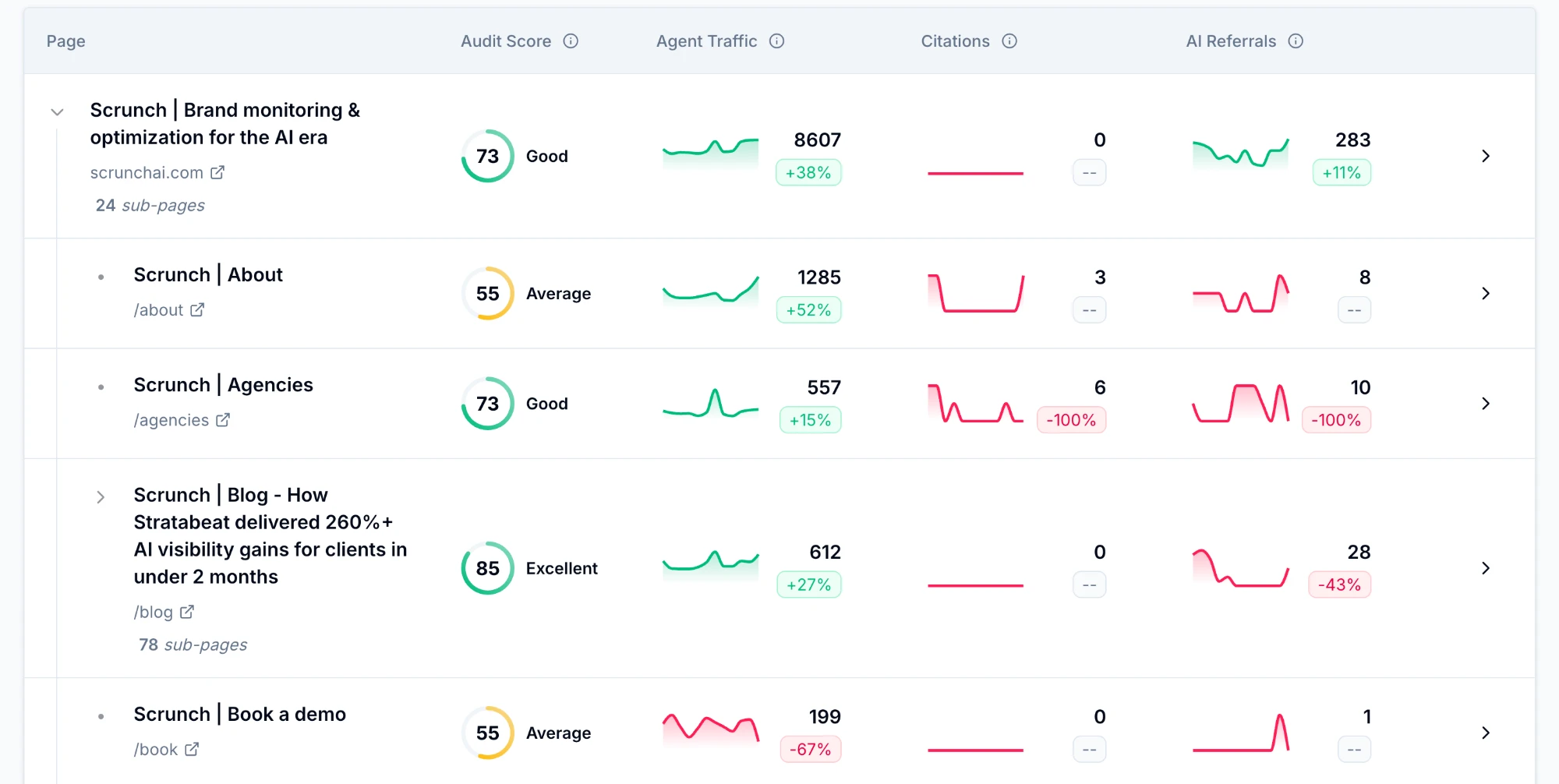
Scrunch's per-page audit view (image via Scrunch), scoring its own site's real pages — scrunchai.com, /about, /agencies, /blog — for agent-readiness. This "citeability" scoring is what AXP's optimization works against.
It's the most forward-looking product in the category — closer to a CDN for AI agents than a tracking dashboard. Three honest caveats most reviews skip:
- It's newer than the marketing implies. At the time of writing, AXP was still in limited rollout. Confirm it's live for your use case before buying on the strength of it.
- Serving different content to bots than to humans has a history. Search engines call the risky version of this "cloaking." AXP is designed to be a legitimate, declared parallel surface — not deception — but you should understand exactly what you're serving and to whom. Ask Scrunch to show you the exact diff between what an agent gets and what a human gets, and keep that diff auditable.
- The CDN story is ambiguous. Site Diagnostics needs no CDN integration, but the edge content-delivery side appears to route through a CDN. Scrunch's own docs aren't crystal clear on whether full AXP delivery requires it — ask before you assume it drops into your stack for free.
How Scrunch collects its data
Worth knowing before you trust the numbers: Scrunch uses a hybrid collection method — browser automation to capture what a real, logged-in user actually sees in tools like ChatGPT and Perplexity, plus official platform APIs where they exist. That matters because an API response isn't always identical to the answer a person sees in the product UI. API-only trackers can drift from reality; a hybrid approach is the more accurate way to do it, and a point in Scrunch's favor.
Which AI engines Scrunch tracks
This is where the sticker price gets slippery, so read carefully.
Scrunch's marketing lists coverage across ChatGPT, Claude, Gemini, Perplexity, Google AI Mode, Google AI Overviews, Meta AI, Microsoft Copilot, and Grok — 9 surfaces. But you don't get all of them on the entry plan. The Core plan tracks exactly 4 engines: ChatGPT, Perplexity, Google AI Overviews, and Copilot. The other five — Claude, Gemini, Meta AI, Google AI Mode, and Grok — are gated to custom-priced Enterprise. (Notably, Scrunch doesn't list DeepSeek at all, even on Enterprise.)
So "9 engines" is an Enterprise number. If you're paying $250/mo for Core, you're seeing four. That's the single most important thing to understand before you budget for Scrunch — and it's the gap most alternatives attack.
Scrunch AI pricing
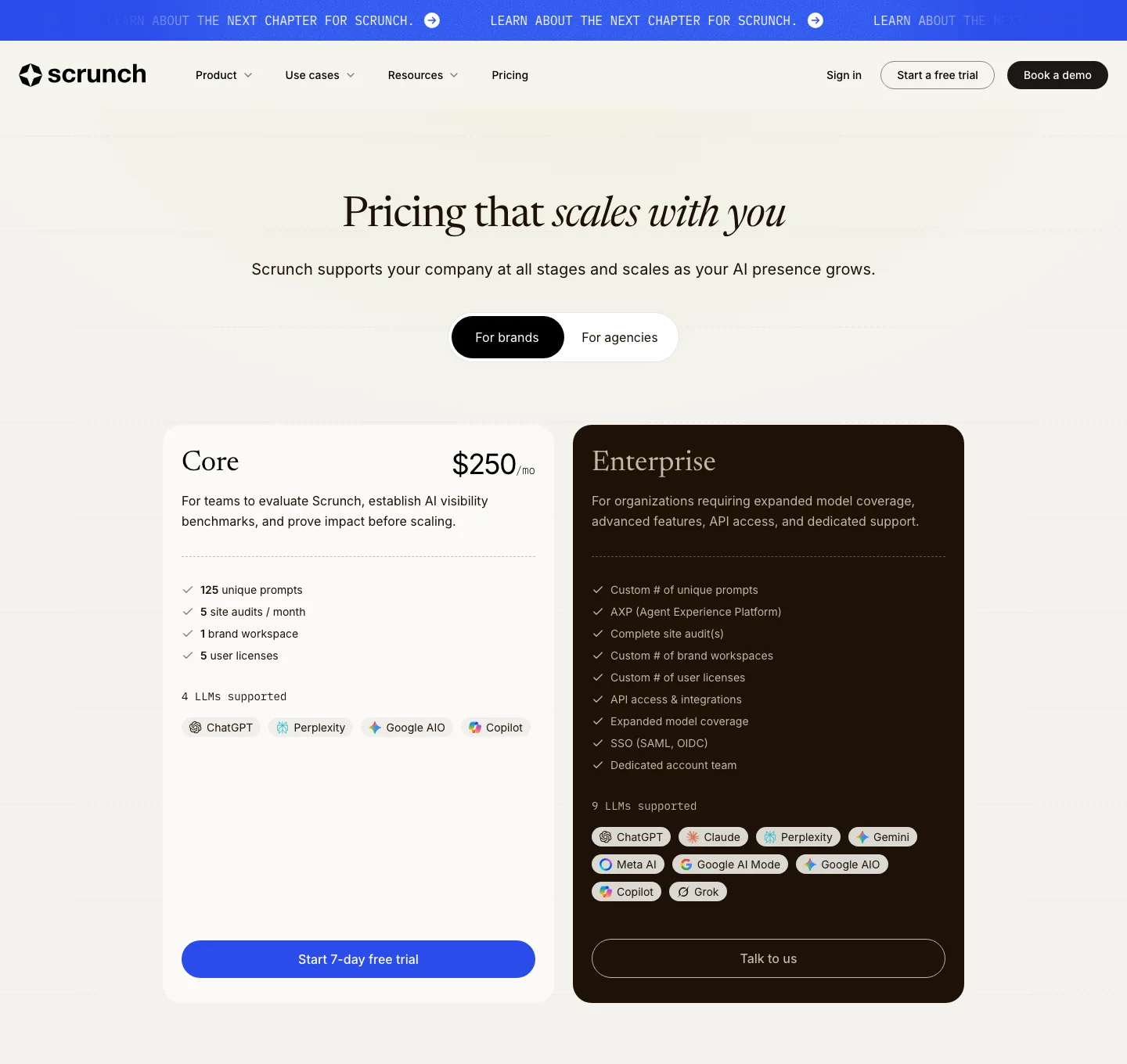
Scrunch's pricing page, July 2026 — for brands, the tiers are Core and Enterprise.
Verified against scrunch.com/pricing on 2026-07-10. For brands, Scrunch shows two tiers — Core and Enterprise — plus a separate "For agencies" view on the same page.
| Tier | Price | Prompts | Workspaces / seats | Engines | Notable |
|---|---|---|---|---|---|
| Core | $250/mo | 125 unique prompts | 1 brand workspace, 5 users | 4 — ChatGPT, Perplexity, Google AIO, Copilot | 5 site audits/mo, 7-day free trial |
| Enterprise | Custom ("Talk to us") | Custom | Custom | 9 — adds Claude, Gemini, Meta AI, Google AI Mode, Grok | AXP, API access, SSO (SAML/OIDC), dedicated account team |
A 7-day free trial of Core is available with no credit card. There is no permanent free tier — the cheapest ongoing option is $250/mo. Scrunch also runs separate agency plans (a "For agencies" toggle on the same pricing page).
Two pricing gotchas reviewers consistently flag:
- Prompt credits burn per engine. Core includes 125 unique prompts, but each engine you track against a prompt consumes against that budget — so spread across all four Core engines, that's roughly ~31 effective unique queries. Model your real prompt × engine volume before you commit.
- Brands vs agencies split. The tiers above are the "For brands" view; Scrunch shows separate agency pricing under a toggle on the same page. Some older reviews also cite stale tier names and per-seat add-ons — so treat scrunch.com/pricing as the source of truth on your buying day.
Scrunch AI capabilities, scored
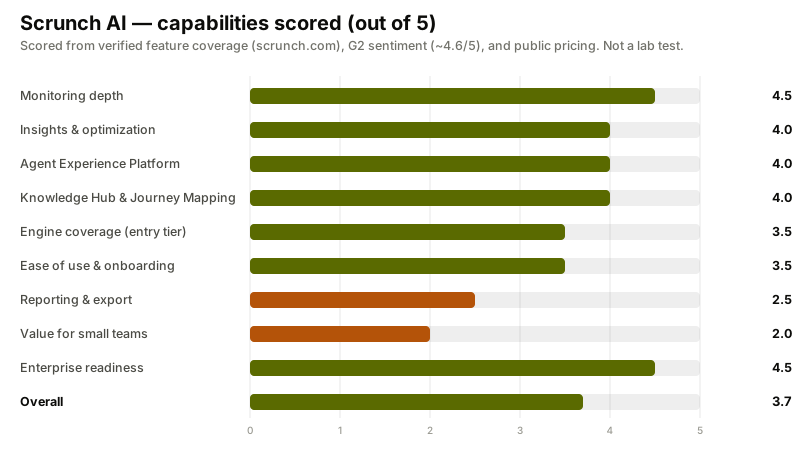
Here's a scored breakdown across the dimensions that actually matter when you're evaluating Scrunch. Unlike vendor scorecards that assert numbers with no method, here's exactly how I scored: each dimension is rated 1–5 from Scrunch's verified feature coverage (scrunch.com, checked 2026-07-10), third-party sentiment (G2 ~4.6/5 across 50+ reviews), and public pricing — not a hands-on lab test. The scores lean toward what a buyer comparing Scrunch to cheaper tools cares about.
| Capability | Score | Why |
|---|---|---|
| Monitoring depth | 4.5 / 5 | Presence + position, Share of Voice, sentiment, citation sources, prompt-variant analytics, and benchmarking — deeper than most trackers |
| Insights & optimization | 4.0 / 5 | Content Gaps and Site Diagnostics are concrete; higher-level strategic advice runs vague |
| Agent Experience Platform | 4.0 / 5 | Genuinely novel agent-facing layer — but newer, limited rollout, and CDN story unclear |
| Knowledge Hub & Journey Mapping | 4.0 / 5 | Accuracy control + AI-journey view that most rivals don't offer |
| Engine coverage | 3.5 / 5 | Up to ~9 surfaces, but only ~4 on the entry tier; the rest need Enterprise |
| Ease of use & onboarding | 3.5 / 5 | Clean, well-liked UI, but setup has a real learning curve |
| Reporting & export | 2.5 / 5 | The single most common reviewer complaint — no clean client reports, thin trend views |
| Value for small teams | 2.0 / 5 | $250/mo floor and per-engine credit burn price out solo users and SMBs |
| Enterprise readiness | 4.5 / 5 | SOC 2 Type II, SSO (SAML/OIDC), RBAC, Trust Center |
| Overall | 3.7 / 5 | A strong enterprise platform held back on price and reporting for smaller buyers |
Scrunch AI pros
- A real, differentiated bet (AXP). No one else in the mainstream AEO set ships an agent-facing site layer. If you believe agent traffic is the future, this is the most forward product in the category.
- Enterprise-grade trust. SOC 2 Type II, SSO (SAML/OAuth via Okta, Azure AD), RBAC, GDPR support, and a public Trust Center. Procurement will be comfortable.
- Well-funded and credible. $19M from Decibel, Mayfield, and Homebrew, plus recognizable enterprise customers. Low vendor-risk.
- Clean, well-liked UI. ~4.6/5 on G2 (50+ reviews), with consistent praise for an intuitive dashboard, useful competitor insights, keyword clustering, and standout human support.
- Both monitoring and optimization in one place, so a serious team isn't stitching two tools together for the analysis half.
Scrunch AI cons
This is where an honest review earns its keep. These come from G2, third-party reviews, and the pricing structure itself:
- The $250/mo floor is steep for solo marketers and small businesses. There's no free tier and no cheap entry.
- Key engines are gated to Enterprise. You pay $250 to see 4 engines; Claude, Gemini, Meta AI, Google AI Mode, and Grok all mean a sales call.
- Prompt credits burn fast across engines, so plans max out quicker than the numbers suggest.
- Reporting and export are weak. Multiple reviewers say there's no clean way to generate client-ready reports, and day-over-day / week-over-week trend visualizations are thin.
- Optimization advice can be vague. It tells you where you're not cited better than it tells you exactly what to change — you still execute elsewhere.
- No Reddit tracking. Reddit is a major source AI engines cite; Scrunch doesn't monitor those threads.
- Setup is involved. Reviewers describe a learning curve and a time-consuming initial configuration.
A note on the stats Scrunch cites (≈40% average referral-traffic lift, up to 4× AI visibility): those are vendor-reported outcomes, echoed by some reviewers, not independently audited. Treat them as marketing claims, not benchmarks.
Who Scrunch AI is for — and who should skip it
Scrunch is a strong fit if you are:
- A mid-market or enterprise brand where AI search is already in your customers' buying journey.
- An agency managing AI visibility for multiple clients who can absorb $250–$500+/mo.
- A team that needs SOC 2 / SSO for procurement.
- A forward-leaning team that specifically wants the AXP agent-facing layer.
Skip Scrunch (for now) if you are:
- A solo founder, indie maker, or small business — the $250 floor and 4-engine entry are hard to justify.
- Someone who just wants to check where you stand across AI engines without a subscription — there's no free tier, so start with a free tool instead.
- A team whose main need is client reporting/export or Reddit monitoring — both are current weak spots.
Scrunch AI vs the alternatives
If Scrunch's price or engine gating is your blocker, you have real options. The short version:
- Cheapest broad engine coverage + a real free tier: FixAEO — 6 engines (ChatGPT, Gemini, Perplexity, Copilot, Google AI Overviews, Google AI Mode) on its $29/mo Lite tier, a $79/mo Growth tier that adds daily rescans, 5 brands, and 50 prompts, plus a free-forever daily scan and 22 free tools. It's the self-serve opposite of Scrunch's enterprise motion (disclosure: it's mine).
- Deepest enterprise demand data: Profound — Prompt Volume data on what people actually ask AI, from $99/mo (ChatGPT only) up to enterprise.
- Widest engine list for the price: RankScale — 17+ engines from ~$20/mo on a credit model.
- Clean marketing-team analytics: Peec AI — transparent tiers, unlimited seats.
Here's how the shortlist stacks up against Scrunch on the numbers that drive most switches:
| Tool | Entry price | Engines (entry) | Free tier | Best for |
|---|---|---|---|---|
| Scrunch AI | $250/mo | ~4 | No — 7-day trial | Mid-market/enterprise + agencies |
| FixAEO | $29/mo ($25 annual) | 6 | Yes — free-forever + trial | Founders & small teams |
| FixAEO Growth | $79/mo ($68 annual) | 6 | Yes — free-forever + trial | Growing teams wanting daily scans |
| Profound | $99/mo | 1 (Starter) / 3 (Growth) | No | Funded enterprise, demand data |
| Peec AI | $95/mo | 3 of 7 (add-ons) | No — trial | Marketing teams, clean dashboards |
| RankScale | ~$20/mo | 17+ (all included) | No — trial + free audit | Widest coverage, lowest entry |
| AthenaHQ | Free, then $295/mo | 5 / 8 | Yes — Essential tier | Enterprise analytics on a free start |
The through-line: Scrunch's entry price is the highest in this group while its entry-tier engine count is among the lowest, because the coverage it's known for lives on Enterprise. That's the exact gap the cheaper self-serve tools exploit.
For the full head-to-head with prices and free-tier details on all nine, see the best Scrunch AI alternatives for 2026.
Is Scrunch AI worth it? The verdict
Scrunch is a serious, well-built, well-funded platform, and the AXP bet makes it the most interesting tool in the category. If you're an enterprise or a funded agency, AI search is already driving pipeline for you, and you can spend $250–$500+/mo (realistically Enterprise for full coverage), it earns a spot on your shortlist — especially if the agent-facing site layer fits your roadmap.
But it's an enterprise product priced like one. The $250 floor, four-engine entry tier, and demo-gated full coverage put it out of reach for the founders and small teams who make up most of the AEO market. If that's you, the honest move is to start with a free or self-serve tool, prove that AI search matters for your brand, and only graduate to something like Scrunch when the budget and the need are both real.
How I researched this
Every price, tier, and engine count above came from scrunch.com and scrunch.com/pricing, fetched on 2026-07-10. The feature detail — Monitoring metrics, the AI referral vs agent-traffic split, Content Gaps, Site Diagnostics, Knowledge Hub, Journey Mapping, and AXP's two optimization modes — was verified against Scrunch's own product, guide, and FAQ pages, not a competitor's summary. Where a module's live page was JavaScript-rendered and couldn't be read directly (Knowledge Hub, Journey Mapping), I said so and marked those as confirmed by URL plus Scrunch-authored descriptions rather than full page copy. Funding figures come from the company's Series A announcement (PRNewswire, July 2025) and investor confirmations. Sentiment and the pros/cons draw on G2 (~4.6/5, 50+ reviews) and independent review blogs, cross-checked against the pricing structure itself. Where a claim was vendor-reported (traffic-lift and visibility multipliers), I labeled it as such rather than presenting it as verified. Where numbers move often — prompt counts, packaging names — I said so and pointed you to the live page. The two product screenshots are Scrunch's own interface, shown via Scrunch for illustration and labeled as such — the Monitoring view uses Scrunch's placeholder demo brands (Skynet, Delos, Rekall), not live data, while the page-audit view shows Scrunch's own real pages; every other figure is my own original diagram, not vendor marketing.
FAQ
What is Scrunch AI?
Scrunch AI (scrunch.com) is an enterprise AI-search visibility and optimization platform. It tracks how your brand appears in AI answers across engines like ChatGPT, Perplexity, and Google AI Overviews, tells you where you're not cited, and — via its Agent Experience Platform — serves a machine-readable version of your site to AI crawlers. It was founded in 2023 in Salt Lake City by Chris Andrew and Robert MacCloy and has raised about $19M.
How much does Scrunch AI cost?
Scrunch's Core plan is $250/mo — 125 prompts, 1 brand workspace, 5 users, and 4 engines (ChatGPT, Perplexity, Google AI Overviews, Copilot). Full 9-engine coverage plus AXP, API access, and SSO sit on custom-priced Enterprise. There's a 7-day free trial with no card, but no permanent free tier. Agencies have separate plans.
How many AI engines does Scrunch track?
9 on Enterprise — ChatGPT, Claude, Gemini, Perplexity, Google AI Mode, Google AI Overviews, Meta AI, Copilot, and Grok (no DeepSeek). But the entry Core plan tracks just 4 (ChatGPT, Perplexity, Google AI Overviews, Copilot); the other five are gated to Enterprise.
What is Scrunch's Agent Experience Platform (AXP)?
AXP serves a clean, lightweight, machine-readable version of your website directly to AI agents and crawlers, separate from your human-facing site, so LLMs can read and cite your content more reliably. It's Scrunch's flagship differentiator. Note it was still rolling out at the time of writing, and serving bots different content than humans is something to implement carefully.
Does Scrunch AI have a free trial or free plan?
There's a 7-day free trial of the Core plan with no credit card required, but no permanent free tier. If you want to check your AI visibility for free on an ongoing basis, a tool like FixAEO offers a free daily scan instead.
Is Scrunch AI worth it?
For mid-market and enterprise brands (and agencies) where AI search already drives buying decisions and the budget supports $250–$500+/mo, yes — especially if the AXP agent layer fits your plans. For solo founders and small teams, it's likely overkill; a free or self-serve tool is the better starting point.
What are the best Scrunch AI alternatives?
The strongest are FixAEO (free tier + 6 engines at $29/mo, with a $79/mo Growth tier), Profound (enterprise demand data), Peec AI (clean analytics), RankScale (widest engine list, from ~$20/mo), and AthenaHQ (enterprise analytics with a free Essential tier). See the full Scrunch AI alternatives guide for prices and trade-offs.
Related reading
9 Best Scrunch AI Alternatives in 2026 (Tested & Priced)
9 Scrunch AI alternatives compared on engines, price, and free tiers — honest picks by budget. Several cost a fraction of Scrunch's $250/mo, one is free.
20 min read12 Best Answer Engine Optimization Tools (2026)
12 answer engine optimization tools compared — engines covered, entry price, free tier — with honest takes on which to pick by stage and budget.
19 min read7 Best Profound Alternatives & Competitors in 2026
7 Profound alternatives compared on price, engine coverage, and free tiers — an honest buyer's guide for teams priced out of enterprise AEO.
20 min read8 Best Peec AI Alternatives in 2026 (Hands-On Tested)
8 Peec AI alternatives compared — engines, entry price, free tier — with honest picks by budget. One has a real free tier Peec doesn't.
23 min readWhat is AEO? Answer Engine Optimization explained
Answer Engine Optimization (AEO) means getting AI assistants to recommend your brand. Learn what AEO is, why it matters more than SEO, and how to start.
18 min read
Free AEO tools
Put this into practice with free FixAEO tools — no signup required.
AI Visibility Checker
Score your brand across 9 AI engines
AEO Audit Tool
Answer-engine readiness scan
Schema Generator
Build valid JSON-LD structured data
llms.txt Generator
Create a spec-compliant llms.txt
Sitemap Validator
Check your XML sitemap for errors
AI Content Grader
Grade content for AI citation readiness
Find the gap. Then fix it.
Check how AI engines find, describe, and cite your site. Free, no signup. On a paid plan, AI Marketer can turn the evidence into briefs, drafts, optimizations, and reports.