The best AI SEO tools in 2026 (free and paid)
AI SEO is two jobs: using AI to do SEO faster, and getting AI search to recommend you. Here are the tools I trust for both, ranked by who they actually fit — startup, agency, or enterprise.

On this page

Every "best AI SEO tools" list I've read this year makes the same mistake. It picks a lane — either "AI writes your content" or "AI answer engines cite you" — and ignores the other half. In practice, most teams need both, and the shortlist you actually want depends on whether you're a startup that just needs a signal, an agency running ten brands, or an enterprise buyer with a procurement checklist.
I build one of the tools in the AI-visibility half of this list (FixAEO), so I've spent the last eighteen months looking at every serious tool in the category — how they rank, how they price, and where each one breaks. This is the list I give founders and marketing leads when they email me. It's opinionated. I'll tell you where FixAEO wins and where I'd send you to a competitor instead.
Curious how your site does?
See how AI engines describe your site — free, about 60 seconds, no signup.
The two kinds of "AI SEO" tool
Before you shortlist anything, you have to answer one question: which job are you buying for?
| Job | What the tool does | Examples |
|---|---|---|
| Use AI to do SEO | Write, optimize, and research content with AI. The output is a page, a brief, or a keyword cluster. | Surfer, Jasper, Frase, Semrush AI |
| Get found by AI search | Track and improve how AI assistants — ChatGPT, Claude, Perplexity, Gemini, and the rest — describe and recommend you. | FixAEO, Profound, Peec AI, Otterly, AthenaHQ |
The first job is a mature market with old-guard players who've bolted AI onto existing SEO suites. The second is the new one — barely two years old, and where most of 2026's real budget is going, because it's the job that changes whether a buyer ever hears about your brand in the first place.
The line is blurring. Surfer, Semrush, and Ahrefs have all shipped AI-visibility features. Those are useful add-ons, but they're not the same product as the purpose-built AEO tools. If AI visibility is the KPI you actually care about, an add-on won't cut it. If your team lives in Semrush anyway, the add-on is often enough to get started.
For an AEO-only comparison, see the deep dive in best AEO tools in 2026. For the subset of tools that go beyond assisting and act on their own — fixing pages, drafting and publishing — see the best AI SEO agents.
Six things I look for in an AI SEO tool
I've watched too many teams buy the wrong tool because the demo looked slick. Here's the filter I use before short-listing anything.
- Engine coverage. How many AI engines does it actually track? Two? Three? Nine? Coverage matters because ChatGPT, Perplexity, Gemini, Claude, Grok, Copilot, DeepSeek, Google AI Overviews, and Google AI Mode all recommend different brands. A tool that only checks ChatGPT is checking a fraction of your surface area.
- Free path to signal. You should be able to run a real scan before you enter a credit card. Anything less is a signal the tool is built to close on procurement, not to deliver value.
- Multi-brand support. Agencies need it from day one. So do multi-product SaaS companies. If the tool only holds one brand cleanly, you'll outgrow it in a month.
- The fix, not just the score. Any tool can tell you your visibility is 12%. The tools worth paying for tell you which page to change and what to add to raise it.
- Public pricing. If pricing is "contact sales" on a $500/mo plan, the vendor doesn't actually want a small-team customer, and support will reflect that.
- A real data connector. If AI visibility is going to be a KPI, it needs to sit next to your other KPIs. Look for GA4 attribution, a rank-tracking API, or an MCP server — something that gets the data out of the dashboard.
Every recommendation below is scored against those six.
Tools for getting cited by AI (AEO / AI visibility)
This is the category that barely existed in 2024 and is now crowded. These tools tell you whether AI engines name your brand, what they say about you, and what to fix.
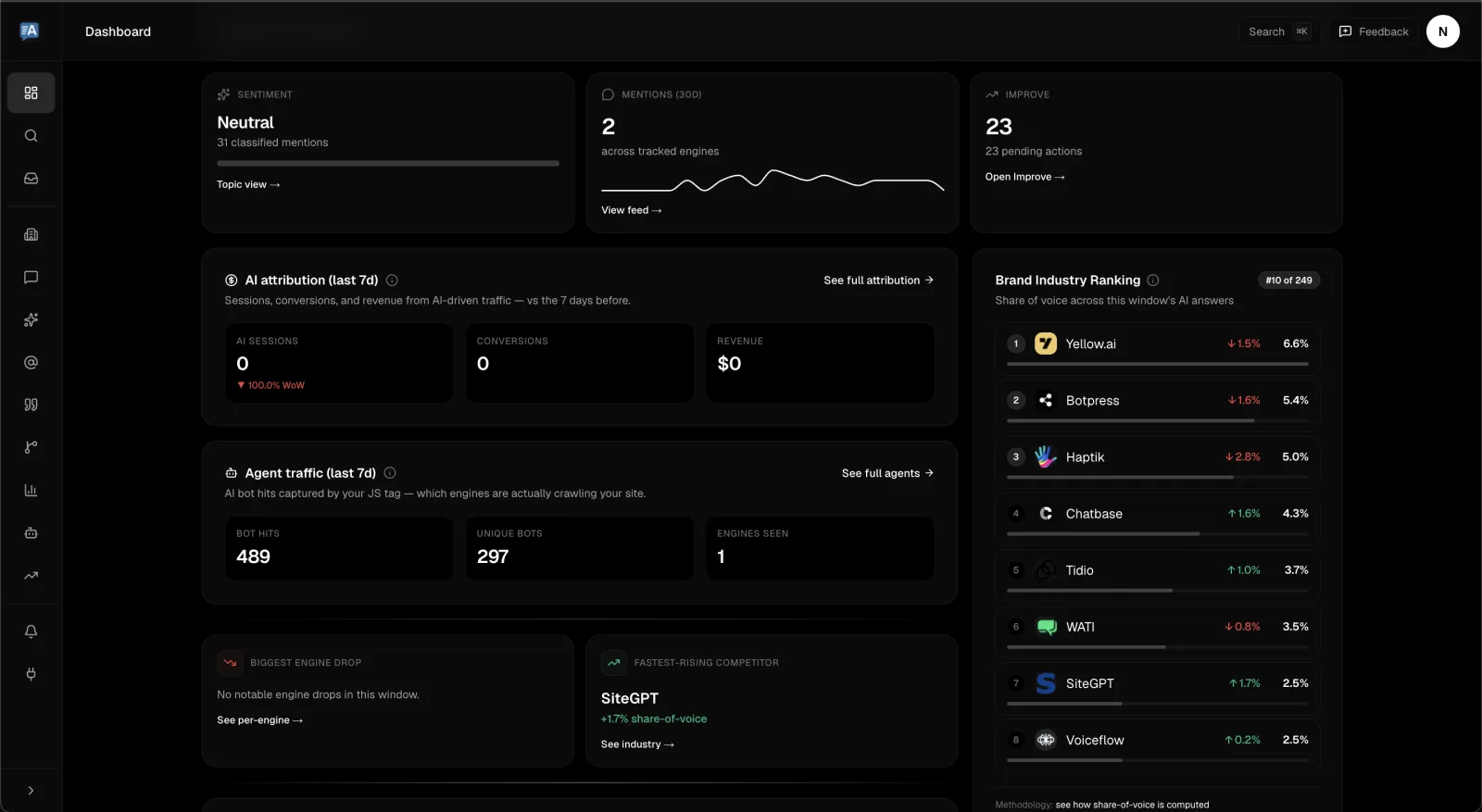
InsiteChat's share of voice across AI answers vs competitors — tracked in FixAEO. The panel to look at first: which prompts you appear on, which prompts your competitors own.
FixAEO — best all-round pick, best free option
Best for: startups that want a real signal today, agencies running many brands, and enterprises that want the broadest engine coverage in the category without an enterprise-only price.
FixAEO is the tool I built. I'll tell you what it does honestly, and where the competition genuinely wins.
FixAEO tracks how nine AI engines — ChatGPT, Claude, Copilot, Gemini, Perplexity, Grok, DeepSeek, Google AI Overviews, and Google AI Mode — describe and recommend your brand. It then converts the gaps into a prioritized action board: which page to change, what to add, and how to prove the fix worked once you shipped it.
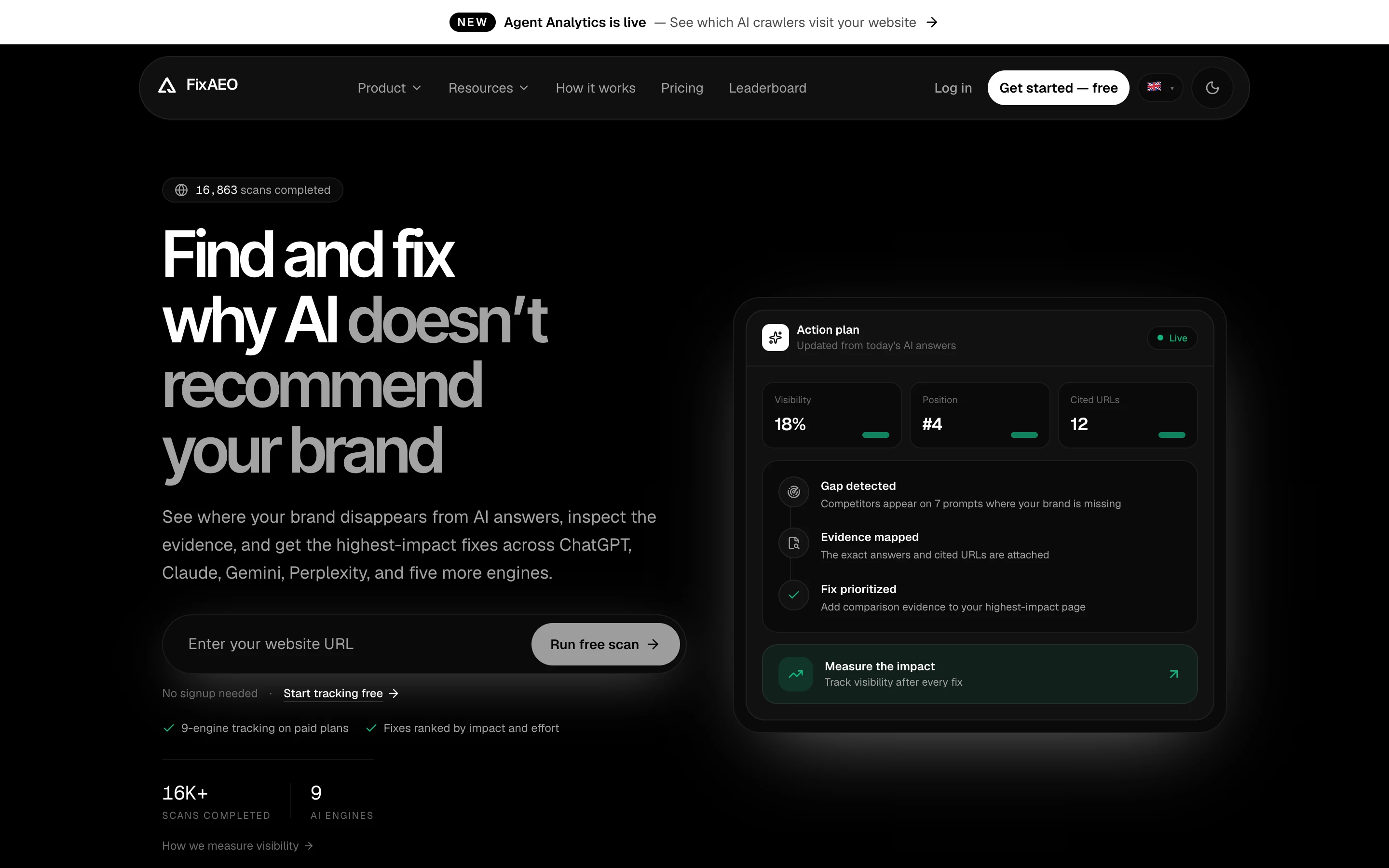
The FixAEO home. Paste a URL, get a real Gemini-powered scan, no signup. Paid plans add the other eight engines, daily refresh, and the fix workflow.
What I lean on internally to keep it ahead of the pack:
- The broadest engine coverage in the category. Nine engines, updated as new engines launch (we added AI Mode within a week of Google shipping it).
- A genuinely free tier. A Gemini-powered scan plus 24 free tools (schema generator, llms.txt validator, robots.txt tester, sitemap validator, more) with no signup. This is the part most competitors skip.
- Cutting-edge AI on the recommendation engine itself. Every action plan is grounded in the same LLM stack our customers are trying to appear in — the tool that recommends fixes uses the same reasoning surface AI search does.
- Multi-brand out of the box. Growth ($79/mo) covers five brands; Enterprise is unlimited. Agencies I work with run their entire portfolio in one workspace.
- A rank-tracking API and an MCP server. Your AI visibility data flows into your own stack — into a Claude Code session, into Cursor, into whatever BI or agent framework you're already running.
| Free tier | Gemini-powered scan + 24 tools, no signup |
| Lite | $29/mo ($25/mo yearly) — 6 engines, 72h refresh, multi-domain, alerts |
| Growth | $79/mo ($68/mo yearly) — daily rescans, 5 brands, 50 tracked prompts |
| Enterprise | Custom — 9 engines, SSO, unlimited brands, dedicated support |
| Strength | Free start, widest engine coverage, cutting-edge fix workflow, works at every company size |
| Weaker on | If your procurement mandates SOC 2 Type II today, we're mid-cert |
Run a free scan or open the AI rank tracker.
Profound — the enterprise sales-led option
Best for: enterprise marketing teams with budget, a procurement process, and a preference for a sales-led motion.
Profound leans hard into enterprise. Sales-led, custom pricing (typically five figures a year), and their headline data is prompt-volume estimates sourced from real AI conversations. If your buyer wants a well-known enterprise vendor and pricing isn't the constraint, they're a solid choice. Overkill for a solo founder or a five-person startup. Their "agents" feature is genuinely interesting for hands-off account work.
Peec AI — best for BI-integrated marketing teams
Best for: marketing teams that already run a BI stack and want AI-visibility data piped into Looker or a warehouse.
Peec's core is tracking mention rate, position, and sentiment, with CSV exports and Looker integrations that just work. Public pricing from around €85/mo. No permanent free tier — you'll do a demo before you scan. If your data lives in Looker and you want AI mentions as a native dimension, this is a good fit.
Otterly — the content-team pick
Best for: content teams that want pre-publish scoring and light AEO tracking bundled with content workflows.
Otterly frames itself as a GEO research platform from around $29/mo. It's a decent option if your primary buyer is a content lead who cares about scoring drafts before they publish. Coverage is thinner than FixAEO or Profound; that's the tradeoff for the price.
AthenaHQ — the sentiment-and-hallucination angle
Best for: teams that want sentiment analysis and hallucination detection alongside AI-visibility tracking, plus BI integrations.
AthenaHQ has a limited Essential free tier (300 credits/mo, 5 models), then a $295/mo paid floor. It's enterprise-leaning — if the AI is saying wrong things about your brand and detecting that specifically is what you want to buy, they're strong here.
AI tools for traditional SEO (content and on-page)
This is the older half of the market. These tools use AI to help you produce and optimize content faster. Their core job is the writing and on-page work; several have added their own AI-visibility tracking (I'll flag which).
Surfer SEO
Best for: optimizing a draft against what's already ranking in Google.
Surfer now positions itself as an "AI search and content intelligence platform." It scores your content against live SERP and NLP data, and has added tracking for how you appear in ChatGPT, Gemini, and Perplexity. Paid from $49/mo (Discovery, billed yearly), with a free option to start. If you're publishing content weekly and want your drafts to hit an on-page score before you publish, Surfer is still the best in class. Their AI-visibility feature is a useful add-on, not a replacement for a dedicated tool.
Jasper
Best for: marketing teams producing content at volume with brand-voice consistency.
Jasper is an AI copywriting and content platform with brand-voice controls, templates, and workflows. Paid from $59/mo (Pro, billed yearly), with a 7-day free trial. Good fit for content ops teams shipping 20+ pieces a month across social, blog, and email. Weaker if your bottleneck is research and structure rather than writing volume.
Frase
Best for: turning a keyword into a research-backed brief in under an hour.
Frase now calls itself a "content operating system for AI search." It researches a topic, drafts it in your voice, publishes to your CMS, and scores it for both search and AI. Paid from $39/mo (Starter, billed yearly), with a 7-day free trial. The tool I'd pick if the biggest bottleneck is briefs — writers can turn Frase output into shippable posts fast.
All-in-one SEO suites that added AI
If you already pay for a full SEO suite, you may not need a separate AI tool right away.
Semrush
The full SEO suite (keywords, backlinks, audits) from $139.95/mo (Pro). Semrush now sells a separate AI Visibility Toolkit at $99/mo per domain to track brand mentions in AI answers, or a Semrush One bundle from $199/mo that combines both. Fine if you already live in Semrush; the per-domain price gets expensive fast if you run more than one brand.
Ahrefs
A leading SEO toolset. Their Brand Radar tracks brand visibility across AI answers (AI Overviews and AI Mode, ChatGPT, Perplexity, Copilot, Gemini, Grok) plus YouTube and Reddit, billed as the largest AI-visibility database. Paid, alongside Ahrefs' core backlink and keyword tools. Good if you're already an Ahrefs customer; not the tool I'd add if your only need is AI visibility.
The 24 free tools inside FixAEO you can use right now
Most tool comparisons skip the free stuff, but the free tier is where I've seen more teams get started than anywhere else.
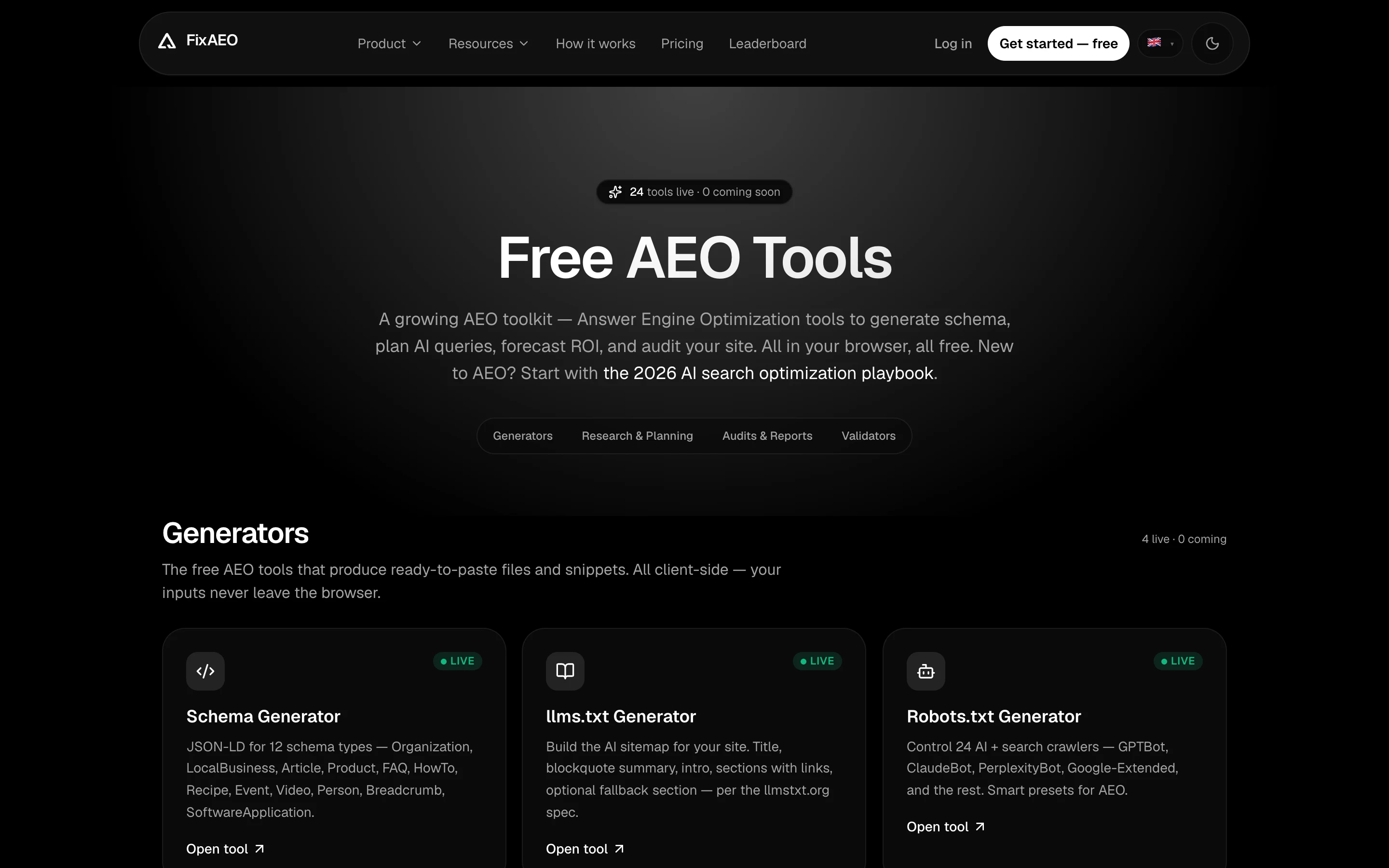
The free FixAEO toolkit — schema generator, llms.txt generator, robots.txt controls, and more, all client-side and zero-signup.
Some of the ones I get emails about most:
- Schema generator — JSON-LD for twelve schema types (Organization, LocalBusiness, Article, Product, FAQ, HowTo, Recipe, Event, Video, Person, Breadcrumb, SoftwareApplication).
- llms.txt generator + validator — build and check the AI sitemap for your site per the llmstxt.org spec.
- Robots.txt generator — control 24 AI + search crawlers with smart AEO presets (GPTBot, ClaudeBot, PerplexityBot, Google-Extended, and the rest).
- Sitemap validator — check your XML sitemap actually works.
- AI content grader — score a draft for how likely it is to get cited.
Every one of them runs in your browser. No data leaves the tab. If your team hasn't touched llms.txt or schema in a year, run the validators before you buy anything.
AI SEO tools by company size
The right tool depends on what stage your company is at. Here's how I'd actually pick.
If you're a startup or solo founder
Start with the FixAEO free tier and one content optimizer's free trial. Total cost to start: $0. Run one scan, look at the fixes, and ship the top two. If you find yourself running the same manual scans twice a month, upgrade to Lite ($29/mo). You do not need Profound, Peec, or an enterprise contract yet.
If you're an agency
You need multi-brand, a portfolio view, and a way to explain the numbers to non-technical clients. FixAEO's Growth tier ($79/mo, 5 brands, daily rescans) is priced for exactly this. If you run more than five brands, either the Growth+ tier or Enterprise makes sense. Alternatives worth trialing: Peec if your clients want the data in Looker; Profound if your buyer is a Fortune 500 CMO who wants an enterprise vendor name on the invoice.
If you're an enterprise
You'll want breadth (nine engines), SSO, SOC 2, and a real data pipeline into your existing stack. FixAEO Enterprise covers the first two and offers the API + MCP server for the pipeline, but it does not claim SOC 2 certification. Profound is the sales-led alternative if procurement is set on a vendor with a mature compliance program and a large sales team. Semrush and Ahrefs are worth adding for their core SEO work; their AI-visibility add-ons are useful but I wouldn't rely on them as your primary AEO signal.
The tools I actually reach for day-to-day
Here's what my browser looks like on a normal working day, in the order I open them:
- FixAEO — for the visibility dashboard and the daily action list on our brands and our customers' brands.
- Perplexity — for research on any topic. Faster than opening ten tabs.
- Frase — when I'm drafting a new pillar page and need a brief in twenty minutes.
- Ahrefs — for the backlink and keyword data we still care about, and to see which pages Google is ranking us on before AI engines even see them.
- The FixAEO Chrome extension — I check any competitor's landing page and see their AI visibility in one click.
No Jasper (I prefer to write the first draft myself). No Semrush (Ahrefs covers what I need). Your stack will be different — that's fine. The point is: I only pay for what I open every day.
Common mistakes when picking an AI SEO tool
I see the same three mistakes over and over.
Mistake 1: buying for the demo, not the daily use. Every tool in this list has a good demo. What matters is whether you'll actually log in three months from now. Ask: which report will I open every week? If you can't name it, don't buy yet.
Mistake 2: assuming ChatGPT-only tracking is enough. ChatGPT is ~60% of the AI search market by usage, but Perplexity dominates for research, Google AI Overviews are eating the SERP, and Claude is where most technical buyers ask questions. A tool that only tracks one engine is telling you the score of one inning of a nine-inning game.
Mistake 3: skipping the fix workflow. A visibility number without a "what to change" list is a vanity metric. When you demo a tool, ask them to walk you through a specific gap and show you exactly what they'd tell you to edit on your site. The tools that hesitate here are the ones you'll cancel in month three.
Which should you pick?
- Publishing a lot of content? Start with Surfer or Frase for optimization; Jasper if you need volume.
- Worried AI doesn't mention your brand? Start with an AEO tool. FixAEO is free to check; move to Profound or Peec if you need enterprise depth or BI integration.
- Already on Semrush or Ahrefs? Use their AI features first, then add a dedicated AEO tool when AI visibility becomes a real KPI.
- Solo or small budget? FixAEO free tier + a content optimizer's trial covers most of what you need at $0 to start.
- Agency? FixAEO Growth for the portfolio; add Peec if your clients live in Looker.
- Enterprise? FixAEO Enterprise for breadth and the data pipeline; Profound if procurement wants a sales-led vendor.
The honest take: in 2026, "AI SEO" increasingly means the second job. Your content can be perfect and still be invisible if ChatGPT recommends a competitor. Tracking and fixing that is the part most teams haven't started yet — which is exactly why the ones who start now win the next twelve months.
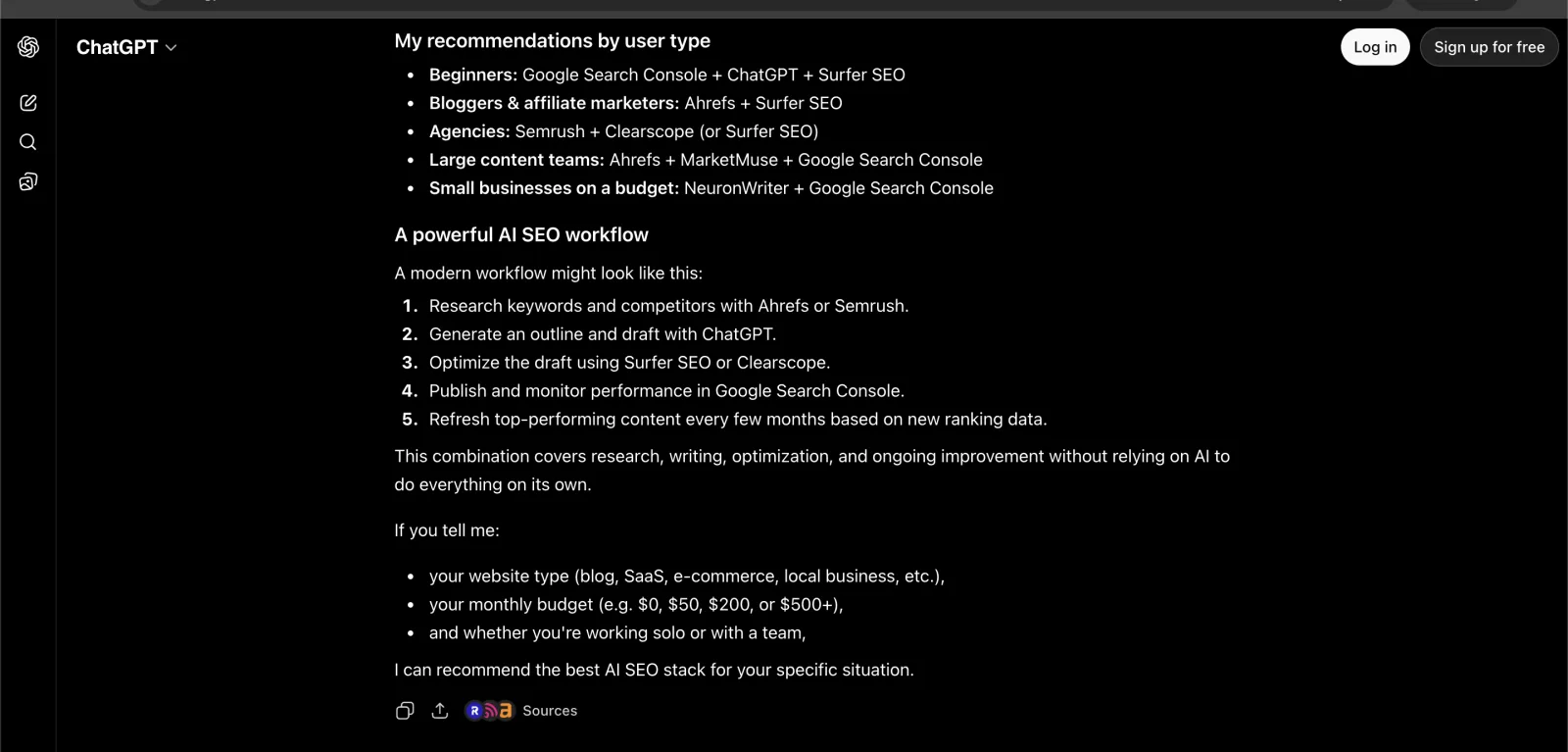
Example: ChatGPT (logged out) recommending AI SEO tools by user type. Being the answer to "best AI SEO tools" is the whole game.
FAQ
What's the best free AI SEO tool?
For AI-visibility (AEO), FixAEO has a genuinely free tier — a Gemini-powered scan plus 24 tools, no signup required. Most content tools (Surfer, Jasper, Frase) are paid with free trials rather than permanent free tiers.
Is AI SEO the same as AEO or GEO?
Not quite. "AI SEO" usually means using AI to do regular SEO faster. AEO (answer engine optimization) and GEO (generative engine optimization) mean optimizing so AI assistants cite you. See AEO vs SEO and GEO vs AEO vs SEO for the full breakdown.
Do I need both kinds of tool?
Eventually, yes. A content tool helps you produce good pages; an AEO tool tells you whether AI search actually surfaces them. They solve different halves of the same problem. Start with the one that solves your bigger bottleneck today.
Will an AI writing tool get me cited by ChatGPT?
It helps you publish faster, but being cited depends on authority, structure, and being a recognized entity — not just volume. That's what AEO tools measure and what a writing tool can't fix on its own.
Which AI SEO tool is best for agencies?
FixAEO's Growth tier is priced for agencies — five brands, daily refreshes, portfolio view, and multi-brand alerts. If your clients want data in Looker, add Peec AI. If a client asks specifically for Profound, that's a fine addition too, but don't lead with it.
Which AI SEO tool is best for enterprises?
FixAEO Enterprise for breadth (nine engines) and the API/MCP integration into your existing stack. Profound if procurement is set on a large sales-led vendor. Both work; the question is whether your buying process rewards vendor size or product coverage.
How much should a small team budget for AI SEO tools?
Under $100/mo will cover you for a while. A FixAEO Lite subscription ($29/mo) plus one content optimizer trial gets a small team started. You can add a suite (Semrush or Ahrefs) once you have data to justify the spend.
What about Ahrefs Brand Radar and Semrush AI Visibility?
Both are good add-ons if you already pay for the suite. Neither is my first pick if AI visibility is your primary KPI — a purpose-built AEO tool will beat a bolt-on for the fix workflow every time. Use them as secondary sources.
Want to see where you actually stand right now? Run a free FixAEO scan — check how all nine AI engines describe your brand, no signup needed. If you're an agency or enterprise, open the AI rank tracker or book a demo to see the multi-brand workflow.
Related reading
12 Best AI SEO Agents for 2026: What They Actually Automate (and What They Don't)
A sourced look at 12 real AI SEO agents for 2026 — technical fixers, content generators, and visibility-action tools — with honest autonomy verdicts, plus one 'agent' that just buys ChatGPT ads.
62 min read12 Best Answer Engine Optimization Tools (2026)
12 answer engine optimization tools compared — engines covered, entry price, free tier — with honest takes on which to pick by stage and budget.
19 min readBest AI Search Engines in 2026: I Tested All 15
I tested 15 AI search engines for a month — Perplexity, ChatGPT, Gemini, Claude, Grok and more. An honest ranking of which to use and what each does best.
37 min readWhat is AEO? Answer Engine Optimization explained
Answer Engine Optimization (AEO) means getting AI assistants to recommend your brand. Learn what AEO is, why it matters more than SEO, and how to start.
18 min readGenerative Engine Optimization Tool: What to Look For
A generative engine optimization tool tracks whether AI engines cite your brand. Here's what a real GEO tool does, how I built one, and how to pick the right one in 2026.
17 min readAEO vs SEO: what changed and what to do about it
AEO vs SEO in 2026: AI answers and search engines reward different signals. The data, a plain comparison, and a 30-day migration plan your SEO team can run.
17 min read
Free AEO tools
Put this into practice with free FixAEO tools — no signup required.
AI Visibility Checker
Score your brand across 9 AI engines
AEO Audit Tool
Answer-engine readiness scan
Schema Generator
Build valid JSON-LD structured data
llms.txt Generator
Create a spec-compliant llms.txt
Sitemap Validator
Check your XML sitemap for errors
AI Content Grader
Grade content for AI citation readiness
Find the gap. Then fix it.
Check how AI engines find, describe, and cite your site. Free, no signup. On a paid plan, AI Marketer can turn the evidence into briefs, drafts, optimizations, and reports.