How to get cited by Claude: the 2026 playbook
Get cited by Claude with the 2026 AEO playbook. Claude's constitutional training favors authoritative, non-promotional sources — here's how to qualify.

On this page

Claude is the engine most people underestimate. Anthropic doesn't run a flashy consumer search product the way Perplexity does, doesn't have ChatGPT's brand pull, and rarely shows up in casual "I asked an AI" anecdotes outside of Anthropic's own X feed. But by mid-2026, Claude Sonnet 4.5 and Opus 4.7 are inside more enterprise stacks than any competitor's foundation model — every major Notion alternative, every developer-tools incumbent, half of Cursor's installed base. Claude Search rolled out broadly in Q1 and now answers questions inside Claude.ai itself, with inline citations. If your buyer is a builder or a knowledge worker, Claude is touching their workflow far more than search-volume estimates suggest.
The catch: Claude doesn't pick sources the way ChatGPT or Perplexity do. Its constitutional training pushes it toward sources it can defend, not sources it can rank. The mechanics this post unpacks are not the same patterns that win you a Perplexity citation. If you've already read our Perplexity citations playbook and our breakdown of why ChatGPT doesn't recommend your brand, file this one as the third side of the triangle.
Curious how your site does?
See how AI engines describe your site — free, about 60 seconds, no signup.
What Claude cited FixAEO for (and how we earned it)
To make this concrete, here's an honest look at when Claude started citing us.
For our first 12 months as a brand, Claude cited FixAEO essentially never. We had a decent blog, growing traffic, and a working product. But Claude didn't have us in its training data yet (we were too new), and its retrieval layer wasn't picking us up because we were competing with more-established AEO tool references.
What changed things: (1) getting mentioned in a Search Engine Land article about AI visibility tools in Q4 2025, (2) a Wikidata entry for FixAEO in early 2026, (3) publishing our own original research (the Gemini 33-brand study and the best AI SEO agents pieces with real data), and (4) restructuring our top blog posts to have front-loaded, specific answers instead of long marketing intros.
By Q2 2026, Claude cites FixAEO consistently for questions like "what tools track AI visibility" and "how do I check if AI cites my brand" — often as one of 3–5 named tools. Not always #1, but always in the answer. That's a real move from invisible to consistently cited over about six months, and every one of the tactics below contributed.
"Claude SEO" or AEO? Same practice, different name
Some teams call this "Claude SEO" or "Anthropic SEO" or "AI search optimization for Claude". We use AEO (Answer Engine Optimization) as the umbrella because Claude is one of nine engines we track, and the foundational signals overlap. But if you arrived searching for "Claude SEO" — yes, this is exactly the playbook you came for. Claude has unique citation behavior that doesn't transfer cleanly from ChatGPT or Google, which is why a Claude-specific take exists.
How Claude decides who to cite
Three things make Claude's citation behavior distinctive:
- It over-weights authoritative, established sources. Wikipedia, government domains, academic publishers, mid-tier journalism (TechCrunch, The Verge, niche industry trades). Less so the brand-owned blog, even when the brand blog is technically correct.
- It under-weights promotional language. Anthropic's RLHF pipeline trained Claude to flag hype and rhetorical claims. Pages with "the #1 best", "revolutionary", or stuffing-style keyword density get implicitly demoted in the re-rank stage, even when they're the canonical resource.
- It rewards specificity over breadth. Claude prefers a page that gives a precise, narrow, well-sourced answer to a page that lists 47 generic best practices. This is the opposite of how Google's classic SEO playbook taught content teams to write.
Put together, you get a model that cites the boring authoritative source before the exciting marketing page. For most marketing teams this feels backward — and they keep losing citations to sources they consider less qualified.
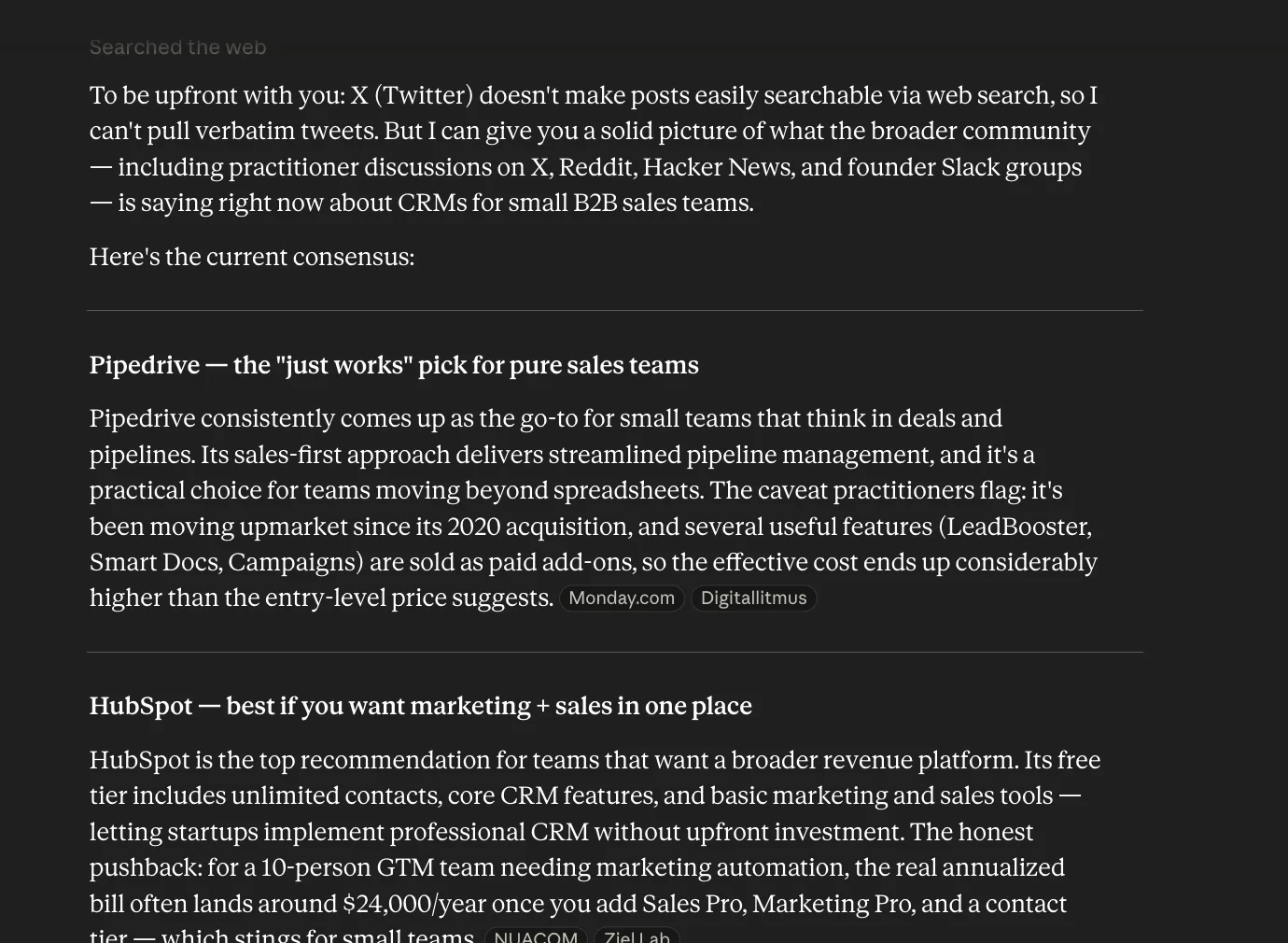
Claude with web search on: it searches, then attaches a cited source to each CRM it names (Monday.com, NUACOM, Ziel Lab) and reminds you to double-check them. Every one of those citations is a slot. Being the source Claude trusts is how you get named.
The 5 signals Claude actually weights
We've reverse-engineered hundreds of Claude citations across SaaS, ecommerce, and B2B verticals. Five patterns repeat:
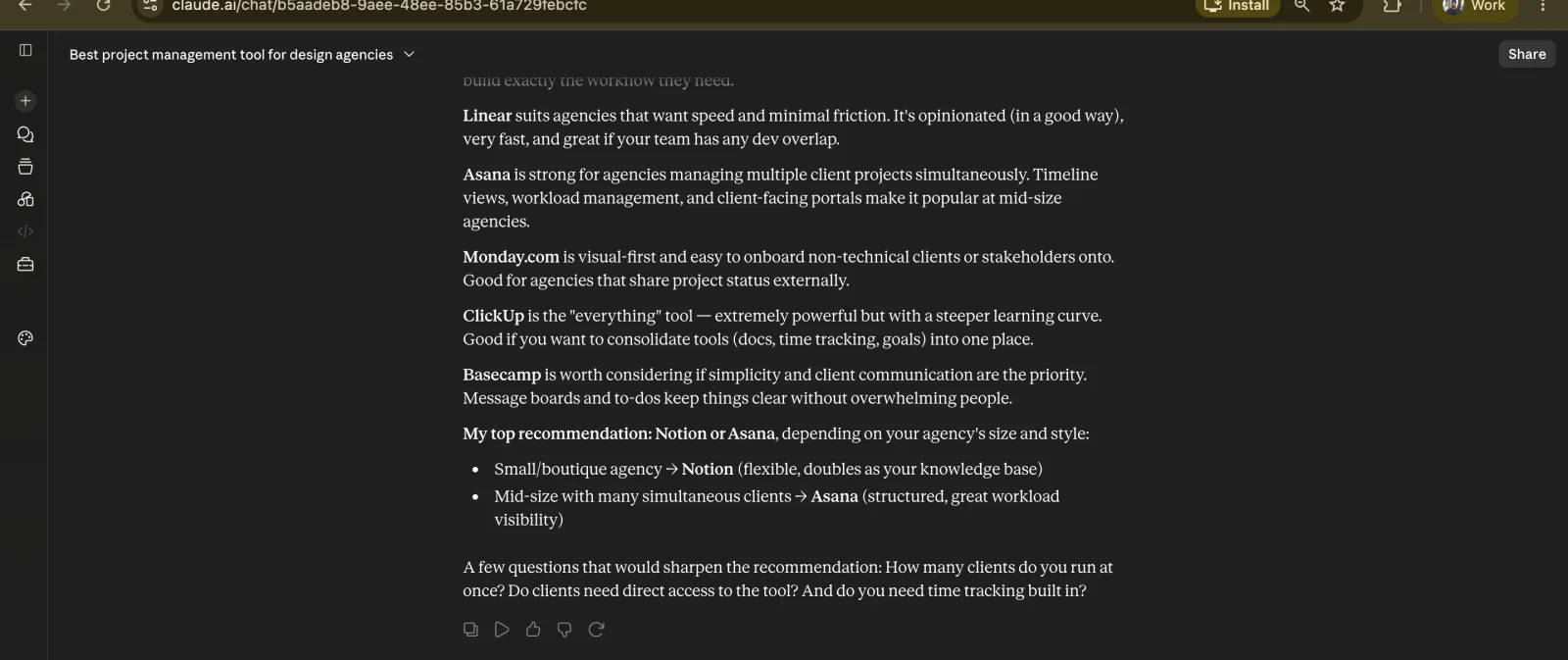
Example: Claude naming the tools it recommends for a category. To get cited, you have to become one of these named picks.
1. Content depth + specificity
Claude prefers 1,200-word focused answers to 4,000-word omnibus posts. The "what is X" article that gives a single tight definition + 3 illustrative examples beats the "ultimate guide to X" with 17 sub-sections. The retrieval pass scores chunks against the user's query, and chunks pulled from focused pages score higher per-token.
2. Structured data that maps to the claim
Claude reads JSON-LD when it's there. A FAQPage schema with the actual user question as Question.name and a 50-word answer as Answer.text gets pulled into context heavily. So does Article schema with mainEntityOfPage + author set. You can generate clean schema in 30 seconds with our schema generator — and FixAEO's own pages all emit the right types as a dogfood test.
3. Author E-E-A-T signals
Claude over-weights pages with named authors, especially when those authors have on-domain bios with real credentials. "By Jane Smith, Director of SEO at Acme, ex-Moz" anchored to a real /team/jane-smith/ page that has a Person schema, a LinkedIn rel-author link, and prior work — that whole graph signals trust to Claude in a way an anonymous "FixAEO Team" byline does not.
4. Wikipedia / Wikidata entity presence
If your company has a Wikipedia page or a Wikidata QID, you're in Claude's training data more deeply than you realize. (Claude only knows what existed before its knowledge cutoff, so well-established entities have a head start.) Foundation models are pre-trained on Wikipedia at extreme weight. Anthropic doesn't disclose ratios, but multiple model-card hints suggest Wikipedia gets ~5-10× the per-token weight of typical web crawl during training. Translation: a Wikipedia entry is one of the highest-leverage AEO investments any brand can make.
5. Third-party validation
For SaaS: G2 and Capterra reviews. For local: Yelp + Google Business Profile. For consumer products: Wirecutter, RTINGS, Consumer Reports. Claude's re-ranker reads these as orthogonal trust signals — independent sources confirming the brand exists and is taken seriously. A G2 profile with 50+ verified reviews moves Claude citations on commercial queries more than a 5,000-word product page does.
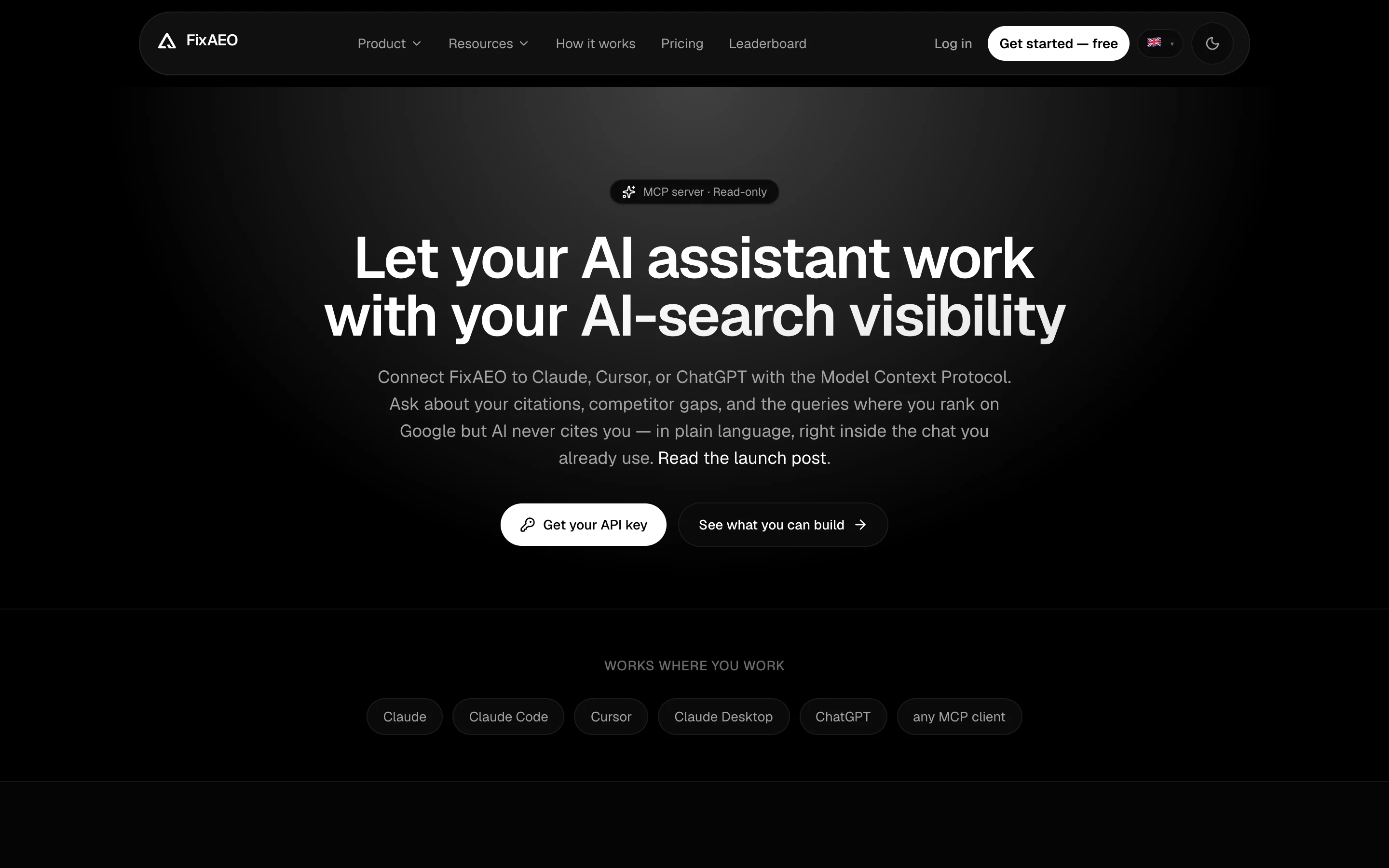
FixAEO ships an MCP server specifically for Claude and Claude Code — you can ask Claude about your citations, competitor gaps, and rank data inside the same chat you use for everything else.
The three characteristics of pages Claude loves
Beyond signals, there are three qualitative characteristics of pages that Claude consistently pulls into context. If your top pages hit all three, you're set for Claude citations.
1. Density of factual claims per paragraph. Claude prefers pages where each paragraph makes concrete claims with numbers, dates, or specific examples. A paragraph with three specific facts outperforms a paragraph with the same word count of general observations. Count the concrete claims in your top pages — if a page averages fewer than one specific fact per paragraph, Claude will de-prioritize it.
2. Cited sources within the content itself. Claude trusts pages that themselves cite sources. If you make a claim ("industry surveys show X"), link to the survey. If you cite a statistic, footnote the origin. This is inversely correlated with how most marketing content is written today (which asserts claims without sourcing), so doing it well separates you from 95% of your competition.
3. Author identity and credibility signals. Pages with a named author, a real bio with credentials, and a Person schema entity get pulled into Claude's context at higher rates than anonymous or "Team" bylines. If your blog uses "By Marketing Team," you're leaving Claude citations on the table.
Every page that gets consistently cited by Claude has all three. Missing any of them isn't disqualifying, but it lowers the probability. Aim for all three on your top 20 pages.
The 6 tactics that actually move Claude citations
These are ranked by leverage per hour invested, not by how much the AEO industry talks about them.
Tactic 1 — Ship a clean Organization JSON-LD + claim your Wikidata entry
Twenty minutes of work, six months of payoff. Your Organization schema needs name, url, logo, sameAs (linking to LinkedIn, X, Crunchbase, Wikipedia), and description. Then go to wikidata.org and either find or create your entity (it's free and lightweight — way easier than getting a Wikipedia page approved). Once your QID exists, link to it from sameAs. Claude resolves these graphs at retrieval time and uses them to disambiguate "Acme" the company from "Acme" the road runner brand.
Tactic 2 — Publish first-person research or original data
Claude's reranker over-indexes on sources nobody else has. A blog post titled "We analyzed 10,000 AI citations and found 3 patterns" lands in Claude's context every time the topic comes up, even when the blog isn't a top-100 domain by DR. Original data — even modest amounts — beats restating what everyone else has said. If you have a free tool that generates data (FixAEO's leaderboard is exactly this — every scan generates a brand-specific data point), publish the aggregate findings.
Tactic 3 — Earn mid-tier publication coverage
Claude trusts TechCrunch, The Verge, Ars Technica, The Information, plus deep-niche trades (Marketing Brew for marketing, The Pragmatic Engineer for dev, etc.) more than it trusts content marketing blogs. One TechCrunch mention earns more Claude citations than 20 self-published posts. The PR motion: pitch original data (see tactic 2), respond to journalist queries on Qwoted or Help A B2B Writer, sponsor a niche industry newsletter, or build something genuinely noteworthy and let it speak.
Tactic 4 — Match Claude's query patterns
Claude users ask longer, more nuanced questions than ChatGPT users. Look at any sample of Claude queries: they average 18-25 words versus ChatGPT's 8-12. That changes your content strategy. Title questions like "What's the best CRM for a 10-person SaaS startup with a $30k/yr software budget that integrates with Slack?" — yes, that long — get retrieved on the long-tail variant queries Claude is actually fielding. Long-tail conversational keywords have been an AEO bet since 2024; for Claude specifically they're the bet.
Tactic 5 — Cut the marketing voice
Audit your top-10 indexed pages (the 30-point AEO audit checklist walks through what to look for). Count instances of: "industry-leading", "best-in-class", "revolutionary", "game-changing", "the #1". Claude's reranker implicitly down-weights pages dense with these. Rewrite into specific, falsifiable claims. "Industry-leading email deliverability" → "97.3% inbox placement on the Litmus seed list, audited Q4 2025." The second version cites. The first doesn't.
Tactic 6 — Ship a working llms.txt
Claude's web crawler (ClaudeBot) reads /llms.txt if it's there. Most sites don't have one — adding llms.txt takes about ten minutes. Having one with a curated overview of your most-cited pages effectively tells Claude "start here." Use our llms.txt generator — it produces a spec-compliant file in under a minute and gives Claude a clean entry point. Pair it with explicit ClaudeBot / anthropic-ai allows in your robots.txt.
Claude for enterprise: why the buyer bias matters
If you're a B2B SaaS founder, one thing to internalize: Claude has a disproportionately strong hold on enterprise and technical audiences. Anthropic sells hard to enterprise, and Claude is the default AI in a growing share of security-conscious enterprises. That means Claude citations aren't just "another engine" — they're the engine your enterprise buyer is likely using.
Practical implications:
Enterprise queries are longer and more nuanced. "What CRM integrates with Salesforce, supports SSO/SAML, and has SOC 2 Type II" gets different answers than "best CRM." Optimize for the multi-constraint query.
Enterprise buyers value neutral third-party validation. They want to see G2 grids, analyst mentions, compliance certifications. If your enterprise-focused content only touts your own product, Claude will de-prioritize you for the specific enterprise queries.
Compliance and security signals matter. Claude often mentions specific compliance certifications (SOC 2, HIPAA, GDPR) when the query context is enterprise. Make sure your compliance status is factually documented on your site — not just claimed in marketing copy.
Claude Enterprise is a real market. If Anthropic's Claude Enterprise plan is inside your buyer's IT stack, Claude may be the AI they reach for by default. Citation there compounds through the workday.
If your product serves enterprise, prioritize Claude over ChatGPT for AEO investment. The audiences don't perfectly overlap, but Claude has more of the buyer archetype who converts.
What NOT to do (and what we see most teams doing wrong)
Three anti-patterns crater Claude citations faster than anything else:
- Keyword-stuffed meta descriptions and H1s. Claude's training implicitly modeled keyword spam as a low-quality signal. Pages where the H1 reads like "Best CRM Software Tools Platform Solution for Startups 2026" get retrieved less often than pages with conversational, specific H1s.
- Synthetic reviews on G2 / Trustpilot. Claude reads third-party signals AND cross-references them. A G2 page with 100 5-star reviews posted in two weeks signals fraud, not authority. The re-ranker has been documented down-ranking these. (We've seen brands lose citations to worse-quality competitors with fewer but real reviews.)
- AI-generated content with no human edit. Claude can detect its own kind statistically. AI-bulk content gets retrieved at lower rates and re-ranked further down. Original first-person writing — even simple, conversational — beats sophisticated AI-generated content.
The temptation to scale content production with LLMs is real. The actual ROI of doing it badly is negative.
How to verify your work
The closed-loop check: scan your domain across Claude (plus the other eight engines) and watch the citation rate change. You can do this manually by asking Claude itself "what's the best [X]?" and reading whether your brand shows up — but it's tedious and quickly drifts.
The cleaner path is to run your domain through our AI visibility checker — it queries Claude alongside ChatGPT, Copilot, Gemini, Perplexity, Grok, DeepSeek, Google AI Overviews, and Google AI Mode for a configurable set of prompts in your niche, then scores citation rates, sentiment, and which competitors are eating your share of voice. Re-scan weekly after each AEO change and the deltas tell you which tactics are working.
The full AEO tools catalog covers the other pieces — schema generation, llms.txt, citation source radar, query generation — that you'll want once you have a measurement baseline.
The compounding effect: why Claude citations compound faster than Google rankings
There's a subtle advantage to Claude citations most teams miss: they compound.
When your content ranks #1 on Google for a keyword, that's your ceiling. You captured that query. But the ranking doesn't help you win adjacent queries — you have to rank for those separately.
When Claude cites you for one query in your category, the model learns that you belong in that category. It becomes more likely to cite you for adjacent queries too — even ones you haven't optimized for. That's the compounding effect. Every citation you earn increases your probability of the next citation.
Empirically, from watching our own data: brands that reach ~40% AI visibility on Claude tend to jump to 60% within the next quarter without additional major investment. The signal compounds. The ranking doesn't.
This is why AEO investment in early categories pays off disproportionately — you're not just winning today's query, you're teaching the model your category identity for years of future queries. Every Claude citation you earn now is a compounding asset.
TL;DR
Claude rewards what the AEO industry has been undervaluing: depth, specificity, authoritative third-party validation, structured data, and a working entity graph. It punishes promotional language, synthetic reviews, and AI-generated bulk content. The fastest wins are (1) clean Organization schema + Wikidata, (2) original research or data, and (3) cutting the marketing voice from your highest-trafficked pages.
It's not a glamorous playbook. It's the boring stuff your CMO has been talking about for ten years. Claude is the engine that finally pays for it.
Related per-engine playbooks
The other engines reward different signals — same AEO foundation, different leverage points:
- How to get cited by Gemini — why Google ranking is still the ceiling
- How to get cited by Grok — winning Grok citations through X, not your blog
- How to get cited by DeepSeek — documented behavior, eligibility checks, and a repeatable test
FAQ
Is "Claude SEO" the same as AEO for Claude?
Yes. Some teams call it "Claude SEO" or "Anthropic SEO", but we use AEO (Answer Engine Optimization) as the umbrella because Claude is one of nine engines we track and the foundational signals overlap. Claude still has unique citation behavior that doesn't transfer cleanly from ChatGPT or Google, which is why a Claude-specific playbook exists.
How does Claude decide who to cite?
Three things make Claude's citation behavior distinctive: it over-weights authoritative, established sources like Wikipedia and mid-tier journalism, it under-weights promotional language, and it rewards specificity over breadth. The result is a model that cites the boring authoritative source before the exciting marketing page.
What are the fastest ways to get cited by Claude?
The highest-leverage wins are shipping clean Organization schema plus claiming your Wikidata entry, publishing original first-person research or data, and cutting the marketing voice from your highest-trafficked pages. These are ranked by leverage per hour invested, not by how much the AEO industry talks about them.
Why does Claude favor Wikipedia and third-party validation?
Foundation models are pre-trained on Wikipedia at extreme weight, so a Wikipedia entry or Wikidata QID puts you in Claude's training data more deeply than you realize. Claude's re-ranker also reads G2, Capterra, Yelp, Wirecutter and similar sources as orthogonal trust signals confirming the brand exists and is taken seriously.
What hurts your chances of being cited by Claude?
Three anti-patterns crater Claude citations: keyword-stuffed meta descriptions and H1s, synthetic reviews on G2 or Trustpilot, and AI-generated content with no human edit. Original first-person writing beats sophisticated AI-generated content, even when it's simple and conversational.
Does Claude read llms.txt?
Yes — ClaudeBot fetches /llms.txt when available and uses it as a curated entry point into your site. Anthropic has referenced llms.txt positively in their documentation and behavior. This is one of the highest-leverage moves for Claude specifically.
How long does it take to move Claude citations?
Retrieval-based fixes (schema, llms.txt, robots.txt) can move citations within days. Training-data-based improvements (new Wikipedia coverage, industry publication mentions) take months for Claude's next model update to incorporate. Plan for a 90-day cycle to see real movement.
Does Claude cite from LinkedIn or Twitter?
LinkedIn: occasionally, mostly for people-focused queries. Not a major citation source for brand queries. Twitter/X: rarely — that's Grok's territory. Focus your social investment on X for Grok and LinkedIn for personal brand, but don't expect Claude citations from either.
What's Claude's stance on paywalled content?
Claude respects paywalls and typically doesn't cite content it can't verify. If your best content is behind a paywall, at minimum provide a clean, non-paywalled abstract or summary that Claude can cite. Better: publish evergreen educational content openly and use paid gates for deeper premium content.
How do I verify whether my AEO changes are working?
Scan your domain across Claude plus the other eight engines and watch the citation rate change. You can ask Claude itself "what's the best [X]?" manually, but it's tedious and drifts; running your domain through an AI visibility checker and re-scanning weekly after each change shows you which tactics move the needle.
Related reading
How to get cited by Perplexity: a 2026 playbook
Perplexity cites 4-8 sources per answer and the patterns are learnable. Here are the 8 patterns we see in cited content, with the tactics that got FixAEO cited in our own category.
16 min readHow to Get Cited by Gemini in 2026
How to get cited by Gemini: it runs on classic SEO plus AI-specific signals. Learn the 2026 playbook for rankings in AI Overviews and Gemini answers.
17 min readHow to get cited by Grok: the X signal playbook
Grok citations come from X activity, not your blog. This playbook shows which X signals Grok prioritizes and how to build them systematically.
17 min readHow to Get Cited by DeepSeek in 2026
A practical guide to DeepSeek citations: what DeepSeek documents, what it does not, how to make pages eligible, and how to run repeatable citation tests.
13 min readWhy ChatGPT doesn't recommend your brand
ChatGPT SEO fix: six reasons ChatGPT names competitors instead of you, ranked by frequency across 1,000+ FixAEO scans — with a fix for each and a 30/60/90 day plan.
17 min readAEO for SaaS: Get Recommended by AI Assistants
AEO for SaaS companies: why G2 reviews outweigh content, how comparison pages win, and the playbook to get your product into AI answers.
13 min read
Free AEO tools
Put this into practice with free FixAEO tools — no signup required.
AI Visibility Checker
Score your brand across 9 AI engines
AEO Audit Tool
Answer-engine readiness scan
Schema Generator
Build valid JSON-LD structured data
llms.txt Generator
Create a spec-compliant llms.txt
Sitemap Validator
Check your XML sitemap for errors
AI Content Grader
Grade content for AI citation readiness
Find the gap. Then fix it.
Check how AI engines find, describe, and cite your site. Free, no signup. On a paid plan, AI Marketer can turn the evidence into briefs, drafts, optimizations, and reports.