LLMrefs Review (2026): Features, Pricing, Pros & Cons
An honest LLMrefs review — what it does, real 2026 pricing, the engines it tracks, pros, cons, alternatives, and who should skip it. Verified July 2026.

On this page
LLMrefs is one of the newer, faster-moving names in AI-search visibility — a flat $79/month, broad engine coverage, and a clean "track keywords, not prompts" pitch that lands with SEO teams. It's also barely a year old, weekly rather than real-time, and light on the enterprise-governance story. This review is the honest version: what LLMrefs actually does, what it costs, where it's strong, where it isn't, and who should look elsewhere.
Disclosure: I build FixAEO, a free, self-serve AEO tool that competes with LLMrefs. So read this knowing that — I'll point out plainly where LLMrefs beats us. Every price and fact below was checked against LLMrefs' own pages on 2026-07-13, not lifted from an older review; where a number moves often (and a few do), I've said so.
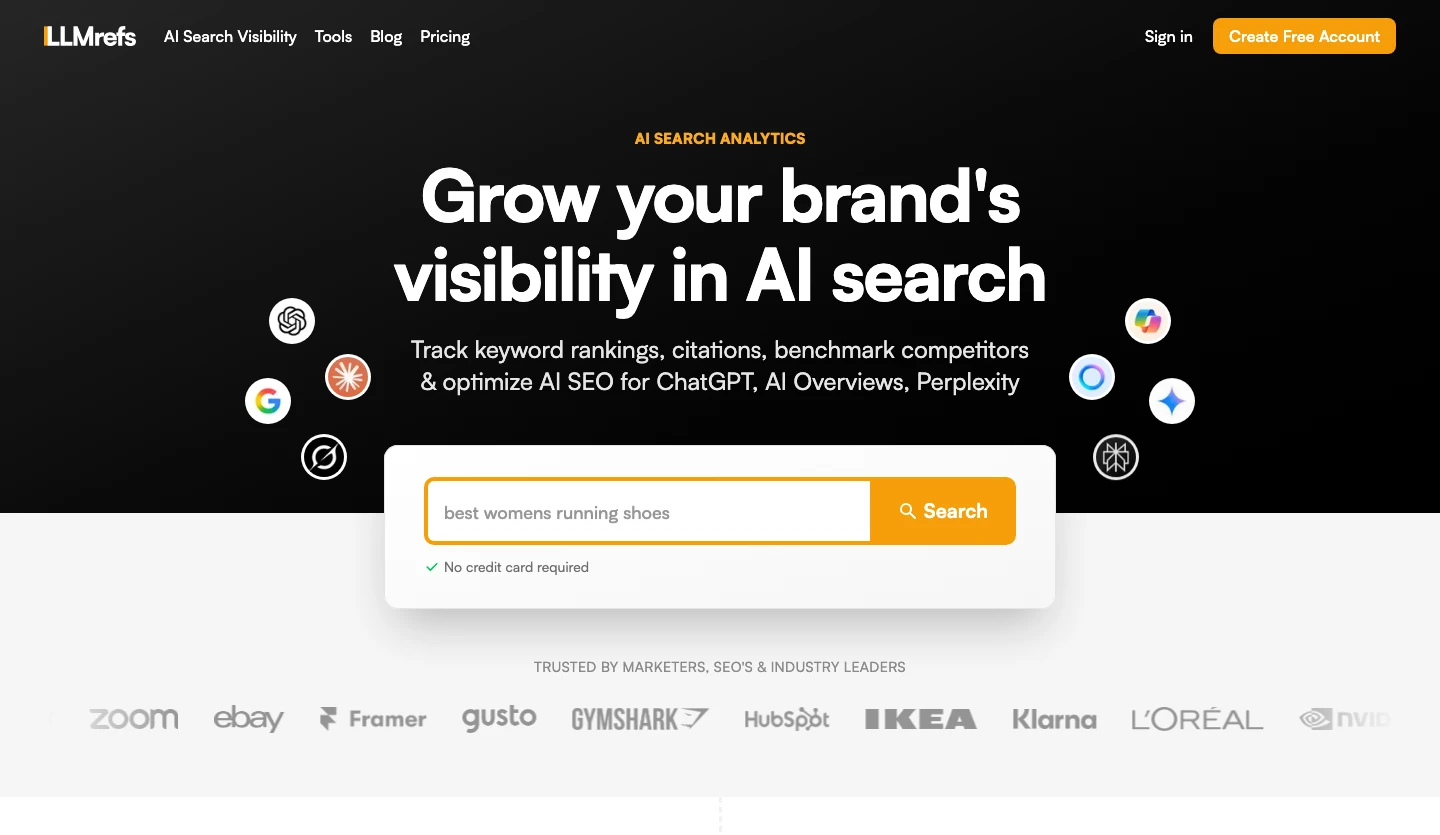
LLMrefs' homepage, July 2026 — the pitch is keyword-style rank tracking for AI answers.
Curious how your site does?
See how AI engines describe your site — free, about 60 seconds, no signup.
The quick verdict
LLMrefs is a strong, fairly-priced AI-visibility tracker for agencies and SEO teams — held back mainly by how young it is. For $79/month flat (unlimited seats and domains) you get keyword-style tracking across 10+ AI engines, automatic prompt fan-out, competitor benchmarking, and citation analysis. It's excellent value if weekly refresh is enough and you don't need enterprise compliance.
- Buy it if: you're an agency or multi-brand team that wants broad engine coverage at a flat, seat-unlimited price.
- Skip it if: you need real-time data, sentiment analysis, enterprise (SOC 2) governance, or a permanent free tier (if it's the free tier that's stopping you, FixAEO — ours — is the free-first alternative; more below).
- Our score: 3.6/5 — the capabilities scorecard below breaks down why.
Now the full review.
What is LLMrefs?
LLMrefs (llmrefs.com) is an AI search visibility tracker — the category people call AEO (Answer Engine Optimization) or GEO (Generative Engine Optimization). In plain terms: it measures how often your brand is mentioned, cited, and recommended when tools like ChatGPT, Gemini, and Perplexity answer questions in your space, and benchmarks that against competitors.
The category exists because search is splitting. More buyers now ask ChatGPT, Gemini, or Perplexity for recommendations instead of scrolling Google's ten blue links — and those answers name a handful of brands rather than listing everyone. If you're not one of the named few, you're invisible, and a traditional rankings report won't warn you, because AI answers don't map neatly to positions. Tools like LLMrefs exist to measure that new surface: are you in the answer, for the questions your buyers actually ask?
Its distinguishing framing is "track keywords, not prompts." You hand it seed keywords plus a competitor set; LLMrefs expands each keyword into a fan-out of 8+ prompt variations (comparisons, "alternatives," how-tos), runs those across the engines, and reports where you show up. The headline outputs are a Share of Voice (the share of answers that mention you), a proprietary LLMrefs Score (AI Visibility Score), and citation tracking (which domains the AI leaned on). It's a measurement tool, not a content generator.
LLMrefs at a glance
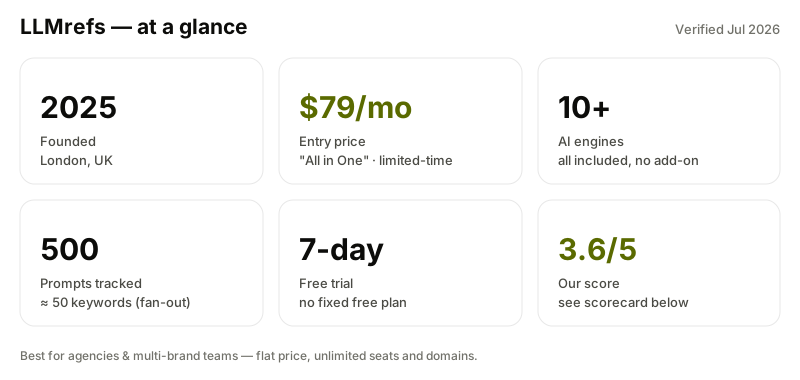
Founded in 2025 and based in London, LLMrefs is led by founder and CEO James Berry (the homepage bylines him directly). It's a young platform, though — without the multi-year track record, or the compliance paperwork, of the enterprise incumbents. On funding there's nothing disclosed: one write-up calls it bootstrapped, but that's unconfirmed and its about page lists only a London address — so I wouldn't lean on the funding story either way.
What LLMrefs does — the full feature set
Keyword tracking with query fan-out
This is the core, and it's genuinely useful. You give LLMrefs a keyword; it auto-generates a spread of real-world prompt variations around it and tracks all of them, so you're not hand-writing prompts one by one. For teams coming from classic SEO, "keywords in, visibility out" is a familiar, low-friction model.
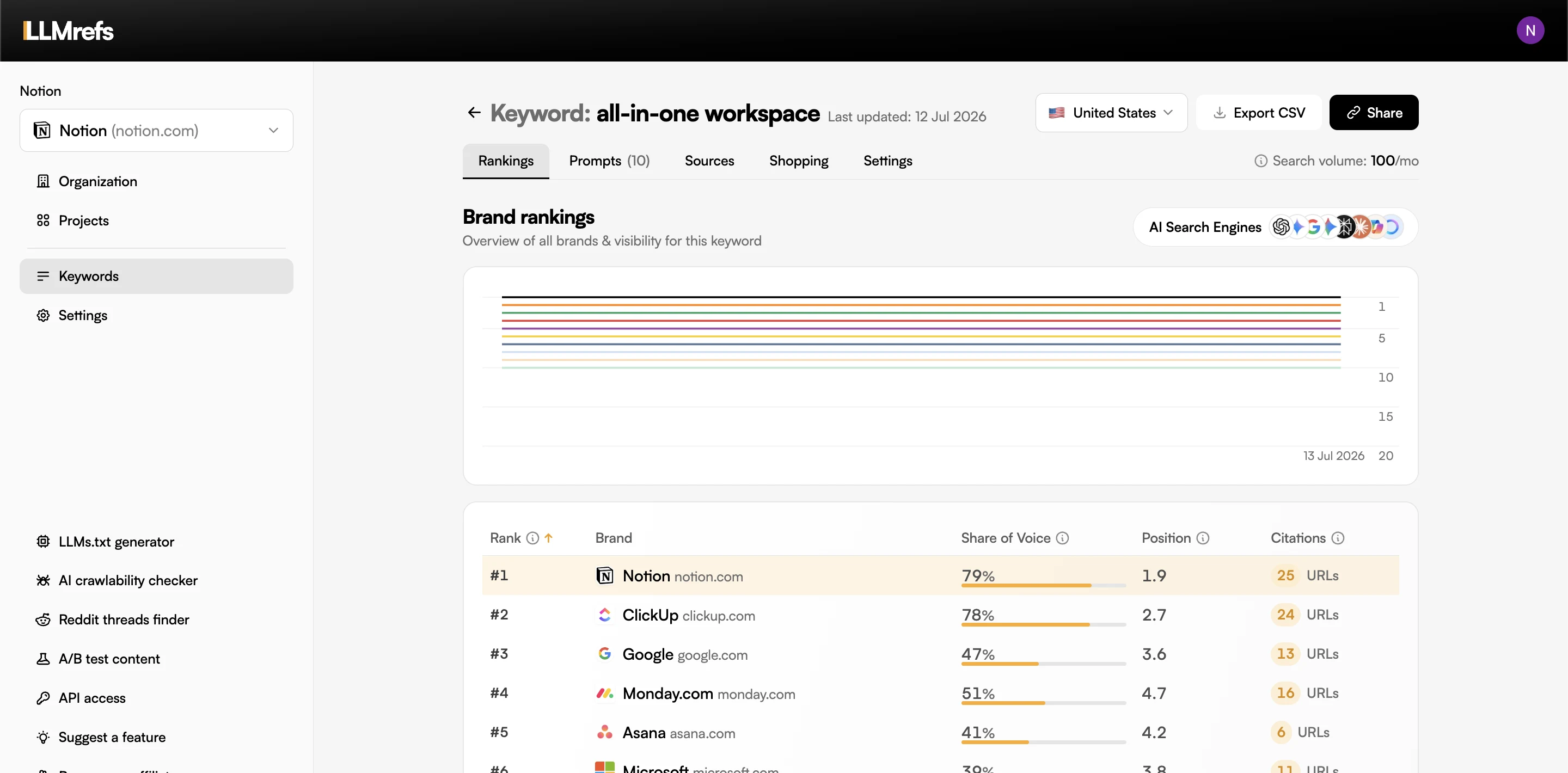
A real LLMrefs keyword view: for "all-in-one workspace" it ranks Notion, ClickUp, Asana and the rest by Share of Voice, position, and citations — across every engine at once.
The fan-out is the part that saves the most time. In a prompt-first tool you sit down and write "best CRM for startups," "CRM alternatives to HubSpot," "is X CRM good for small teams," and twenty more by hand. LLMrefs generates that spread from one seed keyword and keeps it refreshed, so the surface you're tracking grows without manual upkeep.
"Track keywords, not prompts" — does that pitch hold up?
LLMrefs leans hard on this line, so it's worth examining — it's the whole philosophy. The argument: buyers don't type one canonical prompt, so tracking a keyword (and letting the tool fan it into many prompts) mirrors how AI answers actually vary. That's largely right, and it's why the model feels natural to anyone coming from SEO — you keep thinking in keywords, the tool absorbs the prompt sprawl.
The tradeoff is control. You get less say over the exact prompts than a prompt-first tool gives you, and the tracking is only as good as the generated fan-out. For most brands that's a fair trade — the fan-out surfaces variations you'd never think to write. But if your category hinges on a handful of very specific buyer questions, confirm the generated prompts actually match them, not just adjacent keywords, before you trust the score.
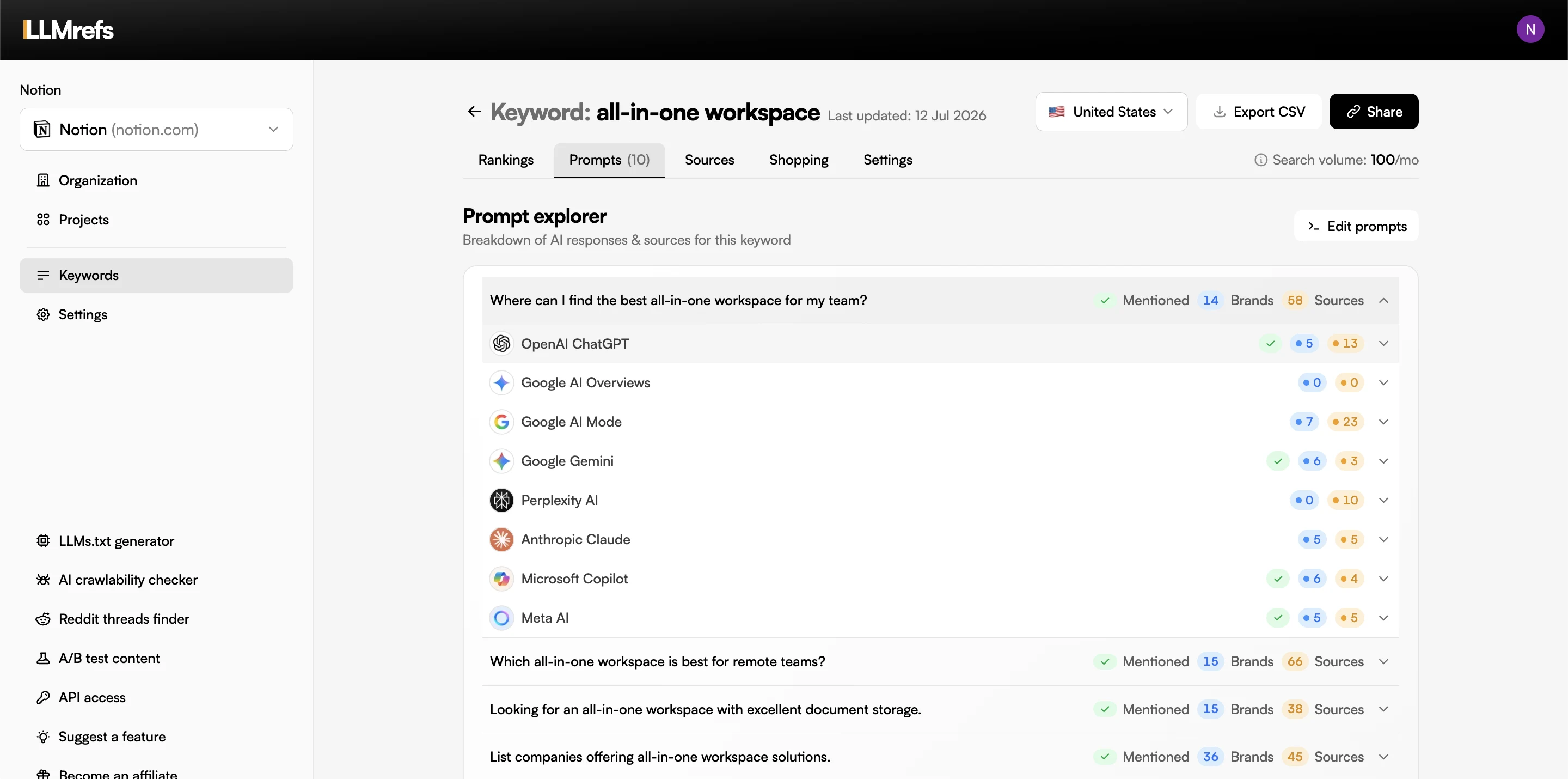
The fan-out in practice: one keyword becomes ten real buyer questions, each broken down engine by engine.
Share of Voice and the LLMrefs Score
For each keyword, LLMrefs reports your Share of Voice (the percent of answers that name you), your position versus competitors, and a rolled-up LLMrefs Score with trend indicators. In practice you use it two ways: the Score is the single number you put on a dashboard and watch week over week, and Share of Voice is the competitive one — it tells you not just whether you're mentioned, but how much of the category's AI airtime you own versus rivals. Watch the trend more than the absolute number; because AI answers drift, the direction of travel is more trustworthy than any single week's reading.
Competitor benchmarking
Define a competitor set and LLMrefs shows the top brands per topic, who's gaining, and who's losing — the "are we winning this category in AI answers" view a Google rankings report can't give you. This is where the tool earns its keep for positioning work: you can see, per topic, which competitor the models default to recommending, then go work on closing that specific gap.
Citations and source analysis
It tracks the top cited domains for your topics and flags new citations — where the AI pulls its answers from. That's the practical heart of AEO: the models build answers from third-party pages far more than from your own site, so knowing which domains they trust in your category tells you exactly where to go earn a mention (a Reddit thread, a review roundup, an industry publication) rather than guessing.
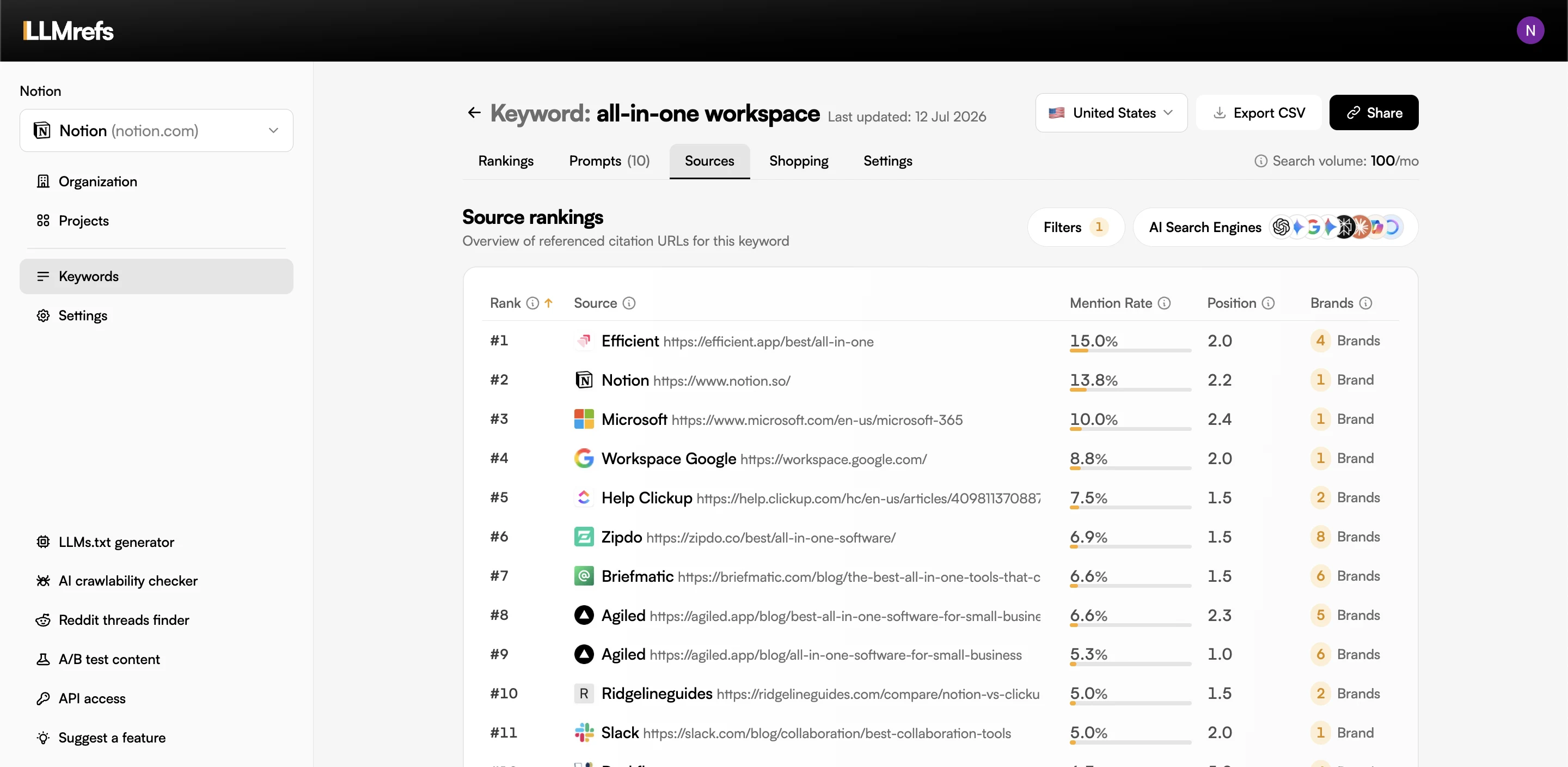
Source rankings: the exact URLs the models cite in your category, ranked by how often — effectively your target list for earning mentions.
The bundled bonus tools
LLMrefs throws in a set of free AI-SEO utilities: an AI crawlability checker (can the bots actually read your pages), a Reddit-threads finder (spot the conversations the models cite), an llms.txt generator, and a query fan-out generator (preview the prompt variations a keyword would expand into). They're useful for a quick audit or to sanity-check your keyword list — though most are lightweight standalone tools rather than deep platform features.
One honest gap: LLMrefs is mentions/citation/ranking-focused, not a sentiment or PR-narrative tool. If your job is tracking how AI describes your brand (tone, framing), this isn't built for that.
How LLMrefs collects its data
Most competitor reviews skip this — it matters. LLMrefs says it uses "respectful, compliant access to AI engines and APIs," and runs each prompt multiple times (with statistical sampling) to average out the fact that LLMs give different answers to the same question. That multi-run approach is the right call for a category where a single query isn't repeatable.
Two things the site is genuinely inconsistent about, so I'll flag them rather than pick one:
- Refresh cadence. The pricing page and most reviews say weekly reports, but the feature page mentions "daily runs." Best read: prompts may run often, but dashboards refresh at least weekly — fine for most teams, a limitation for fast-moving news categories.
- Geographic coverage. LLMrefs contradicts itself here: its pricing page and the homepage's pricing block say 50+ countries and 20+ languages, while the homepage's own features section says 20+ and 10+. Verify against the live page for your region before you rely on it.
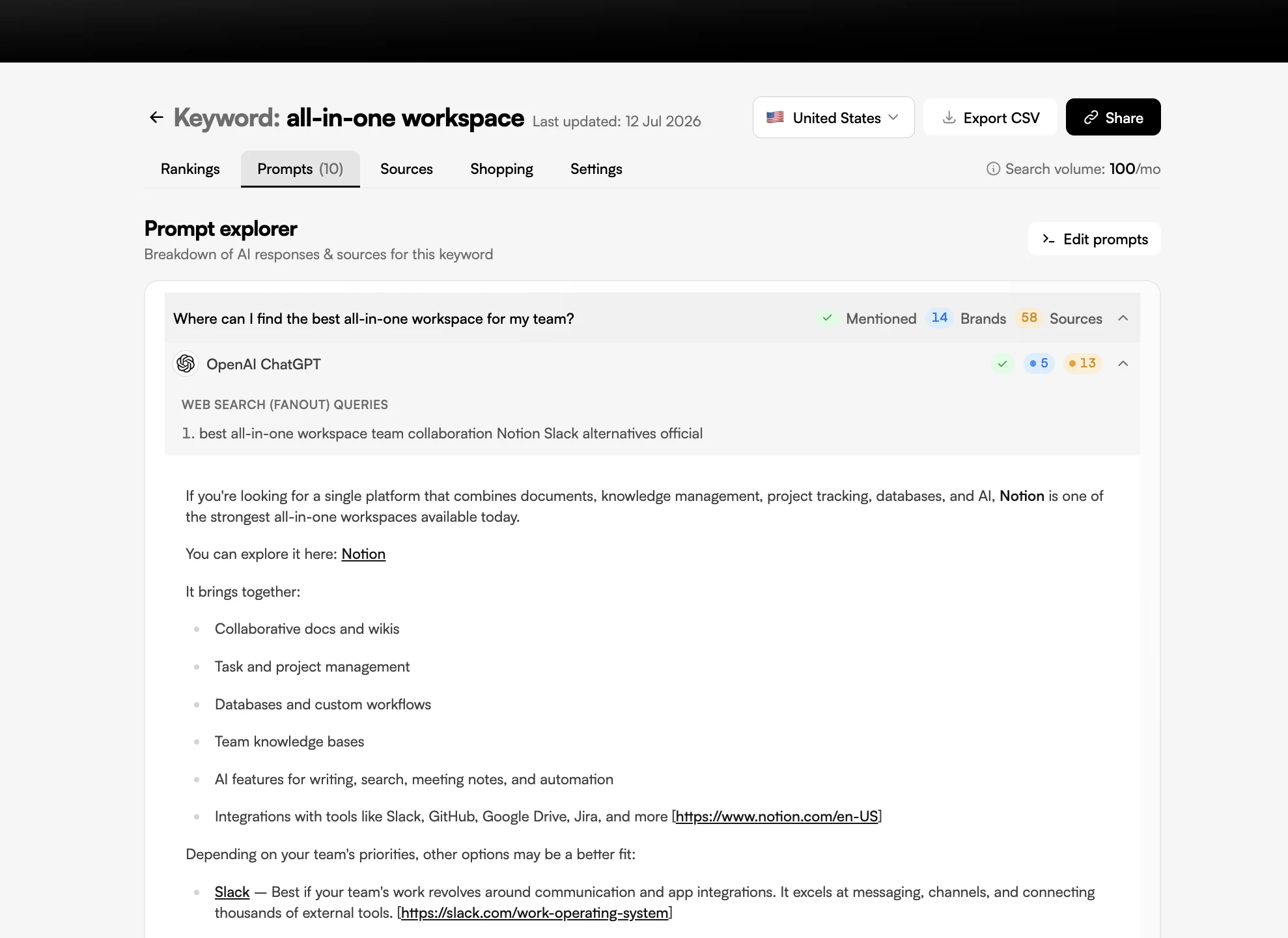
Drilling into a single answer: LLMrefs shows the exact fan-out query it ran and the raw response it read — citations and all.
Setting up LLMrefs: what using it actually looks like
Because it's keyword-first, getting started feels closer to setting up a rank tracker than learning a new analytics suite. Roughly:
- Create a project with your brand name and domain — the free signup needs no credit card.
- Add your keywords — the topics buyers ask about. LLMrefs fans each one into prompt variations automatically, so a handful of seed keywords becomes a much larger tracked set.
- Add competitors you want to benchmark against.
- Let it run. LLMrefs queries the engines, runs each prompt several times, and populates your Share of Voice, LLMrefs Score, rankings, and cited sources.
- Read the dashboard — per keyword you see who's winning, which engines mention you, and which domains the models cite; export to CSV or pull the data via the API for reporting.
- Set alerts so you hear about visibility swings without logging in daily.
If you've used any SEO rank tracker, the learning curve is gentle — the keyword mental model does most of the work. The friction is at the edges: you're trusting the auto-generated fan-out to represent your buyers' real questions, and the ~50-keyword base allotment fills up faster than you'd expect once you add competitors and topics. Plan your keyword list deliberately rather than dumping everything in on day one.
Which AI engines LLMrefs tracks
Broad coverage is one of LLMrefs' real strengths — 10+ engines, all included at one price, no per-engine add-ons:
| Family | Engines LLMrefs lists |
|---|---|
| OpenAI | ChatGPT, ChatGPT Search |
| AI Overviews, AI Mode, Gemini | |
| Others | Perplexity, Anthropic Claude, xAI Grok, Microsoft Copilot, Meta AI, DeepSeek |
Note the counting nuance: the homepage names all eleven — it breaks out ChatGPT Search as its own engine — while the pricing page lists a slightly shorter set. Either way, the breadth is competitive with tools that charge far more — many rivals gate the extra engines behind higher tiers or charge per engine.
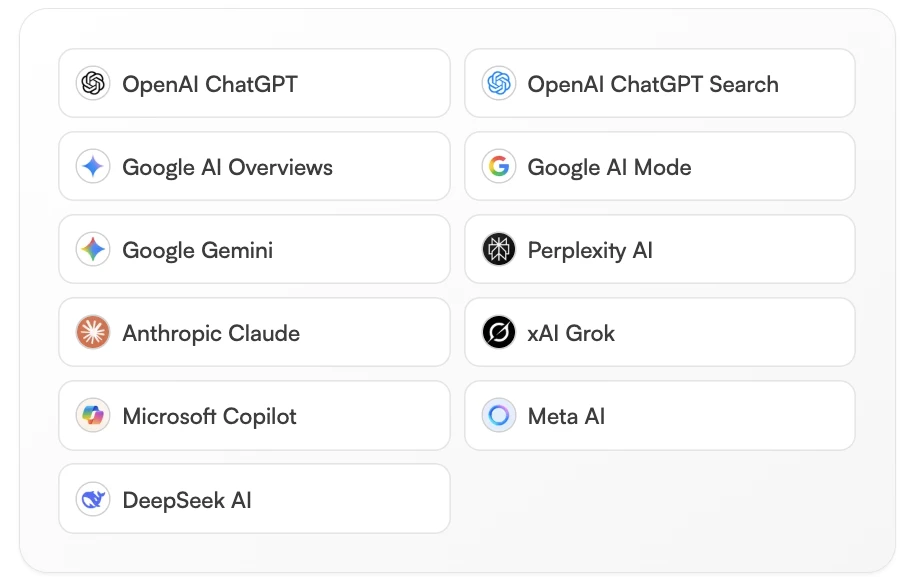
All 11 engines LLMrefs tracks — every one included at the single price, no per-engine add-ons.
LLMrefs pricing
Pricing is refreshingly simple — one plan. Here it is straight from the source (verified on llmrefs.com/#pricing, 2026-07-13):
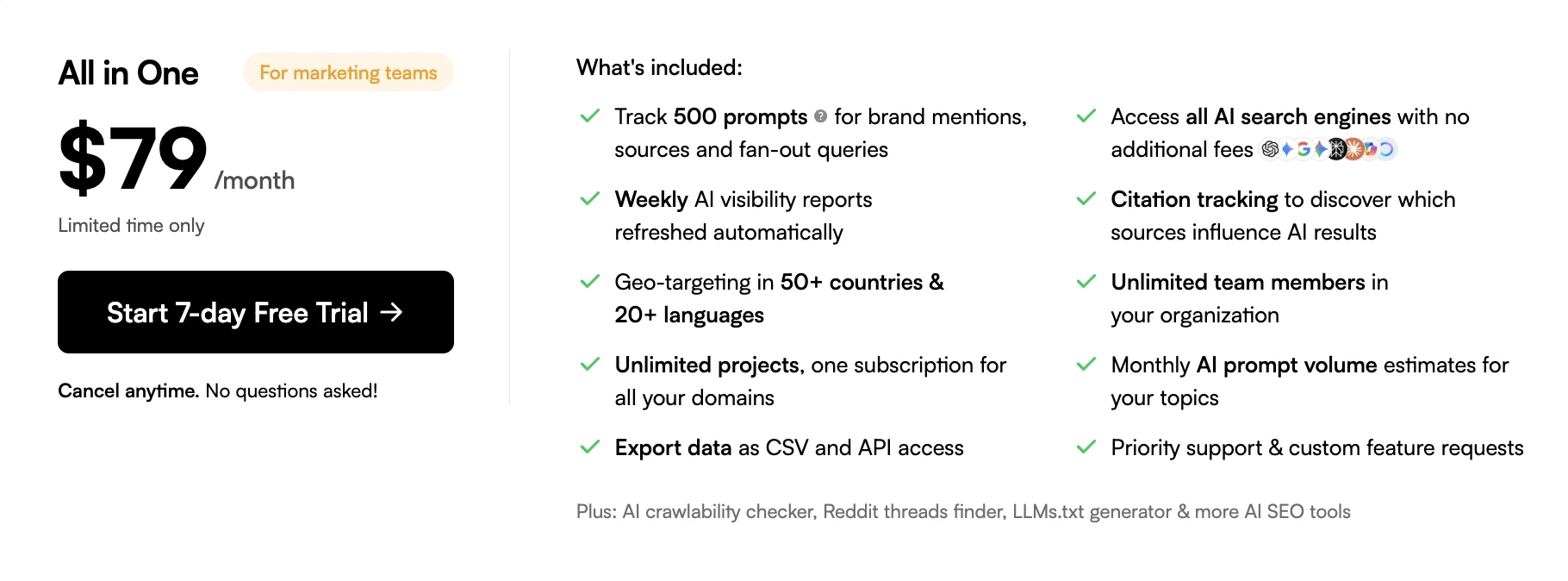
LLMrefs' pricing page: one $79/mo "All in One" plan plus a 7-day free trial. A couple of reviews mention a custom Enterprise quote, but it isn't prominent on the site.
A few honest notes:
- There's no clearly-published permanent free plan. You can create a free account to set up a project, and the pricing page pushes the 7-day trial — but LLMrefs does not advertise a fixed free tier with a set keyword cap on its live pricing page. (Some third-party reviews claim a "1-keyword free plan," while a competitor's review claims "no free tier." As of my check, the accurate statement is: 7-day trial + free signup, no clearly-defined free plan.)
- The $79 is explicitly "limited-time." Treat it as a mid-2026 snapshot; it may rise. There's no published annual discount.
- The "~50 keywords" is our estimate. LLMrefs sells "500 prompts," not a keyword number. Because it fans each seed keyword into 8+ prompts, ~50 keywords is a reasonable read — but that's our math, not a figure LLMrefs publishes.
- Cost-per-prompt math: 500 prompts at $79 is about $0.16 per tracked prompt/month — cheap for the coverage, and the unlimited seats and domains make it especially strong for agencies and multi-brand teams that would pay per-seat elsewhere.
LLMrefs capabilities, scored
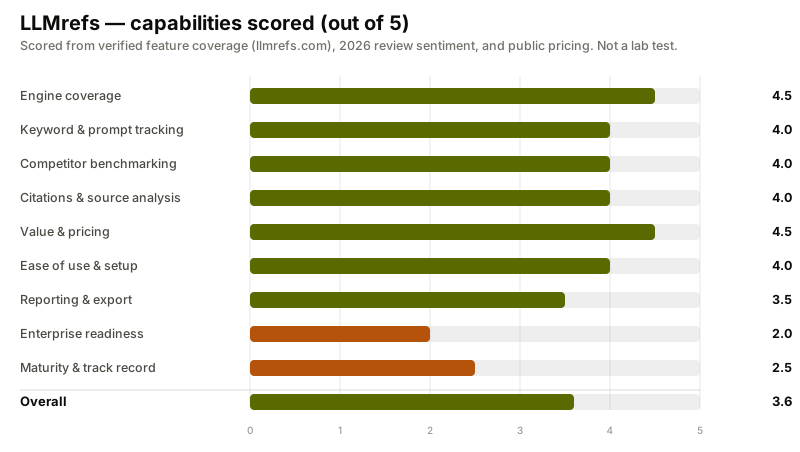
The scores above come from verified feature coverage on llmrefs.com, 2026 review sentiment, and public pricing — not a lab benchmark, and I've shown the rubric so you can argue with it. The shape is clear: LLMrefs is strong on coverage, value, and everyday usability, and weak on maturity and enterprise readiness — exactly what you'd expect from a well-built one-year-old tool.
Two scores deserve a word. Value (4.5) reflects the flat, uncapped pricing as much as the feature list — dollar for dollar, few tools give you this much engine coverage and this many seats. Enterprise readiness (2.0) and maturity (2.5) are the drags: no published SOC 2, a weekly refresh, and barely a year of operating history. None of that makes LLMrefs bad — it makes it a young challenger you'd buy for value and coverage, not for surviving a Fortune 500 procurement review.
LLMrefs pros
- Simple, flat pricing — one $79 plan with unlimited seats and unlimited projects/domains. For agencies and multi-brand teams, this is the standout: no per-seat or per-domain tax.
- Broad engine coverage (10+) with everything included — no "unlock more engines" upsell.
- Automatic keyword-to-prompt fan-out removes the tedious manual prompt setup other tools require.
- Citation and competitor views that translate directly into AEO to-dos.
- Bundled free tools and a genuine 7-day trial to evaluate before paying.
- Keyword-first model that SEO teams grok immediately, with a gentle learning curve.
LLMrefs cons
- Very young (2025). Limited historical data depth and a short track record; roadmap risk is real.
- Weekly, not real-time. Fine for most, limiting for fast-moving/news categories (and the site's own daily-vs-weekly wording is inconsistent).
- No clearly-published free plan — just a trial and a free signup, so you can't run an ongoing zero-cost program.
- Thin enterprise-governance story. Reviewers note no public SOC 2 / compliance posture; if procurement needs that today, LLMrefs isn't there yet (reported — verify directly).
- "Limited-time" $79 could rise, and the ~50-keyword base can feel tight once you add competitors and topics.
- Not for sentiment/PR — it measures presence and citations, not how you're portrayed.
Who LLMrefs is for — and who should skip it
Agencies and consultants get the most value here. The flat $79 with unlimited seats and domains means you can track every client under one subscription without per-seat or per-domain fees stacking up — once you're past a few clients, that model can make LLMrefs cheaper than seat-based competitors outright.
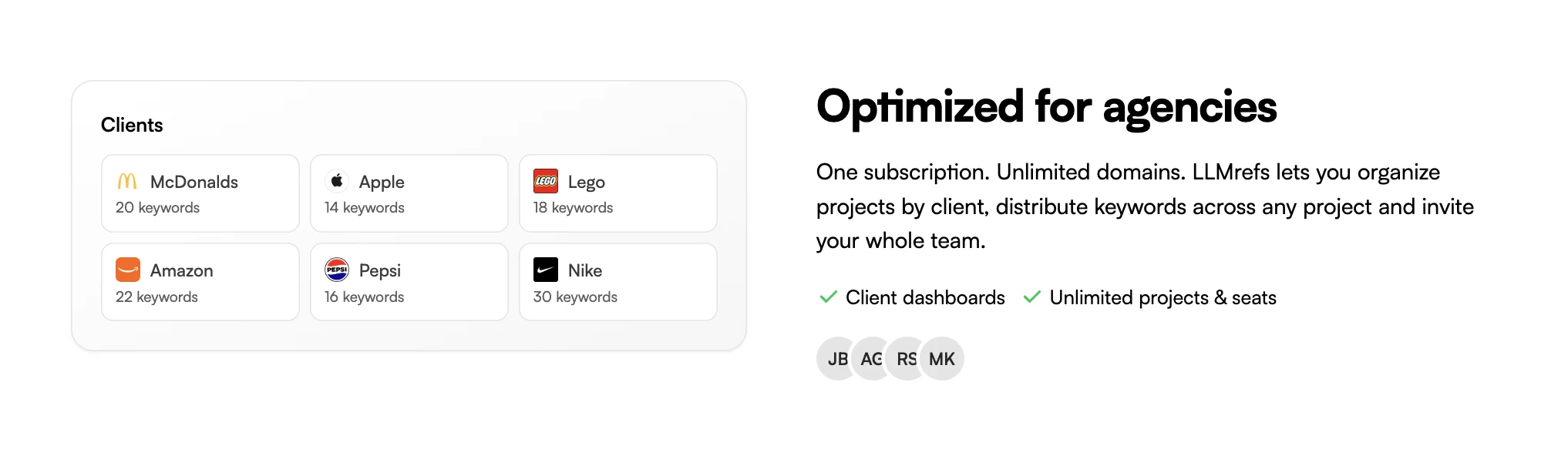
The agency model: organize clients as projects under one subscription — unlimited domains and seats, so costs don't scale per client.
In-house SEO teams moving into AEO get a tool that speaks their language: you keep working in keywords, and the fan-out handles the prompt sprawl. It slots into an existing SEO workflow with almost no retraining.
B2B and startup growth teams can lean on the competitor benchmarking to see which rival the models default to recommending in their category, then target the specific citations that close the gap.
Budget-conscious brands get 10+ engines at a price well below the enterprise platforms — broad coverage without a five-figure contract.
Skip it (for now) if you need SOC 2 / enterprise compliance signed off today; need real-time or daily tracking for a news-speed category; want sentiment and PR-narrative analysis (how AI describes you, not just whether); or need a permanent free tier to run an ongoing program at zero cost — that's where a free-first tool like FixAEO fits (my disclosure applies).
LLMrefs vs the alternatives
LLMrefs sits in the mid-market: pricier than the cheapest trackers, far cheaper than the enterprise platforms. Rough entry pricing, mid-2026 (verify each on the vendor's page; see best AEO tools for the full field):
| Tool | Entry price | Free option | Engines | Best for |
|---|---|---|---|---|
| LLMrefs | $79/mo | 7-day trial | 10+ | agencies, multi-brand (unlimited seats/domains) |
| FixAEO (us) | Free + from $29/mo | permanent free scan | 9 | self-serve SMBs |
| Rankscale | from ~$20/mo (credit-metered) | no — card-required trial | 9–10 (17+ advertised) | budget breadth, if you can live with credits |
| Otterly | from ~$29/mo | trial | 4 | small teams |
| Peec AI | from ~$90/mo | trial | 3–4 | European teams |
| Profound | from ~$99/mo (enterprise-leaning) | no | 9+ | enterprise |
A quick lane-by-lane read:
- vs FixAEO (us): we're free to start and self-serve, which suits SMBs testing whether AI search matters before paying; LLMrefs has broader engine coverage and the unlimited-domain model agencies want. Disclosure applies — I build FixAEO.
- vs Otterly: Otterly is cheaper on the sticker (~$29), but its entry tier covers 4 core engines — Gemini, Google AI Mode and Claude are paid add-ons — and the next tier up jumps to $189. LLMrefs is $79 with 10+ engines and no per-engine fees. If you track one brand and a handful of prompts, Otterly is enough; past that, LLMrefs is better value.
- vs Rankscale: Rankscale undercuts LLMrefs on sticker price (~$20) and advertises more engines, not fewer. The catch is the bill: Rankscale meters credits, so the monthly total moves, and there's no real free tier. LLMrefs' flat $79 is the predictable one. Pick Rankscale if the widest engine list at the lowest sticker is the whole goal; pick LLMrefs if you want to know what you'll pay.
- vs Peec AI: Peec leans European and is similarly priced; LLMrefs generally wins on engine breadth and seat/domain limits.
- vs Profound: not really the same buyer — Profound is enterprise-grade (governance, higher price, sales-led). If procurement needs compliance, that's the lane; if you're self-serve, LLMrefs is far more accessible.
The honest read: if unlimited seats/domains and broad coverage matter, LLMrefs is priced well. If you want to start free, we (FixAEO) and a couple of others fit better; if you need enterprise governance, Profound-class tools do. See our Profound and Peec breakdowns for those lanes.
If you'd rather start free (disclosure: that's us)
I'll be straight, since I flagged it up top: FixAEO is our tool, so weigh this accordingly. But if the thing keeping you off LLMrefs is the $79 with no permanent free tier, that gap is exactly what we built for. FixAEO runs a free scan on Google Gemini — no signup, about 60 seconds — so you can find out whether AI search even moves the needle for your brand before you pay anyone. Where LLMrefs is genuinely stronger: broader engine coverage and the unlimited-domain model agencies love. Where we think we win: free to start, self-serve, and you see results in a minute. Run a free scan and judge for yourself.
Does your SEO tool already do this?
Fair question before you add another subscription. The big SEO suites have started bolting on AI-visibility features — Ahrefs has Brand Radar, Semrush has an AI-search toolkit — so if you already pay for one, check what's included before buying LLMrefs.
The honest distinction: those modules are add-ons to a search-first product, and they tend to be lighter on engine coverage and prompt depth. A dedicated tool like LLMrefs is built around the AI-answer surface from the ground up — the automatic keyword-to-prompt fan-out, 10+ engines at no extra cost, and citation analysis usually go deeper than a bundled feature. So: if AI visibility is a nice-to-have you glance at monthly, your existing suite may be enough. If it's a channel you're actively managing — reporting to clients, chasing citations, benchmarking competitors week to week — a purpose-built tracker earns its place. That's true of LLMrefs and, honestly, of us; it's the category, not the vendor.
Is LLMrefs worth it? The verdict
Buy it if you're an agency or multi-brand team that wants broad AI-engine coverage at a flat, seat-unlimited price, and weekly refresh is enough — it's genuinely good value there, and my score reflects that (3.6/5).
Skip it if you need enterprise compliance today, real-time data, sentiment analysis, or a permanent free tier. Those are real gaps, not nitpicks — and for a one-year-old tool, expected.
It's a well-built, fairly-priced tracker held back mainly by its age. If the roadmap keeps pace — enterprise compliance, faster refresh, sentiment — it's one to watch, and the flat pricing makes it cheap to trial before you commit. Put simply: for agencies and multi-brand teams it's an easy recommendation today; for solo brands, run the trial first; for enterprises, wait or look elsewhere.
How I researched this
No sponsorship, no affiliate link. I verified LLMrefs' features, engine list, and pricing against its own pages (homepage, pricing, features, tools, about) on 2026-07-13, and cross-checked founding and funding details against secondary sources (which I've flagged as reported, since the company doesn't publish them). I could not independently verify self-reported marketing claims ("10,000+ marketers," client logos) or the disputed free-tier limits — where sources conflicted, I said so rather than pick the flattering number. And I build a competing tool, which is disclosed above.
FAQ
What is LLMrefs?
LLMrefs is an AI-search visibility tracker (AEO/GEO). It measures how often your brand is mentioned, cited, and recommended across AI answer engines like ChatGPT, Gemini, and Perplexity, using a keyword-based model with automatic prompt fan-out, and reports Share of Voice, an AI Visibility Score, and citation sources.
How much does LLMrefs cost?
One plan: "All in One" at $79/month (labeled "limited time"), which tracks 500 prompts (~50 keywords) across all engines with unlimited seats and domains. There's a 7-day free trial. Verified against llmrefs.com/pricing on 2026-07-13.
Does LLMrefs have a free plan?
There's a 7-day free trial and a free account signup to set up a project, but LLMrefs does not advertise a fixed permanent free plan on its live pricing page as of July 2026. Reviews disagree on this, so check the current pricing page.
How many AI engines does LLMrefs track?
10+, all included at the single price: ChatGPT (and ChatGPT Search), Google AI Overviews, Google AI Mode, Gemini, Perplexity, Claude, Grok, Copilot, Meta AI, and DeepSeek. The homepage names all eleven (breaking out ChatGPT Search); the pricing page lists a slightly shorter set.
Is LLMrefs worth it?
For agencies and multi-brand teams that want broad engine coverage at a flat, unlimited-seat price and are fine with weekly refresh, yes — it's strong value (we scored it 3.6/5). Skip it if you need enterprise compliance, real-time data, sentiment analysis, or a permanent free tier.
What are the best LLMrefs alternatives?
Depends on the lane: FixAEO (free to start, self-serve), Rankscale and Otterly (budget), Peec AI (European teams), and Profound (enterprise). See our best AEO tools comparison for the full picture.
Is LLMrefs accurate?
Reasonably. It runs each prompt multiple times to smooth out the fact that LLMs answer the same question differently — the right approach for this category. But no AI-visibility tool is exact: answers drift day to day, and LLMrefs refreshes at least weekly, so treat its numbers as a reliable trend line rather than a to-the-decimal ranking.
Does LLMrefs have an API?
Yes — the $79 plan includes API access and CSV export, so you can pull visibility data into your own dashboards or client reports. Specific endpoints aren't detailed publicly, so check the current docs if an integration is critical to your workflow.
LLMrefs vs Otterly — which is better?
They target different budgets. Otterly is cheaper (~$29/mo) and tracks fewer engines (~4); LLMrefs is $79 but covers 10+ engines with unlimited seats and domains. Solo operators and tiny teams may prefer Otterly's price; agencies and multi-brand teams usually get more from LLMrefs' flat, uncapped model.
Is LLMrefs worth it for a small brand or solo founder?
If you only need to track one brand and a few keywords, $79/mo is a real commitment — start with the 7-day trial (or a free-first tool) to confirm AI search actually drives your buyers before you pay. If you're an agency or run several brands, the flat price is much easier to justify.
LLMrefs vs Profound — which should I pick?
Different lanes. LLMrefs is the flat-priced, self-serve, agency-friendly option ($79/mo, unlimited seats and domains). Profound is enterprise-leaning — deeper governance, higher price, sales-led onboarding. If you're an SMB or agency, LLMrefs (or a free-first tool) fits; if you're an enterprise with procurement and compliance requirements, weigh Profound and its alternatives instead.
How is the LLMrefs Score calculated?
LLMrefs doesn't publish the exact formula. In practice it blends how often you're mentioned, your position in answers, and your citations into a single trend number. Because the method isn't disclosed, treat the Score as a consistent internal benchmark to watch over time rather than an absolute figure you can compare across tools.
Does LLMrefs work for local or ecommerce brands?
Yes — it's category-agnostic. You track whatever keywords your buyers ask, so it works for local, ecommerce, SaaS, or B2B alike, and the geo-targeting (50+ countries per its pricing page) helps local and international brands specifically. The usual caveat applies: make sure the auto-generated prompts match how your customers actually phrase things.
Is LLMrefs legit and safe to use?
Yes — it's a real, operating product (founded 2025, London) with public pricing, a free trial, and a documented feature set. The main caveats are maturity, not legitimacy: it's young, so historical depth and enterprise compliance (e.g. a published SOC 2) lag the older incumbents. Nothing about signing up is unusual for a SaaS tool.
Related reading
Scrunch AI Review (2026): Features, Pricing, Pros & Cons
An honest Scrunch AI review — what it does, the Agent Experience Platform, real 2026 pricing, engine coverage, pros, cons, and who should skip it. Verified July 2026.
20 min read12 Best Answer Engine Optimization Tools (2026)
12 answer engine optimization tools compared — engines covered, entry price, free tier — with honest takes on which to pick by stage and budget.
19 min read7 Best Profound Alternatives & Competitors in 2026
7 Profound alternatives compared on price, engine coverage, and free tiers — an honest buyer's guide for teams priced out of enterprise AEO.
20 min read8 Best Peec AI Alternatives in 2026 (Hands-On Tested)
8 Peec AI alternatives compared — engines, entry price, free tier — with honest picks by budget. One has a real free tier Peec doesn't.
23 min readWhat is AEO? Answer Engine Optimization explained
Answer Engine Optimization (AEO) means getting AI assistants to recommend your brand. Learn what AEO is, why it matters more than SEO, and how to start.
18 min read
Free AEO tools
Put this into practice with free FixAEO tools — no signup required.
AI Visibility Checker
Score your brand across 9 AI engines
AEO Audit Tool
Answer-engine readiness scan
Schema Generator
Build valid JSON-LD structured data
llms.txt Generator
Create a spec-compliant llms.txt
Sitemap Validator
Check your XML sitemap for errors
AI Content Grader
Grade content for AI citation readiness
Find the gap. Then fix it.
Check how AI engines find, describe, and cite your site. Free, no signup. On a paid plan, AI Marketer can turn the evidence into briefs, drafts, optimizations, and reports.